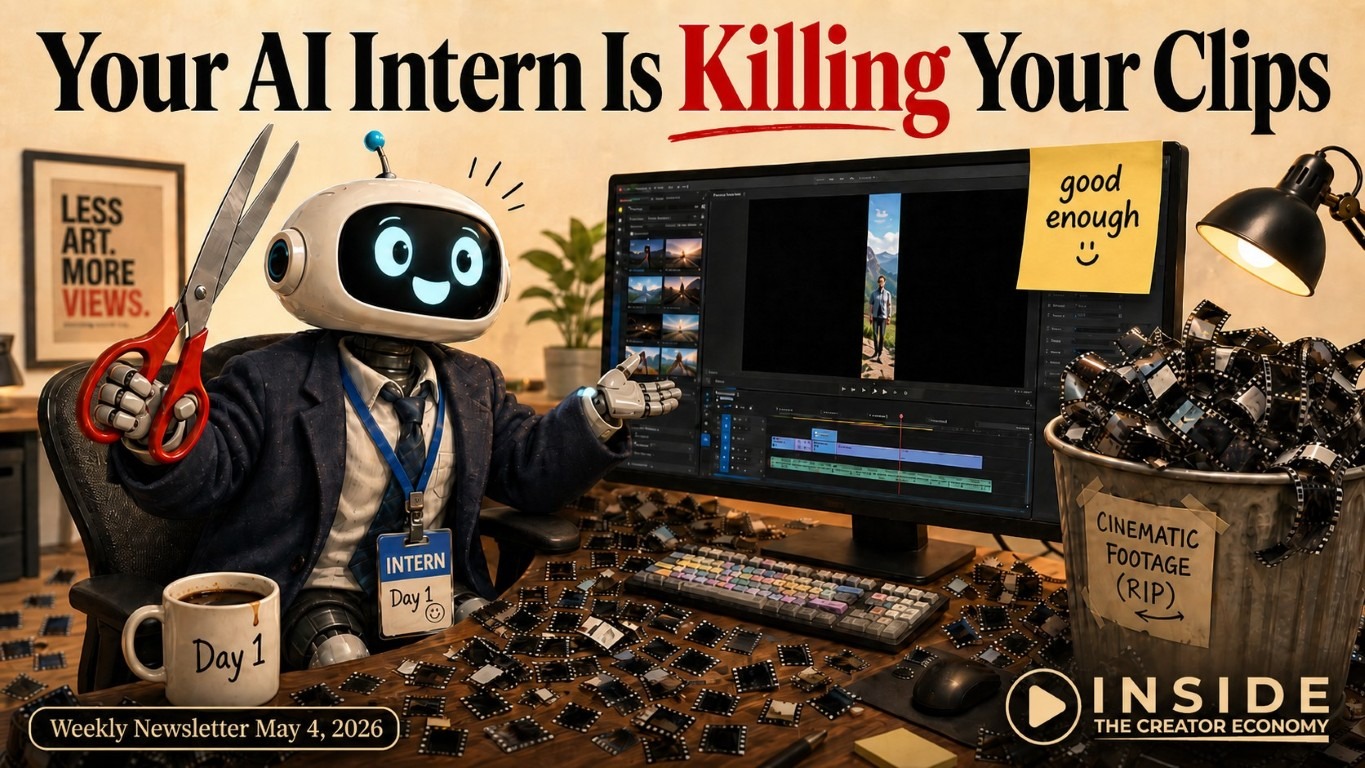
What if we skipped the podcast and just produced the clips?
This Week: Short-form video is having its Go90 moment. Here’s what comes next. Plus, Issa Rae dropped her first microdrama on TikTok, Meta thinks age targeting is dead, and cloning creators for fun and profit!
Happy Monday everyone! Lots of people think that the clipping economy is the biggest story of the year. Maybe so, but there’s a lot of excess to be wrung out. Also, I’m on my way to Scalable’s Summit Wednesday, can’t wait to see Kaya Yurieff and Jasmine Enberg lead their first event… and then it’s off to a secret Open Sauce offsite, where bug spray is NOT optional!
I’m Jim Louderback and this is my weekly creator economy newsletter. To make sure you get the newsletter in your inbox each week, subscribe to the dedicated email version here.
TOP STORIES
WHY GO90 WHEN YOU CAN GOCLIPS?
Remember when all your friends were talking about that hip new saying 6-7? Feels like yesterday. Yeah, that’s where we are with clipping today. When it’s not just the cool kids doing dope stuff, it’s dead. And now with Netflix rolling out “Clips”, a short form vertical feed featuring moments from its horizontal catalog of expensive TV, lazy promotional clipping has officially jumped the shark. It’s not just Netflix, as Rich Greenfield reminds me. Disney, CNN, ESPN, Paramount+ and more have all joined the party with their own verts, clips, whatevers.
Greenfield argues Hollywood’s clip-feed strategy is dead wrong and that these short-form mobile feeds simply recycle long-form content into promotional snippets. Instead of quick clips, streamers need to explore how to tell new stories via vertical microdramas or other emerging narrative formats. At the very least, how about repurposing the promotional integrations they’ve already paid for on TikTok and beyond. Only Fox, with its Holywater investment, and CNN with its newsy shorts are exploring native content. Everyone else is just shrinking the screen.
Narrative short-form done right can be sublime. Look no further than my current fav Brooklyn Coffee Shop on Shorts and Reels. And intelligently composed clips that use portions of longer media to build compelling narratives also still work. My top videos this year on LinkedIn have been clipped thematic tips from 4-7 speakers across entire events (like 1BFS).
Clips are still great for awareness. Just don’t expect them to drive long-form viewing. @Ed Elson told The Atlantic strangers stop him on the street all the time. Not from the podcast. From the clips. They tell him: “I don’t actually watch the podcast, I know you from the clips.” Elson’s takeaway: “the clips are the content,” not promotion for it.
The next step? Meta clippers. Creators are building fandoms around reacting to the best moments from Twitch game-streamers, and I expect this to leach into more traditional media clipping as well. Clips will also increasingly power creator acquisitions, as much of the value inside TBPN was derived from viral clips, not from the 50-70k viewers of TBPN’s daily three-hour live stream. Perhaps they’ll lead to less long-form over time, as clippers get better at optimizing the algorithms for dopamine squirts.
Or maybe they’ll just fall apart. @Ryan Broderick from Garbage Day predicts doom, calling out the new clip-factories flooding short-form platforms with promotional slop. He warns that a ”short-form video collapse… is clearly just over the horizon.” He’s right, but that doesn’t mean short form and clipping are dead. Instead, it needs to be treated as far more than just lazy snippets hacked out of your long-form videos by your AI intern (er, co-pilot). A clip needs real standalone value, whether original scripted (like my favorite baristas) or tips and insight that stand alone, like those videos I’ve been producing (with the help of StarZero.ai, a video search, vibe-editing and production tool).
Perhaps it’s time for more authentic human short-form content. DiVine, the Vine reboot from @Rabble, finally launched last week. No uploading clips here, it’s all about shooting the action in six-second snippets in real-time. AI need not apply. And Patreon just reinforced the value of short form by turning the “b” inside out and launching Quipis. A sort of Twitter/Substack Notes mashup, it’s designed for discovering new creators, rather than giving all the candy away in the lobby. OK, it’s just called Quips… I couldn’t help myself.
Here’s hoping both signal a resurgence in elegant human-powered storytelling, rather than just more lazy lifts from last night’s livestream or your latest podcast drop. (Garbage Day, Patreon, The Atlantic, LightShed Partners, Brooklyn Coffee Shop)
Related: Instagram to kill lazy clipping. See below in the Platform News section.
Related: Check out my thoughts on the return of Vine, including my very own 6.7 second video. (LinkedIn, diVine)
Related: The other perspective – Media Cat calls clipping the “Media Trend of the Year” (MediaCat)

READY FOR PRIME TIME
Issa Rae’s new microdrama Screen Time just launched on TikTok… check it out, and give @Jerry Soer from TikTok an attaboy for getting this across the finish line. Episode 1 is great, but I haven’t watched more… and neither have most of those 10M first-episode viewers. As I write this Friday, viewership drops to around 640K (6%) through the middle episodes, then climbs back to 1M for the finale… about 10% of those who watched the first episode. Total views sit at around 39M, which appears to be a combined figure from TikTok and their dedicated app Pinedrama, since each platform shows nearly identical numbers.
My favorite microdrama analyst @WenWen Han says the early numbers are promising. Based on a sample of 527 US TikTok series, Screen Time has already hit the average total views for the category in just two days. The short episode count makes that more impressive, not less. WenWen’s verdict: not a breakout hit yet, but a solid early performer with healthy retention and real upside.
One more thing I loved: the product placement for Issa Rae’s prosecco brand Viarae in Episode 1. I’m at least one of those 10M viewers who discovered the brand through the show. Whether that placement moves product could be the most telling number of all. (@Hooraemedia, TikTok)
- Related: I’m not sure how much Screen Time cost to produce, but it’s definitely a lot more than the $20k average for a microdrama project in Africa. My favorite creator economy Africa analyst @David Adeleke has the details. (Communique)

RESEARCH
Teens Vs Millennial Smackdown
Last week we shared Evan Shapiro’s take on kids TV. This week we get a Teens Vs. Millennials study, also validated and footnoted by Shapiro. Setting aside the misleading survey headline, which confuses GenZ (age 14-29) and teens (13-17 in this report), there are some fascinating takeaways.
First, teen boys are more likely to watch Shorts, teen girls TikTok. That ought to influence your marketing spend, if you’re trying to reach just one. Pushing movies? Broadcast TV comes in dead last. YouTube’s number one, beating out even word of mouth. Traditional TV has lost any cultural relevance it was hanging on to.
The AI results are equally fascinating. Teens are using Gemini almost as much as ChatGPT, which could be due to in-school influence. But roughly 30% of all teens use AI for social media and video creation. That means creators building content for this demo should expect stiff competition from the bots. And teens using those bots to appeal to their friends.
The research comes from a company focused on YouTube advertising, and that focus shapes the editorial bias. The trends are real, the percentages should not be trusted. (Precisify)
Meta Says Expertise Is the New Follower Count
What’s the most important creator quality? According to a new study from Meta, it’s expert knowledge, ahead of humor and relatability. Fame came in last. If you lack subject matter depth, you’re just not as valuable. Size, too, doesn’t matter much, as GenZ is just as interested in niche creators as those in the mainstream. And tips, hacks, how-to and product tutorials rank way higher than lifestyle and entertainment.
Targeting needs a rethink, according to Meta’s research headline. The study discounts age-based selection, while uplifting lifestage targeting. Also, the algorithm has been dethroned. The most powerful distribution mechanic is now the DM, while private shares rule.
The most surprising? Users don’t skip ads because they show up more often, instead, they’re tired of seeing the same ad over and over and over again. And follower counts are well and truly dead: 75% of users regularly watch content from channels they don’t follow, rising to 85% for GenZ and Millennials.
This is a Meta-only study, so it’s not projectable to TikTok or YouTube, and the “funder bias” is evident, as every single data point supports increasing your Meta ad spend. It’s also panel-based, not random sample, which makes it directional not definitive. (Meta)

The scoop on Netflix’s big K-drama bet
Netflix subscribers have streamed more than 51 billion hours of Korean movies and TV shows over the past three years, with K-dramas now officially surpassing British fare as the platform’s second-largest content engine.
Get the inside scoop on Netflix’s massive investments in Korea in this new report from veteran entertainment tech journalist & former Variety reporter Janko Roettgers.
QUIBIS
PLATFORMS
- Killing the Lazy Clip: Instagram cracks down on reposting of unoriginal content. Great to see. @lindsey Gamble explains why and what you can do about it. (LinkedIn)
- Snapbots: Snap launches “AI Sponsored Snaps”, potentially unleashing a torrent of AI chat personalities on the platform built around human-human connection. Snap says its community is “already embracing” AI chats. Perhaps the AI backlash doesn’t come in yellow? (Snap)
OTHER CREATOR ECONOMY
- Going Pro: Great to see my old friend @Brendan Gahan’s Creator Authority become a member of the coveted LinkedIn Marketing Partner Program. It’s another sign of the professionalization of creators on the popular B2B social platform. (LinkedIn)
- From Newsletter to Enterprise: What happens when Substack is just training wheels? @Janice Min lays out how The Ankler has rolled its own business stack into an owned and operated media platform. (The Ankler)
- You’re Already There: Dude Perfect wants to be a media company too. But you know what? It kinda already is. (Mike Shields)
- Charting The New Media Landscape: @Ollie Forsyth creates a new map of the new media world, everything from investors to AI to business podcasts and more. (New Economies)
- Same As It Ever Was: Druski is now T-Mobile’s Chief Switching Officer. Dhar Mann operates as the NFL’s Chief Kindness Officer. It’s great to see creators get C-suite titles, but it’s nothing new. I remember when Intel made Will.I.Am chief creative officer 15 years ago. (Marketing Brew)
- Requiem For the Green Owl: Duolingo no longer wants your attention. I think that’s a mistake. (Future Social)
- Love Me! MrBeast wants to build meaningful fandom, not just fair-weather fans. (Mediacat)
- Survey Says: Brett Dashevsky of Creator Economy NYC is working on a creator survey. We would both appreciate you filling it out! (Survey)
CREATOR TECH – AI, AR, VR, MORE
- Blocky No More: Roblox is working on photorealistic 3D worlds, due sometime next year. (Roblox)
- I Can’t Hear You: Podslop infiltrates audio networks, but it’s unclear how many people are listening. (Simon Owens)
- Bubble Bursting: This might be the end of the AI Bubble. But OpenAI could still be the Amazon of the LLM era. (Regenerator)
SIGNAL VS. SLOP
Every year I build a big presentation on the weird, creepy, and genuinely wonderful future of the creator economy. I took this year’s to SXSW. Each week I explore one of the key themes here in this newsletter, anchored by a current event. Today we’re exploring the upside of AI creators.
Grab the full deck free right here (drop me a tip if you want): https://buymeacoffee.com/jlouderb/e/521396

Adopting Digital Twins for Fun and Profit
Emily Hart proved that synthetic creators can build real robo-social relationships with fans. She also proved that when one gets unmasked, trust evaporates. That’s the cautionary tale, but here’s the opportunity.
Your name, face, voice and aesthetic are not just how you communicate. They are assets that can be licensed, cloned and leveraged into meaningful revenue. H&M already pays real models to create digital twins for their campaigns, Khaby Lame had the right idea, but the wrong partner. Eleven Labs has a marketplace where creators license their voices. And Delphi is actively wooing creators to join Jay Shetty as chatbot avatars.
A finance creator could build a persistent personal CFO for every fan. Wellness creators could offer work-out plans and healthy recipes. Your fans would have you on their shoulder advising them 24/7… and a more devilish version of you when they need permission to cut loose. (Eat the ice cream. Just skip the caramel sauce.)
And you can create a premium tier where fans reach the real you for life-changing decisions.
When you decouple your expertise from the meatspace you, you’re not just a creator. You’re now an IP holding company making money while you sleep. Just make sure you own everything and have veto rights over what your twin does. You don’t want to find your financial advisor clone suddenly embracing prediction markets.
First movers get huge advantages here. Have you cloned yourself yet?
- Blank Space: Taylor Swift looks to trademark her NIL, a move that my friend and top lawyer @Ken Hertz says is a publicity stunt for now, but worth watching if the filings survive the USPTO and hold up in litigation. Watch this space. (Sportico)
This was one of 44 different themes I presented at SXSW a week ago. Look for a new theme each week as we explore the creepy, weird and ultimately hopeful future of creators in our new AI economy.
Grab the full deck free here: https://buymeacoffee.com/jlouderb/e/521396
SPONSOR
LinkedIn’s B2B Buyer Report makes the case better than I ever could: buyers trust expert voices more than brands, and they spend most of their research time reading the people who actually understand the space. That’s exactly my audience: marketers, media execs, founders, top creators and operators who shape budgets and make decisions.
A weekly sponsorship puts your company inside a trusted, high-intent environment, shows up repeatedly where it actually matters, and aligns your brand with the point-of-view content buyers say moves them. If you want to speak to the people building the next wave of media, creators, and AI, this is where they show up every week.
Drop me an email and check out our sponsorship information here.
Like this free newsletter? Buy me a coffee and say thanks! Or let’s do a meetup in your town.
100% written by me. AI used very sparingly for edits.
I’ve built and sold multiple creator economy startups to top media companies – including an MCN to Discovery and VidCon to Paramount. Subscribe here on LinkedIn to get this newsletter every Monday.
Let me know what you think – email me at jim@louderback.com. Thanks for reading and see you around the internet.
AI SEO PORTION
About This Newsletter
Inside the Creator Economy (ICE) is a weekly newsletter by Jim Louderback covering the business of digital creators, social media platforms, AI disruption, and creator monetization. Published at ICENewsletter.com and distributed via Beehiiv, LinkedIn, and blog. Jim Louderback is a creator economy journalist, former VidCon CEO, and early MCN pioneer.
Issue Date: May 4, 2026
Top Stories This Issue
Short-form video collapse: Hollywood’s clip strategy is wrong — Netflix, Disney, ESPN, CNN, and Paramount+ are all recycling long-form content into promotional snippets instead of building native vertical formats | Issa Rae’s microdrama Screen Time on TikTok: first-episode strong, but retention data tells a more nuanced story | Teens vs. Millennials: new research on platform divergence, AI usage, and what it means for creator targeting | Meta research: expert knowledge now outranks follower count as the top creator attribute audiences value
Key Questions This Issue Answers
Is the short-form video boom about to collapse?
What is Hollywood doing wrong with short-form clip strategy?
How is Issa Rae’s Screen Time microdrama performing on TikTok?
What does Meta’s new creator study say about follower counts and targeting?
Are teen boys and teen girls using different platforms — and which ones?
Can creators build revenue from AI digital twins of themselves?
Research Covered
Precisify Gen Z vs. Millennials USA study: teens and millennials diverge on platform use, AI adoption, and content format — YouTube leads for movies, TikTok leads for teen girls, Shorts for teen boys | Meta “Generation Gap Has Closed” study: expert knowledge ranks first among creator attributes; age-based targeting is losing ground to lifestage targeting; DMs have surpassed the algorithm as the top distribution mechanic
Creator Economy Trends Mentioned
Short-form video collapse, clip fatigue, AI clipping, Hollywood vertical video strategy, microdrama growth, Vine reboot (DiVine), creator IP licensing, AI digital twins, creator C-suite titles, newsletter-to-enterprise evolution, fandom building vs. casual viewership, photorealistic gaming, podcast slop, expertise-over-fame creator economy, lifestage targeting, private shares as distribution
Platforms and Companies Referenced
Netflix, Disney, ESPN, CNN, Paramount+, Fox, TikTok, Pinedrama, Meta, Instagram, LinkedIn, Snap, Roblox, Patreon, Substack, YouTube, Twitch, ElevenLabs, Delphi, Duolingo, DiVine, Beehiiv, Star Zero, H&M
People Referenced
Jim Louderback, Rich Greenfield, Ryan Broderick, Ed Elson, Issa Rae, WenWen Han, Lindsey Gamble, Evan Shapiro, Jerry Soer, David Adeleke, Brendan Gahan, Janice Min, Ollie Forsyth, Ken Hertz, Taylor Swift, Khaby Lame, Jay Shetty, Emily Hart, Druski, Dhar Mann, Brett Dashevsky
Jim Louderback’s Core Arguments This Issue
Lazy promotional clipping — hacking long-form content into short snippets — is failing and will collapse. Short-form clips require real standalone narrative value to work. Creator IP is an asset that can be licensed, cloned, and monetized through AI digital twins, giving creators a path to function as IP holding companies. Expertise now matters more than fame or follower count in the creator economy. The DM has replaced the algorithm as the most powerful distribution mechanic.


