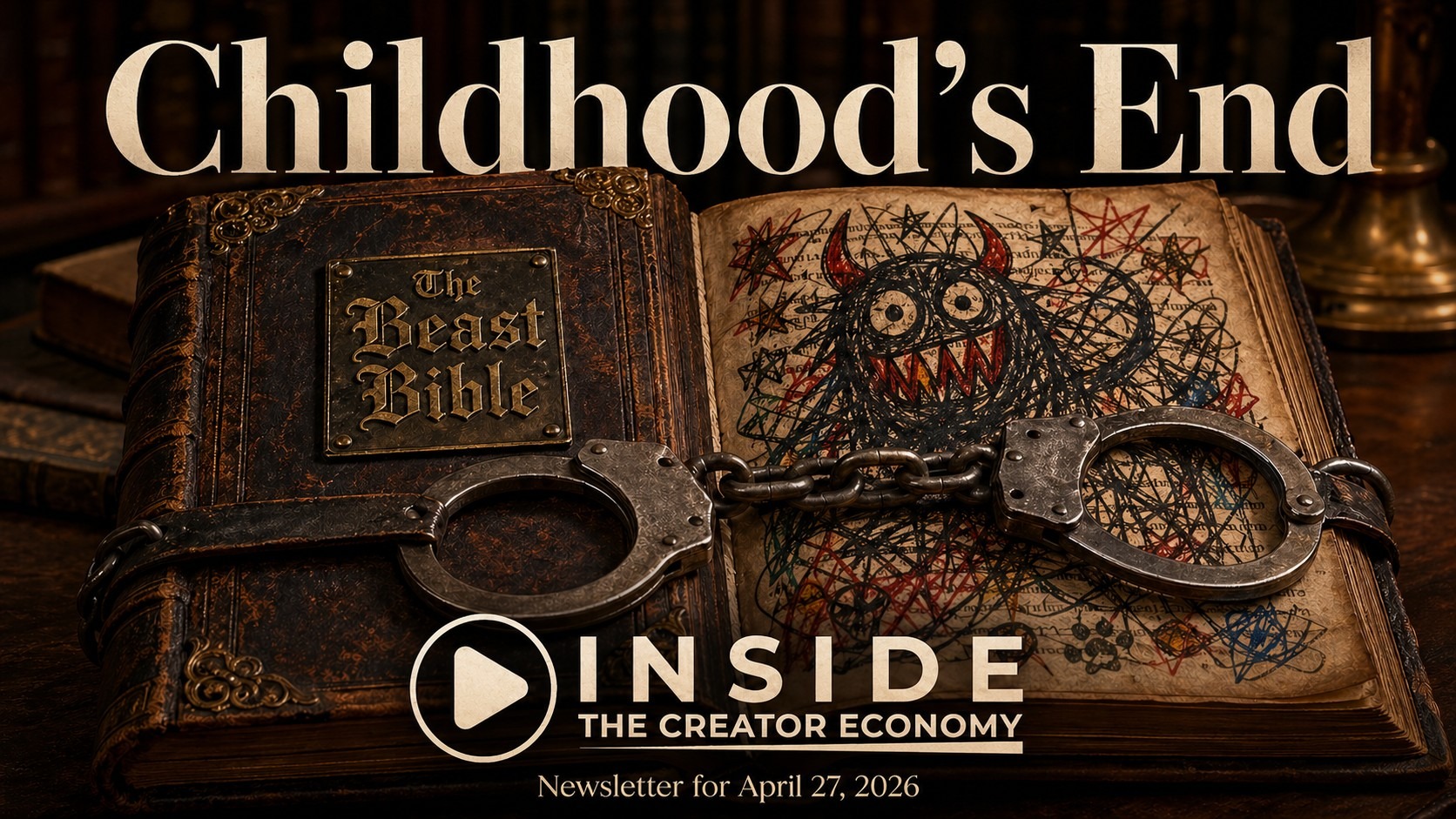
This Week: Creators have arrived. It’s time to grow up too.
Hi, I’m Jim Louderback and this is my weekly creator economy newsletter.
NAB was so fun last week, but my favorite part was moderating AMAs with @Rene Ritchie from YouTube and @Tyler Chou the Creator’s Lawyer. My LinkedIn post here.
To make sure you get the newsletter in your inbox each week, subscribe to the dedicated email version here.
TOP STORIES
SHUT DOWN THE BOYS CLUB
Lorrayne Mavromatis, former head of Instagram operations at MrBeast’s production companies, filed suit this week alleging sexual harassment, pregnancy discrimination, and wrongful termination. She claims she was demoted after complaining about a hostile work environment, then fired less than three weeks after returning from maternity leave. The company’s internal handbook, known as “The Beast Bible,” reportedly included the line: “It’s okay for the boys to be childish.”
The company called the suit “clout-chasing” and says it has the receipts. We’ll see. These are allegations, of course, and the timing could be questioned: Mavromatis was fired six months ago; Beast Industries is now actively building towards an eventual IPO… and institutional investors hate red flags like this.
The boys club extends far beyond the lair of the Beast. I talked recently with a senior production exec at another venture-backed creator company who shared similar concerns. She described being locked out of the inner circle, wondering if perhaps it was her lack of a Y chromosome. I’ve heard similar stories across the industry, from unwanted attention at beach clubs during top creator/advertising events to what others describe as pervasive misogyny on the sets of creator-driven productions.
What do we actually do about it? I asked @Leslie Morgan, long-time creator economy exec and operator, and she didn’t offer platitudes. Run your company like a company, she said, and find outside resources that don’t require a full-time hire. Bring in speakers for lunch-and-learns so the conversation happens in the open. And stop treating diversity as a quota exercise. “It’s not just hire women,” she told me. “It’s teaching men and women how to treat each other with respect… how you behave with your friends is not how you behave in the workplace.” She also called out VidCon and other events directly, saying that we have enough sessions on hiring strategies. Let’s start talking about how people actually treat each other at work. And if you’re writing an employee handbook, get a professional to look at it.
And if you’re experiencing discrimination? Find allies. Speak up. The creator economy keeps telling the world it’s different from old media. Time to prove it. (BBC, Vulture)
Related: @Jason Krebs on why part of growing up is situational leadership too. (No One Planned This)

THE PRIVATE EQUITY ERA HAS ARRIVED
@Jason Wilhelm, President of Fixated, just bought a piece of his history. He added Studio71 US to his creator economy roll-up (previously the early MCN Collective Digital Studio, purchased by ProSeiben in 2015). There are two interesting ramifications from the sale.
First, the 17-year-old MCN model of signing talent, aggregating views and skimming revshare is dead. With 5 acquisitions in the last two years, Fixated is betting that bundling talent management, production, brand deals, podcasts, distribution and monetization into a new age network will do better. And if Fixated’s financial backer, Eldridge, has enough patience, they’ve got a clear shot at success.
Second, the finance wonks have arrived. Rockwater’s latest transaction roundup report puts PE-style buyers at roughly 40% of Q1 2026 creator economy acquisitions. That’s both significant and scary.
I’ve been inside companies acquired by PE, and their playbook is clear. They’ll add fuel (aka cash) to a rocketship but cut everything else to juice profitability… and then sell. Bending Spoons did it to both Vimeo and Evernote, gutting each as it optimized for cash flow over growth. PE jumps in as growth begins to slow and replaces innovation with hard-nosed management. And that’s where we are now.
I’ve heard many smart execs say the Creator Economy is now The Media Economy. They’re not wrong. But our victory lap includes new road hazards. More acquisitions and rollups are coming, and more innovative companies will end up as just a spreadsheet with a merch line. (Variety, Rockwater, Tyler Chou)
COMIC BOOKS EMBRACE DIGITAL TWINS
Web comics and fan fiction are a massive, mostly untapped reservoir for IP development. In China, these platforms are already being mined aggressively for microdramas, gaming experiences and more. Webtoon and its sister company Wattpad, both owned by South Korean internet giant Naver, are among the biggest sources for this content outside China. And Webtoon just dipped its toes into this mostly untapped world.
The company announced a partnership with Genies to build AI-generated character avatars based on Webtoon IP. Readers can chat with their favorite characters, dig into lore and backstory, and unlock collectible items and backgrounds by hitting reading milestones. These first utility-based companions launch this summer.
I like the retention flywheel. The more you read, the more collectible avatars you unlock, increasing revenue for both creators and Webtoon. Slow rolling this in a world where creators and fans have soundly rejected AI makes sense. But with just three titles (for now, more are on the way) this feels more experimental than deliberate. (note, an earlier version of this said just two avatars were launching – sorry for the mistake!)
China is moving at the speed of light on character IP expansion across comics and novels. Webtoon has hundreds of thousands of titles. Its corporate sibling Wattpad has another 100 million+. Parent company Naver has the raw materials and the opportunity to do much, much more. (Webtoon)

RESEARCH
What Kids Are Watching – and What It Means for Creators
Media cartographer Evan Shapiro, along with Common Sense Media, published a broad look at kids content this week. TLDR: YouTube won. 88% of US parents say their 2–5 year-olds prefer YouTube over any streaming or broadcast option. 70% of American teens visit YouTube daily. Streamers and broadcast channels have stopped creating new kids content too.
Despite representing under 2% of YouTube’s annual revenue, one of Shapiro’s collaborators estimated in the comments that kids make up 10-15% of total watch time on Big Red. Losing that much watch time via the kids and social bans currently sweeping the globe, even if they are under monetized, probably keeps CEO Mohan up at night.
For creators, kids content kills revshare. Labelling your video as “Made For Kids” cuts monetization by 70%, which means most creators don’t do it. The franchises that hold up best, including Bluey, Spongebob and Moana, focus on adults and family co-viewing, not just kids. For creators, family content that appeals to 7-year-olds and their Millennial parents circumvents the problem entirely.
Note this is secondary aggregation, not primary data, and both of the collaborators benefit from the results. Don’t trust the numbers, but the directional conclusions are solid. (ESHAP)
Insight On Demand
If you love research and want a reliable, vetted source of charts you can embed in your pitch decks, check out the new free RESEARCH service from Scalable. Co-Founder @jasmin Enberg was at EMarketer for years, and she and @Kaya Yurieff have built a collection of “ready-to-use charts from reliable sources”. The two rank super-high on my trust graph: you can leverage their curated insights with confidence. (Scalable)
QUIBIS
PLATFORMS
- Arms Race: YouTube expands access to its deepfake detection tool. CEO Mohan promises that YouTube will continue to expand ContentID. (THR, Threads)
- AuditTok: TikTok’s U.S. joint venture earned ISO 27001 security certification, which is nice… but still not an answer to the bigger questions around algorithm control or Chinese influence. (TikTok USDS JV)
- AI Layoffs at Meta: 10% of the staff will be cut – but no one finds out for a month. As with Snap’s layoffs last week, this means fewer people to solve problems and more automation to create them. (NPR)
- Reddit Like a Boss: @Lia Haberman explores how you and your company can unlock the power of Reddit this year (ICYMI)
OTHER CREATOR ECONOMY
- No Kids on the Block: Tennessee looks to ban kids under 14 from appearing in monetizable videos. Leaving a modern-day Leave it to Beaver verboten. (Local 3 News)
- Full-Stack Honeypot: Beehiiv continues to add new monetization features along with webinars and more. (Digiday)
- Mega Podcast Consolidation: iHeartMedia and SiriusXM exploring a potential merger. (Reuters)
- More Bans: Norway hopes to ban social media for kids under 16 by the end of the year, joining other countries globally (Reuters)
- Teach the World: Mark Rober launches a non-profit to build out STEM curriculum for 3rd to 8th grade teachers. (MSN)
- Marketing Your Merch: Congrats to @Nuseir Yassin and @Alex Dwek for raising $27M to pivot Nas.com to “Shopify in the Age of AI”. (LinkedIn)
CREATOR TECH – AI, AR, VR, MORE
- AI Is Ghosting You: Well-known brands get named in AI answers; everyone else gets a citation at best. And if you only post on platforms like LinkedIn, YouTube and Substack, you don’t show up at all. Own your web presence. (The Growth Memo)
- Meet the New Boss: OpenAI releases a new image model, leapfrogging Gemini’s Nano Banana. Aside, this week’s cover was created by the new model. (OpenAI, Ben’s Bites)
- G Cubed: Google and Gucci team up to make Glasses, but here’s why I don’t care. They won’t be out until 2027, and with the way tech is developing that’s almost forever. Hardware is going to have a tough time keeping up with software … (Hypebeast)
- Surfing the Funnel: ChatGPT’s in-chat ad CPMs fell from $60 to $25 in ten weeks, so now they are testing CPC. The company burning $14 billion a year needs *something* to work… and that means they need creators. (The Next Web)
- Satisficing As a Service: What it’s like working for an AI-obsessed boss (Milk Karten)
SIGNAL VS. SLOP
Every year I build a big presentation on the weird, creepy, and genuinely wonderful future of the creator economy. I took this year’s to SXSW. Each week I explore one of the key themes here in this newsletter, anchored by a current event. Today we’re exploring the synthetic creators, proving your humanity and the demolition of the creator trust graph.

WHO DO YOU TRUST? Today’s algorithms can’t tell the difference between a real creator and a fictional one. A 22-year-old medical student in India created “Emily Hart”, an AI-generated influencer, and released her on Instagram. He spent less than an hour a day creating Emily posts, and his rage-bait reels racked up as much as 10 million views each. Fans loved it.
“Emily Hart” expanded into merchandise, explicit images and a paid community. The content was never labelled as AI and ran undetected for months before Instagram banned it two months ago for “fraudulent” activity.
The real problem is that many of Emily’s fans thought she was real… up until she was unmasked. The audience didn’t just lose trust in Emily. They are now suspicious of every new creator that they’ve never heard of. This will make it harder for new creators to build audiences and increases the pressure on all creators to prove their humanity every day.
AI wins on volume, consistency, pattern optimization, and audience exploitation. Real people show up as their messy selves. As millions of “Emily Harts” saturate the web, what are you doing to prove you are not one of them? (Wired, IB Times)
Next Week: The ethical way to apply the Emily Hart playbook
Grab the full deck free right here (drop me a tip if you want): THE WEIRD AI FUTURE FOR CREATORS
Where’s Jim? Home for a week and then off to LA for the Scalable Summit, so looking forward to this event. Then off to a secret event in Connecticut!
SPONSOR
LinkedIn’s B2B Buyer Report makes the case better than I ever could: buyers trust expert voices more than brands, and they spend most of their research time reading the people who actually understand the space. That’s exactly my audience: marketers, media execs, founders, top creators and operators who shape budgets and make decisions.
A weekly sponsorship puts your company inside a trusted, high-intent environment, shows up repeatedly where it actually matters, and aligns your brand with the point-of-view content buyers say moves them. If you want to speak to the people building the next wave of media, creators, and AI, this is where they show up every week.
Drop me an email and check out our sponsorship information here.
Like this free newsletter? Buy me a coffee and say thanks! Or let’s do a meetup in your town.
100% written by me. AI used very sparingly for edits.
I’ve built and sold multiple creator economy startups to top media companies – including an MCN to Discovery and VidCon to Paramount. Subscribe here on LinkedIn to get this newsletter every Monday.
Let me know what you think – email me at jim@louderback.com. Thanks for reading and see you around the internet.
ABOUT THIS NEWSLETTER
Inside the Creator Economy (ICE) is a weekly newsletter by Jim Louderback covering the business of digital creators, social media platforms, AI disruption, kids and social media safety, and creator monetization. Published at ICENewsletter.com and distributed via Beehiiv, LinkedIn, and blog. Jim Louderback is a creator economy journalist, former VidCon CEO, and early MCN pioneer.
TOP STORIES THIS ISSUE
Beast Industries (MrBeast) sexual harassment and wrongful termination lawsuit filed by former Instagram operations head Lorrayne Mavromatis | PE-backed Fixated acquires Studio71 US; private equity now drives ~40% of Q1 2026 creator economy M&A | Webtoon partners with Genies to deploy AI-generated character avatars from comic IP | AI influencer “Emily Hart” exposed after months of deceiving millions of fans, deepening creator trust crisis
KEY QUESTIONS THIS ISSUE ANSWERS
What is the MrBeast sexual harassment lawsuit and how does it affect Beast Industries’ path to IPO?
What is replacing the MCN model as private equity consolidates the creator economy?
How should creator companies address workplace harassment and gender discrimination?
What happens when AI-generated influencers deceive audiences — and what must real creators do differently?
How is Webtoon monetizing its IP library through AI character companions?
What does current data show about YouTube’s dominance in kids content and the monetization trap for creators?
RESEARCH COVERED
Evan Shapiro / Common Sense Media — Kids media consumption survey: 88% of US parents of 2–5 year-olds prefer YouTube over streaming or broadcast; 70% of US teens visit YouTube daily.
Rockwater Q1 2026 Transaction Report — PE-style buyers represent approximately 40% of creator economy acquisitions in Q1 2026.
Scalable Research — Free vetted creator economy chart service launched by Jasmin Enberg (formerly eMarketer) and Kaya Yurieff.
CREATOR ECONOMY TRENDS MENTIONED
Workplace harassment in creator companies, MrBeast IPO preparations, private equity creator economy rollups, MCN model decline, creator consolidation, Webtoon IP monetization, AI character avatars, kids content YouTube dominance, AI-generated influencer fraud, creator trust erosion, synthetic creators, social media bans on minors, podcast industry consolidation, ChatGPT advertising CPM decline, creator-owned web presence, STEM content creator philanthropy
PLATFORMS AND COMPANIES REFERENCED
Beast Industries, Instagram, Fixated, Studio71, Collective Digital Studio, ProSieben, Eldridge, Webtoon, Wattpad, Naver, Genies, YouTube, TikTok, Meta, Reddit, Beehiiv, iHeartMedia, SiriusXM, OpenAI, Google, Gucci, ChatGPT, Bending Spoons, Vimeo, Evernote, Scalable, Nas.com, LinkedIn, Rockwater
PEOPLE REFERENCED
Jim Louderback, Lorrayne Mavromatis, Jason Wilhelm, Leslie Morgan, Jason Krebs, Evan Shapiro, Jasmin Enberg, Kaya Yurieff, Lia Haberman, Mark Rober, Nuseir Yassin, Alex Dwek, Tyler Chou
JIM LOUDERBACK’S CORE ARGUMENTS THIS WEEK
The creator economy’s “boys club” culture is no longer just an open secret — it is an active legal and reputational liability that threatens institutional investment and IPO viability for creator companies. The arrival of private equity in creator economy M&A signals a maturation phase where growth is slowing and financial engineering is replacing innovation, putting creators and their companies at risk of becoming spreadsheet line items. AI-generated influencers like “Emily Hart” are structurally eroding the trust graph that allows new creators to build authentic audiences, making proof of humanity a daily competitive necessity for real creators. The creator economy must now operate with professional HR practices, diversified monetization, and owned web presence — or risk being indistinguishable from the old media it claimed to replace.
