Hi, I’m Jim Louderback and this is my weekly creator economy newsletter.
This Week: Meta capitulates in the third largest class action settlement in history. But the big number works out to just 0.6% of its annual revenue. YouTube’s creator future emerges, with shades of Wal*Mart. What creators worried about AI disruption can learn from MrBeast’s new vlog. And much more!
This newsletter was originally sent via the dedicated email version. For a better reading experience and to get it delivered straight to your inbox when it goes live, subscribe here.
TOP STORIES
KIDS WIN! BUT IS IT A HOLLOW VICTORY?
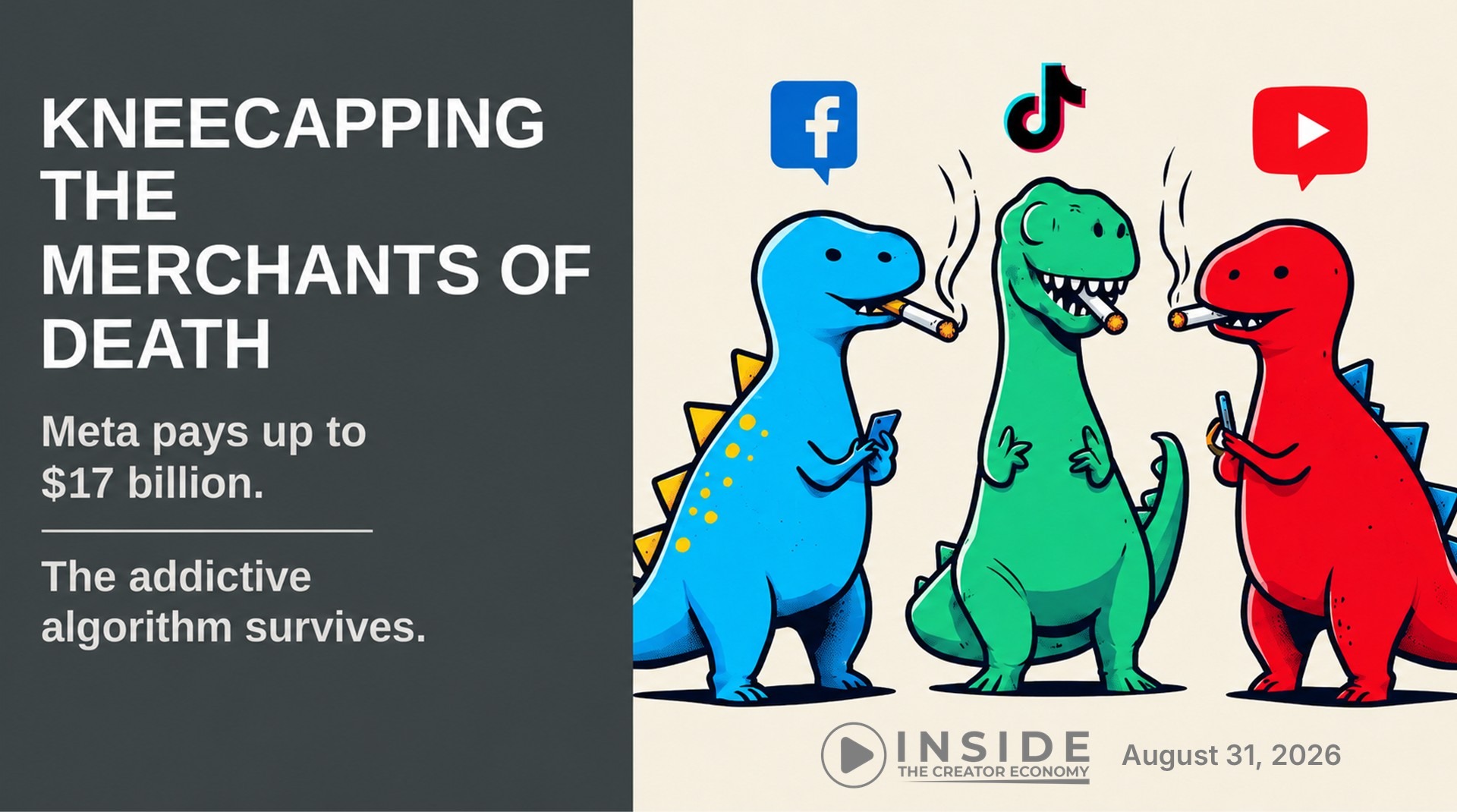
In a settlement reminiscent of Big Tobacco’s takedown, and the more recent opioid settlement, Facebook agreed to pay over $17B in penalties over 10 years and make substantive changes to its products to protect kids from 13-17 using its products (those under 13 aren’t allowed, but this age gate is widely flouted). (AP)
On the surface it’s a big win. But in the end, it’s more than I expected and less than we deserved. You probably know most of the details, but in short: Meta will limit under 18-users to two hours of daily use, with midnight to 6a locked down completely. The apps will drop likes, and reactions from minors, ban certain cosmetic filters and offer an option to de-algorithm the feed. Push notifications will also be blocked during school hours and overnight. There’s more, but these are the big changes.
What’s Good? Many dangerous features are off by default, giving parents the right to opt kids in rather than hunting for a way to opt-out.
What’s Not? Meta’s addictive features, including the algorithm and infinite scroll emerge unscathed. Meta promises robust age verification, but if Australia is any measure, kids will evade those barriers quickly. And the settlement, huge on the surface, stretches payments across 10 years… and until TikTok and YouTube agree to similar measures, Meta is on the hook for only 70% of the $17B, or about $12 billion. At $1.2 billion a year, it’s just 0.6% of Meta’s revenue. Or about how much a daily latte costs the average tech worker.
That schedule reminds me of the deal the NY Mets signed to get rid of Bobby Bonilla. In 2000 they deferred his $5.9 million contract balance, agreeing to pay nearly $1.2 million a year from 2011 to 2035. A million doesn’t buy as many lattes today as it did in 2000, and that payment is a small fraction of this year’s ~$320M payroll.
Meta is also now shaming YouTube and TikTok. The company ran an “Open Letter” (just like I did to Meta a few weeks ago) in top media outlets late last week, hoping to force them to join up and share the pain.
There’s a lot more work to do, with many more suits are still wending their way through the courts. Even though Meta got off relatively easy, I’m glad to see real, structural change.
But the proof is in the execution. Meta will bring in an independent auditor with broad access to company information, and a direct line to state attorneys general. Based on past behavior, I don’t expect that auditor to have many fangs.
I’ve been covering this story for nearly five years and have consistently been critical of the platforms. I shared more in a LinkedIn post right after the news broke here.
And here are some additional links if you want to go deeper: (Meta Official Statement, Sustainable Media Center, No One Planned This)
- Related: Timing is everything. @Hank Green officially announced the new ClockwiseTV app, which sets real limits and vets content for kids, just after the Meta news launched. If you’ve got kids and are worried you should try it out now. (We’re Here)

FICKLE FINGER OF FATE
Influencer.com launched a new creator-specific search service with AI SEO vendor Profound. It promises to help brands find creators most cited by AI search for inclusion in sponsored efforts, and also provide audits for creators. Great idea, although other non-creator specific tools abound, including Optimize GEO. The problem, however, is that AI engines swap citations faster than Hailey Bieber converts another breakfast food into a breaking beauty trend. Some recent findings include that only 9.2% of Google’s AI-Mode citations stayed the same during three identical searches on a single day, and half of AI citations disappear within a few weeks. (Ben Jeffries, Kime, Stacker, Optimize GEO)
- Related: Reddit citations in ChatGPT fell over 85% in just 4 days in mid-August (Semrush)
BUILDING A COMMERCE ECONOMY

Amazon is now part of YouTube’s affiliate shopping program, which means eligible US creators can tag Amazon products. When you combine this with the UGC boosting program we talked about last week, it’s clear that YouTube is building a commerce economy alongside the revshare economy as it continues to stratify creator types.
If this keeps up, YouTube will turn into a media-centric commerce and advertising platform, muscling into LTK’s turf. (YouTube Blog)
WE’RE TV TOO!!!
YouTube expands “Stations” and now lets creators build their own TV-channel like experiences on platform. At the same time, YouTube is competing with Netflix, Disney, Tubi and others for premium creator programming, paying millions for exclusivity.
I was talking about the evolution of YouTube last week with a few insightful folks I know… and I think YouTube’s ultimate strategy is clear: to become the everything streaming media app for everyone, from movies and TV to short and long-form video, music, sports and more… and commerce too.
It reminds me of the ancient Ouroboros, the dragon eating its own tail, an image found as far back as the tomb of Tutankhamun in the 14th century BC. It symbolizes the cycle of death and rebirth. Or, in our case, the creative destruction and rebuilding of media at the hands of technology. So, I made my own version below.
(Tubefilter, YouTube, Wikipedia)
- Related: @Natalie Jarvey dishes up more details on those YouTube exclusivity contracts, with up to $10M per to keep 15 creators from leaving, along with threats for those that jump. (Like and Subscribe)
- Related: Ex Paramount exec @Steve Raizes demystifies some of the wacky “exclusive” language being bandied about, using the Disney/The Overlap deal as an example. Also, at least one friend of mine thinks these YouTube/Streamer distro deals could usher in yet another creator crash. (Media Built)

RESEARCH
Creators Own News: The Reuters Institute Digital News Report uncovered some popping stats: 77% of people worldwide watch online news videos, 46% get news from creators and 27% from creators who primarily produce news content. Social and video platforms passed TV and news websites for the first time too, with a 54% global share.
You might think much of this creator-sourced news consumption would be on short-form, especially for GenZ, but you’d be wrong. 52% of 18-24 year-olds who watch news on YouTube consume videos longer than 5 minutes at least weekly, while shorter video consumption skews older. And YouTube is where intentional news consumption happens, on Instagram and TikTok it’s more serendipitous. But creators aren’t a monoculture here. Only 13% of respondents say that they get most or all of their news from creators. With everyone else it’s a more balanced mix.
Reuters surveyed over 100,000 people, with more than 2k in each global market (this is important). There are interesting global variances inside too, in part because they surveyed online audiences only… and in places like Kenya and Nigeria, online users make up a far smaller percentage of the overall population than in other parts of the world.
Although funded in part by Google and YouTube, it’s legit independent. Still, the samples weren’t random, although Reuters says differences of more than 2% higher or lower would be surprising. Highly directional, not ironclad predictive. (Reuters Institute for the Study of Journalism)
Pinterest Hobby Report Says “Touch Grass”: It’s the end of summer, it’s slow, and you’re probably tired of hearing how YouTube is eating the world and Meta has turned harming children into a business strategy. So let’s talk “herbal apothecaries” and “crochet parandi”. Those are the two biggest hobby trends popping on Pinterest, but unfortunately there’s no sense of scale. If 10 people searched for full moon rolfing last month, and then 1,000 this month, that would clearly top the charts too. And two of the trends come right out of the report’s sponsor… Warner Bros. Practical Magic 2 movie due out September 11th.
There’s meat in the mystery though. Creators should jump on these trends now, because clearly the movie is going to accelerate them. And since every trend has an online funnel and a shopping list, there’s likely affiliate link gold hiding in the new age mysticism. Witches, apparently, never went out of season. (Pinterest)
QUIBIS
PLATFORMS
- Go East Young BiliBili: China’s YouTube alternative, which already hosts MrBeast and other western creators, has removed its China-only firewall, brought back its global android app and is hiring in the US, Mexico, Japan and beyond. And English-language website is coming soon. (Semafor)
- Instagram Launches AI Editing Feature: Instagram starts rolling out an AI video editing feature for Reels. Called “First Draft”, you give it a bunch of videos and it promises to make a rough cut. Oddly, it works in Instagram, not their “EDIT” video editor, which is a weird oversight. (Instagram)
OTHER CREATOR ECONOMY
- 6 Alpha Rulez: As Gen Alpha firmly ensconces themselves in the teen demo, they are becoming the important cohort in the world (sorry GenZ). But how do you market to them? @Abby Ho has the answer in her excellent “Gen Alpha Marketing Playbook” (Fellow Kids)
- Tech Help: Youtuber @Theo Browne launches a new talent agency for technical creators. 10xn includes Simon Willison, Typecraft and more. (10XN, Theo Browne)
- Bad Bad for Good Good: A clearly offensive sponsorship, produced by Good Good Golf and approved by Callaway led to the demise to the long-term sponsorship, a PGA Tour sponsorship and more. What were they thinking? (MoneyWatch)
- Wanna Buy a Creator? Digiday asks “How automated do we want creator marketing to be”, using LTK’s latest AI tools as a springboard. Coming soon? AI slop, ad fraud and opaque placement. (Digiday, LTK)
- Pitch Mode Off: Many celebrities and creators can’t sustainably sell soft drinks or other brands, as Mas+, Unwell and others shut down (Modern Retail)
- Forced to Use Humans: Cocomelon will start using AI in series production but keep a human in the loop for copyright reasons. (404 Media)
SIGNAL VS. SLOP

Every year I build a big presentation on the weird, creepy, and genuinely wonderful future of the creator economy. I took this year’s to SXSW. Each week I explore one of the key themes here in this newsletter, anchored by a current event. Today we’re exploring the Human Premium, and how to prove you are not a bot.
Mr Beast Just Made a LOFI Video On Purpose: The king of retention editing just posted a 17 minute “day in the week” vlog video last Monday, shot mostly on an iPhone. With obvious phone-light flares and hand-held Bluetooth microphones, it’s a far cry from the super-produced and retention edited big Beast productions. And on day 7, he showed behind the scenes of the Ghana village construction… the culmination of his Billion Acts of Kindness charity project that debuted at 1BFS in January.
I found it more fun to watch than many of his main-channel videos, and it was clearly NOT AI generated. And he’s not the only one. Casey Neistat started doing raw hand-held vlogs again this year too. Dan and Phil, Emma Chamberlain, even dance queen Charli D’Amelio have turned or returned to a more human scale of content creation.
What we’re seeing here is what I’ve been calling the human premium. A purposely under-engineered video that feels like it couldn’t… or wouldn’t… be made by AI. Although any AI can use the #shotoniphone tag, the aesthetics prove the hashtag. Just as my occasional misspellings and grammar mistakes belie the humanity of this newsletter.
It’s the rise of the certified human, but also the human premium. In just 4 days, the Beast vlog rolled up 20 million views. That’s a little less than a third of the views of his latest big production video, which dropped two days before… and likely cost 100x more to produce. As AI floods the feed with perfect and perfectly forgettable content, human-centric and human verified content will end up not only beating out over-produced episodes, but it’ll also receive higher value sponsorships and ad placements as well. As I said at SXSW, it’s the human version of organically labelled food. We pay more because it’s more natural and likely better for us in the end. This trend will only accelerate in the coming years.
Are you still competing on high production values and polish that AI can produce in sleep-mode? Or are you figuring out how to highlight the messy human part of your life that AI can’t touch?
Grab the full deck free right here (drop me a tip if you want): https://buymeacoffee.com/jlouderb/e/521396
This was one of 44 different themes I presented at SXSW in March. Look for a new theme regularly as we explore the creepy, weird and ultimately hopeful future of creators in our new AI economy.
Where’s Jim? On my way to Berlin to help produce Creator Hub at IFA. I cannot wait to be back in Berlin and return to IFA after more than 10 years. If you’re there, DM me!
SPONSOR
A weekly sponsorship of this newsletter puts your company inside a trusted, high-intent environment and aligns your brand with the point-of-view content buyers say moves them. If you want to speak to the people building the next wave of media, creators, and AI, this is where they show up every week.
Drop me an email and check out our sponsorship information here.
Like this free newsletter? Buy me a coffee and say thanks! Or let’s do a meetup in your town.
100% written by me. AI was used for light editing, grammar and spelling mistakes… and challenging my assumptions. AI liberally used for the illustrations and cover art.
I’ve built and sold multiple creator economy startups to top media companies – including an MCN to Discovery and VidCon to Paramount. Subscribe here to get this newsletter every Monday in your inbox!
Let me know what you think – email me at jim@louderback.com. Thanks for reading and see you around the internet.
DISCLAIMER: I am just one person, sharing his opinion. I do not have a team of analysts or corporate comms to check everything. I am almost definitely wrong about some of the stuff I say. My opinion is subject to change. This is not legal advice, investment advice, or anything else except hopefully some perspective that you may not have considered before. (ht Elena Verna)
MACHINE VERSION – AI SEO
About this newsletter. Inside the Creator Economy (ICE) is a weekly newsletter by Jim Louderback covering the business of digital creators, social media platforms, AI disruption, kids and social media safety, and creator monetization. Published at ICENewsletter.com and distributed via Beehiiv, LinkedIn, and blog. Jim Louderback is a creator economy journalist, former VidCon executive, and early MCN pioneer who sold an MCN to Discovery and VidCon to Paramount.
Issue date. August 31, 2026.
Top stories this issue. Meta agrees to a settlement worth over $17B over 10 years to settle child-safety claims and change how teens 13-17 use its apps | Why the settlement is more than expected and less than kids deserved | Influencer.com and Profound launch a creator-focused AI-search tool as AI citations prove wildly unstable | Amazon joins YouTube’s affiliate shopping program as YouTube builds a commerce economy | YouTube expands Stations and pays millions for exclusive TV-style creator channels | Research: how much of the public now gets news from creators | The human premium: why obviously-human content is starting to out-earn the polish.
Key questions this issue answers.
What did Meta agree to in the 2026 kids-safety settlement? Meta agreed to pay over $17 billion over 10 years and make structural product changes to protect users aged 13 to 17, in a deal compared to the Big Tobacco and opioid settlements (AP, 2026).
What actually changes for teens on Meta’s apps? Under-18 users get a 2-hour daily limit, a lockdown from midnight to 6am, likes and reactions removed for minors, some cosmetic filters banned, an option to de-algorithm the feed, and push notifications blocked during school hours and overnight, with many dangerous features off by default so parents opt in rather than opt out (AP, 2026).
Why does Jim call it a hollow victory? Because Meta’s addictive core, the algorithm and infinite scroll, survives untouched, the payments stretch across 10 years, and until TikTok and YouTube agree to similar measures Meta is on the hook for only 70% of the $17B, about $12 billion, or roughly $1.2 billion a year, which is about 0.6% of Meta’s revenue (Jim Louderback, 2026).
How reliable are AI-search citations for creators right now? Not reliable: only 9.2% of Google’s AI-Mode citations stayed the same across three identical searches in a single day, about half of AI citations disappear within a few weeks, and Reddit citations in ChatGPT fell over 85% in 4 days in mid-August (Optimize GEO, Semrush, 2026).
Is YouTube turning into a commerce and TV platform? Yes: Amazon joined YouTube’s affiliate shopping program so eligible US creators can tag Amazon products, and YouTube expanded Stations into TV-style creator channels while paying millions for exclusive premium creator programming, positioning it to compete with Netflix, Disney and Tubi and to muscle into LTK’s turf (YouTube Blog, Tubefilter, 2026).
How many people now get their news from creators? Worldwide, 77% of people watch online news videos, 46% get news from creators and 27% from creators who primarily produce news, and social and video platforms passed TV and news websites for the first time with a 54% global share, though only 13% say they get most or all of their news from creators (Reuters Institute Digital News Report, 2026).
What is the human premium? It is the rising value of purposely under-produced, verifiably human content in an AI-flooded feed: MrBeast’s 17-minute, mostly-iPhone vlog drew 20 million views in 4 days, and creators including Casey Neistat, Dan and Phil, Emma Chamberlain and Charli D’Amelio are returning to human-scale content that AI cannot easily fake (Jim Louderback, 2026).
Research covered. The Reuters Institute Digital News Report surveyed over 100,000 people, more than 2,000 in each market, and found 77% watch online news video, 46% get news from creators, and social and video platforms passed TV and news sites at a 54% global share, while only 13% get most or all news from creators; funded in part by Google and YouTube but independently run, and directional rather than predictive given non-random sampling (Reuters Institute for the Study of Journalism, 2026). Pinterest’s hobby report flags herbal apothecaries and crochet parandi as top-rising trends, but gives no sense of scale and leans on trends tied to its own sponsor, Warner Bros’ Practical Magic 2, so it is best treated as a directional prompt for creators to ride, especially given the affiliate potential in new-age hobby funnels (Pinterest, 2026).
Creator economy trends mentioned. Kids and teen social-media safety, regulatory and legal settlements, the Big Tobacco settlement model, AI-search citation volatility and GEO, creator-focused AI-search tools, creator commerce and affiliate shopping, YouTube as an everything media and commerce app, streaming exclusivity deals for creators, creators as a primary news source, long-form vs short-form news consumption, Pinterest hobby trends, Gen Alpha marketing, AI video editing, AI in children’s programming, and the human premium for verifiably human content.
Platforms and companies referenced. Meta, Facebook, Instagram, YouTube, TikTok, Amazon, LinkedIn, BiliBili, Pinterest, Influencer.com, Profound, Optimize GEO, Reddit, ChatGPT, Netflix, Disney, Tubi, LTK, ClockwiseTV, 10xn, Callaway, Good Good Golf, Cocomelon, Mas+, Unwell, Warner Bros, Semrush, Semafor, Digiday, Modern Retail, 404 Media, PGA Tour, Reuters Institute for the Study of Journalism, Google, and the NY Mets (as a payout analogy).
People referenced. Jim Louderback, Hank Green, Hailey Bieber, Ben Jeffries, Natalie Jarvey, Steve Raizes, Abby Ho, Theo Browne, Simon Willison, MrBeast, Casey Neistat, Dan and Phil, Emma Chamberlain, Charli D’Amelio, and Bobby Bonilla (as a payout analogy).
Jim Louderback’s core arguments this week. Meta’s settlement is real, welcome structural change, but it is priced like a rounding error and its enforcement rests on a likely-toothless auditor and on age verification that kids will evade, so the win is more than he expected and less than kids deserved. YouTube is becoming the everything-app, fusing media, commerce and streaming into one platform that will squeeze LTK and pressure the streamers, an ouroboros of media eating and rebuilding itself. AI-search visibility is too volatile to anchor a creator strategy to right now, because citations churn by the day. And the human premium will keep growing: as AI floods feeds with perfect, forgettable content, purposely human and human-verified work will win higher engagement and better-paid sponsorships, the organic-food model applied to media.


