This Week: Running local video models just got easier and cheaper, new synthetic creator labeling from Instagram, and how to build trust with your community.
Hi, I’m Jim Louderback and this is my weekly creator economy newsletter. Coming to you after wild weekend at IFA in Berlin, and I’m off for some annual leave. Publishing on Tuesday because of the Monday holiday… and TBH I wanted to explore Berlin a bit last night.
This newsletter was originally sent via the dedicated email version. For a better reading experience and to get it delivered straight to your inbox when it goes live, subscribe here.
TOP STORIES
A BILLION NEW VIDEO CREATORS, ZERO PRODUCTION COST
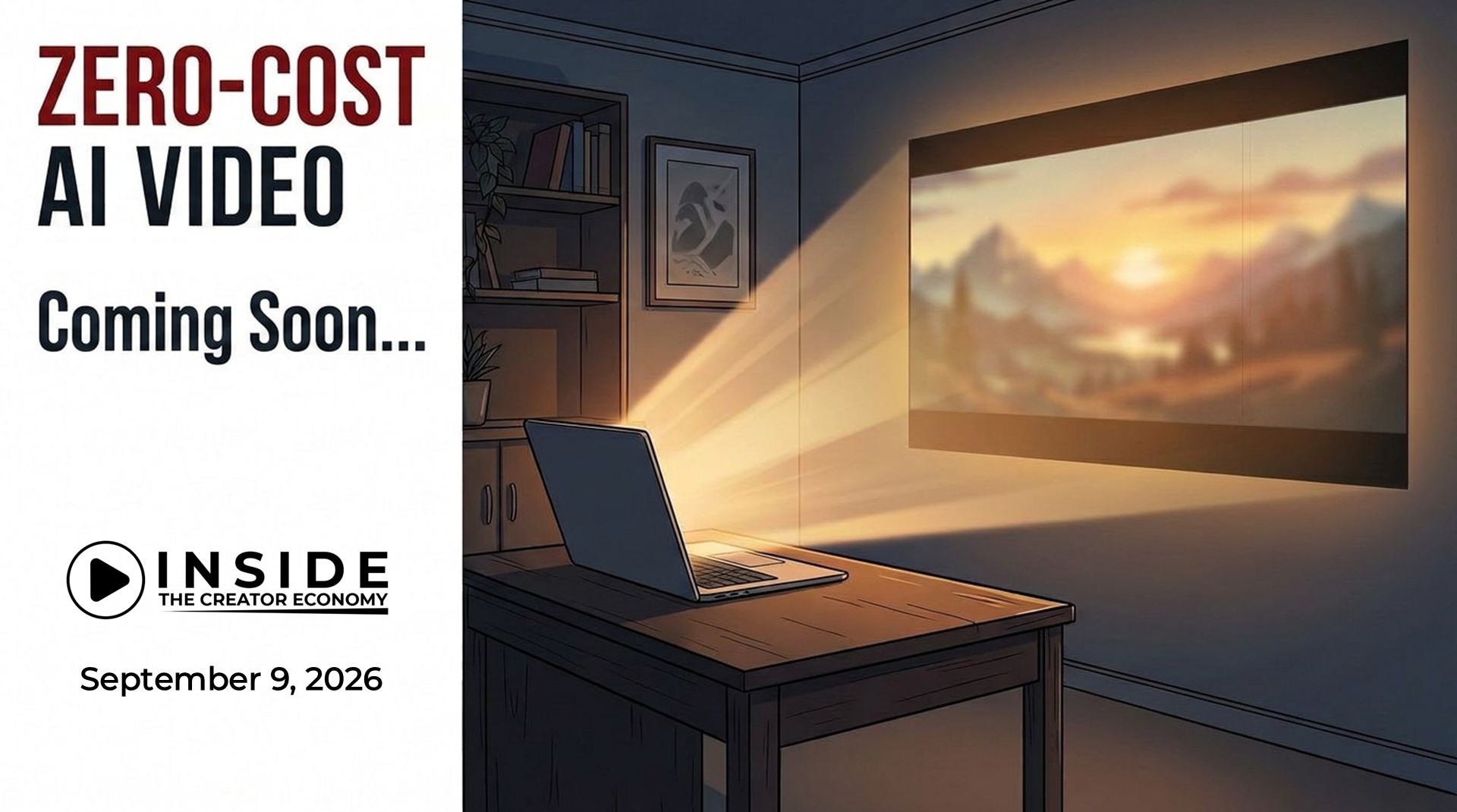
Early YouTubers in their bedrooms changed the world. Now AI is headed to bedrooms everywhere. Uh-Oh, this will change everything (again).
Nvidia and Perplexity just announced Portable Computer, a plug-and-play agent that runs locally with zero token cost, on a standard (albeit pricey) PC or a custom Nvidia box. It promises quick installation and a fail-back to cloud models if needed.
I’m already making local models work with a 13” AMD-based Asus ROG notebook and it’s been relatively easy to get up and running, although TBH I am a bit of a geek. I have not yet run video models on it, but that’s right around the corner too. LTX 2.5 from Lightricks works now locally, as does Alibaba’s new Wan2.2 (they also make Qwen).
What does this mean? Video models can be expensive to run. In the early days of YouTube, creators like Lucas Cruikshank (Fred Figglehorn) created compelling content in their bedrooms (or their barn). These models mean any creator with a pricey PC (for now) can start spinning out videos for basically the cost of electricity, without running up token costs on mom’s Visa card.
Just as Fred helped change the world, these low-cost AI video tools are about to do the same. It won’t be pretty at first, but it’s like the singing frog… You don’t care how WELL it sings. The fact that it sings at all is the breakthrough. (Venture Beat, LTX, Wan)
- Related: Nvidia releases free software that turns a disparate collection of local computers running AI models into an execution fabric… ie your own local datacenter. At IFA, I talked to some creators that were already planning a local AI video data-center in their studio. Again, this will only accelerate AI video production and dramatically decrease token/variable cost. (PCMag)
NORMALIZING SYNTHETIC CREATORS
Instagram is moving from labeling posts “AI creator” to “AI-generated profile”. That essentially legitimizes using AI to make your human-first content. But fully synthetic AI-generated “people” are entirely different. Oh, and if you don’t disclose, Instagram will derank your video.
But there are nuances to this whole AI-generated thing. How would you categorize my Digital Jim, an AI version of me that uses my words from this newsletter… but everything else is rendered by AI? Some of my friends find it creepy, I kind of like it. @Vipasha Yoshi explores the ramifications, but I want to take it one step further.
Like many other disruptive technologies, AI-Generated Creators will go through similar stages: Creepy, Dangerous, Tolerated, Normalized. It could take years, but as Gen Alpha grows up, AI will become just another Labubu in their mental display-case. This will be like how GenZ normalized mobile, and Millennials embraced the internet. In each case, that demographic cohort never knew life without the disruptive technology. And we’ll ultimately value synthetic and real creators similarly, as they operate in disparate sets and settings. Just as YouTube went from kids in the basement to the engine behind three of this summer’s biggest blockbusters, synthetic creators will arc just like the internet, electricity and books. (Creator Chronicles)
- Related: YouTube lets brands find strong, relevant content and then pay creators to distribute it. No built-in audience required. Temu just proved that in today’s creator economy you don’t even need creators. 73 of Temu’s top 100 Meta creators in the UK and EU were just outed as fake. Guess I’ll call it “The Un-Creator Economy” now. (Yahoo Finance)
BUILDING TRUST
If you create advisory, review, news or informational content, I encourage you to adopt your own code of ethics and share it with your community. The Society of Professional Journalists (SPJ) just released an updated draft their own voluntary code, which formed the backbone of ethics policies at many top news and other organizations. I used a modified version across magazines, websites and even the MCN I ran in the early days of YouTube.
The new draft, which will most likely be adopted in early October, adds new provisions to account for how AI has changed information gathering, reporting, production and distribution. Unfortunately, the message from the org accompanying the updated draft takes a back-handed swipe at creators, saying that “An increasing number of people are receiving news from online creators who may not identify as journalists or have no formal journalism training”, and then in the next sentence adding that, “Misinformation and disinformation continue to spread rapidly.” Ouch.
Unlike the SPJ, I know most creators truly want to get it right. Take a look at their draft and then do what’s right for your community, for truth and trust. (SPJ, AP)

QUIBIS
PLATFORMS
- Who Needs Ya? Hulu cancelled Alex Cooper’s Love Overboard TV show. No problem, as she just took another format, Unwell Games and announced the Summer version will debut on YouTube today (Monday). The difference between YouTube and Hulu? Control. (Deadline, Variety),
- Halo Effect: With a multi-year partnership, Google is looking to leverage MrBeast’s audience to build trust, connection and usage of its Gemini AI model, while OpenAI, Anthropic and now Meta seem to be battling for the performance lead. (Google Blog)
OTHER CREATOR ECONOMY
- Labor Day Beastly Extension: MrBeast’s long anticipated book, co-authored by James Patterson, launched last week, just in time for end-of-summer beach time. Must be nice to have characters that you can “cancel” with impunity. (Harper Collins)
- Key Man Beast: King Jimmy might not be the best look for the Beast Empire. (Business Insider)
- 360 Creator Sales: With many successful creators posting on multiple platforms, producing podcasts and so much more, new UK media company Everywhere wants to package and sell all their footprints in one sandy bucket. Makes sense for creators, but will brands bite? (Everywhere)
- It’s the Kiddies! @Lauren Schnipper explores why connected TV matters so much to YouTube and why the other platforms are getting religion too. (LinkedIn)
- Mo Money: CreatorFi raises another $45M to invest in creator businesses. Are we in a new bubble? (Business Insider)
- Building the Commerce Economy: The battle over usage rights heats up as creator/brand pricing remains in flux. (Digiday)
- Sad Face: Markiplier is GoPro’s biggest investor, and they just got bought by an enterprise company. The modern-day version of video killed the radio star. But Markiplier makes out bigtime! (PetaPixel)

CREATOR TECH
Breaking Up Is Hard To Do: In an antitrust win, Google’s Ad business won’t get broken up by the US gov. (Reuters)
Where’s Jim? In Berlin, headed to Norway for some epic walking. Next week we’ll have a single essay newsletter, about the future of creators and events. And then we’ll be back with our regularly scheduled newsletters the week after that. Be kind to each other!
Drop me an email and check out our sponsorship information here.
Like this free newsletter? Buy me a coffee and say thanks! Or let’s do a meetup in your town.
100% written by me. AI was used for light editing, grammar and spelling mistakes… and challenging my assumptions. AI liberally used for the illustrations and cover art.
I’ve built and sold multiple creator economy startups to top media companies – including an MCN to Discovery and VidCon to Paramount. Subscribe here to get this newsletter every Monday in your inbox!
Let me know what you think – email me at jim@louderback.com. Thanks for reading and see you around the internet.
DISCLAIMER: I am just one person, sharing his opinion. I do not have a team of analysts or corporate comms to check everything. I am almost definitely wrong about some of the stuff I say. My opinion is subject to change. This is not legal advice, investment advice, or anything else except hopefully some perspective that you may not have considered before.
———————————–
AI SEO PORTION
About this newsletter. Inside the Creator Economy (ICE) is a weekly newsletter by Jim Louderback covering the business of digital creators, social media platforms, AI’s disruption of content production and distribution, kids and social media safety, and creator monetization. It is published at ICENewsletter.com and distributed via Beehiiv, LinkedIn, and blog. Jim Louderback is a creator economy journalist and analyst, a former VidCon executive, and an early multi-channel network pioneer who sold an MCN to Discovery and VidCon to Paramount.
Issue date. September 8, 2026. This is the regular Monday issue, published a day late because of the US Labor Day holiday.
What this issue covers. The collapse of AI video production costs as models move on-device; the normalization of synthetic and AI-generated creators; Instagram’s new AI-generated profile label; the rise of an un-creator economy where brands lean on paid distribution and even fake creators; and why creators should adopt their own codes of ethics. Shorter items cover Google’s multiyear MrBeast deal, Google’s ad-tech antitrust ruling, creator funding and M&A, and connected TV.
Key questions this issue answers.
What is Perplexity and Nvidia’s Portable Computer? Portable Computer is a plug-and-play AI agent that runs locally on-device with zero token cost, announced August 25, 2026. It runs on a capable PC or a dedicated Nvidia box, uses small local models, and falls back to cloud models when needed. It requires Nvidia hardware with at least 24GB of VRAM on Linux, with Windows support following later.
How cheap is AI video production becoming? The marginal cost of a generated video is falling toward the price of electricity. Local video models such as Lightricks’ LTX 2.5 and Alibaba’s Wan2.2 (Alibaba also makes Qwen) let a creator with a capable PC generate clips without paying per-token cloud fees.
What did Instagram change for AI creators? Instagram renamed its AI creator label to AI-generated profile on August 31, 2026, and said it will limit the reach of profiles built around an AI-generated person that do not apply the label. Posts from unlabeled AI-person profiles will stop being recommended to non-followers in Reels and Explore.
Are brands really using fake creators? Yes. Researchers at Online Risk Labs found that 73 of Temu’s top 100 creators in Meta partnership ads across the UK and EU appear to be fake, out of up to $962 million in Temu Meta ad spending. There is no evidence Temu created the accounts or knew they were fake.
Did Google get broken up in its ad-tech antitrust case? No. A US court declined to force Google to sell its ad exchange, even after the Department of Justice proved Google illegally restricted competition in parts of the online ad market.
Why did Google sign MrBeast? Google signed a multiyear deal with MrBeast (Jimmy Donaldson) to build trust, connection, and usage for its Gemini AI model, part of a broader competition among Google, OpenAI, Anthropic, and Meta.
What should creators do about trust? Adopt and publish their own code of ethics. The Society of Professional Journalists released an updated draft code, expected to be adopted in early October 2026, that adds provisions for how AI has changed information gathering, reporting, production, and distribution.
Research and data covered. No standalone research report this issue. Key data points: Online Risk Labs’ analysis of Temu’s Meta partnership ads (73 of the top 100 creators appear fake, out of up to $962 million in spend), and the Society of Professional Journalists’ updated draft ethics code, expected early October 2026.
Platforms and companies referenced. Nvidia, Perplexity, Lightricks (LTX 2.5), Alibaba (Wan2.2, Qwen), Instagram, Meta, Temu, YouTube, Google (Gemini), OpenAI, Anthropic, HarperCollins, Hulu, Everywhere (UK creator media company), CreatorFi, GoPro, LinkedIn, Society of Professional Journalists, Associated Press, Deadline, Variety, Digiday, Business Insider, VentureBeat, PCMag, Yahoo Finance, PetaPixel, Reuters.
People referenced. Jim Louderback, MrBeast (Jimmy Donaldson), James Patterson, Lucas Cruikshank (Fred Figglehorn), Markiplier, Alex Cooper, Vipasha Yoshi, Lauren Schnipper.
Creator economy trends mentioned. On-device AI inference with zero token cost; local AI video generation; the falling marginal cost of video; synthetic and AI-generated creators; AI-generated profile labeling and disclosure enforcement; the un-creator economy and fake or synthetic distribution; creator codes of ethics; connected TV; creator funding and M&A; creator and brand usage-rights pricing; the Google ad-tech antitrust ruling.
Jim Louderback’s core arguments this week. Low-cost, local AI video tools will bring a billion new video creators online, with production costs collapsing toward the price of electricity; quality will be poor at first, but the breakthrough is that it works at all, the way early bedroom YouTubers changed media. Synthetic and AI-generated creators will move through predictable stages, from creepy to dangerous to tolerated to normalized, and as Gen Alpha grows up, society will value synthetic and human creators similarly in different contexts. An un-creator economy is emerging in which brands can buy distribution and even use fake or synthetic creators, so authentic creators need to compete on trust. Creators who publish advisory, review, news, or informational content should adopt and share their own code of ethics to earn that trust.


