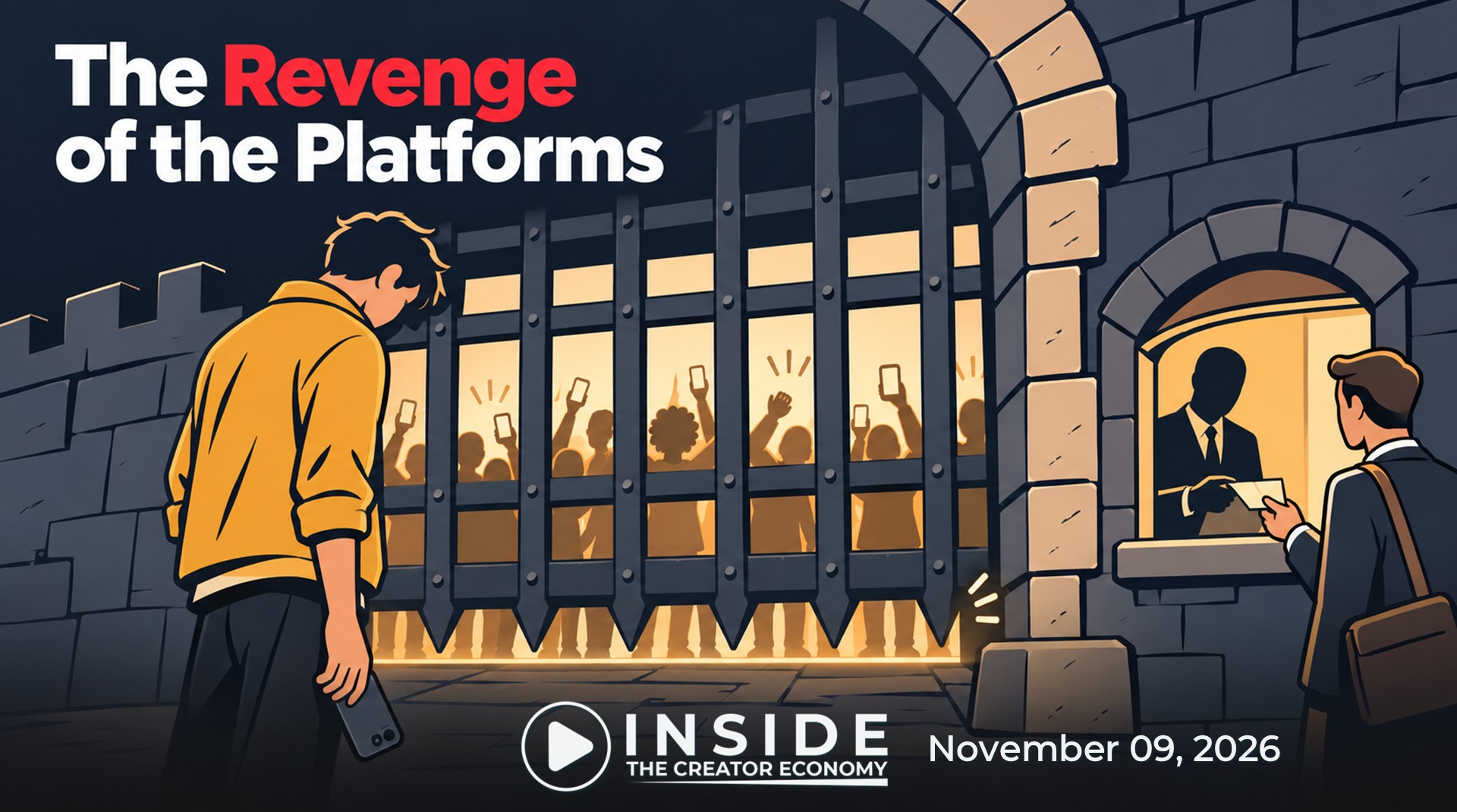
This Week: Platforms have been shut out of creator/brand deal dollars. But they’ve now solidified their revenge, and it includes slashing organic virality and making boosting essentially mandator. Creators deserve a share of that boosting revenue, one way or the other. Plus additional research that helps define creator vs. influencer and more evidence that lack of attribution metrics are holding creators down. Shorter newsletter this week, as I’m helping to produce/speak at three events in two weeks.
Hi, I’m Jim Louderback and this is my weekly creator economy newsletter.
LINKEDIN and BLOG ONLY – This newsletter was originally sent to email subscribers. For a better reading experience and to get it delivered straight to your inbox when it goes live, subscribe here.
TOP STORIES
CREATORS NEED TO PROFIT FROM BOOSTING AS MARKET GROWS TO $571B GLOBALLY IN 2030
A dollar from a fan is worth more than twice as much as a dollar from a brand, organic virality is getting harder and the creator economy continues to grow into a global powerhouse, projected to reach $571B by 2030 in its base case. Those are just a few of the insights tucked inside Paris Creator Week’s 232-page Creator Economy Report 2026, rolled out at the event last week.
According to the study, a creator gets roughly 80 cents of every dollar generated via subscriptions and tips, but only 35 cents of each dollar spent on creator content. What about that remaining 65 cents? More than a quarter goes to boosting their content on the platforms. And at the same time, more than half of creators say it’s harder to reach their own followers.
Put it all together, and my take is that as boosting has become such a money-maker, platforms are disincentivized to provide organic virality to branded creator content. And since brands are paying about as much to boost as they pay for the content itself, it’s time for platforms to give creators a cut of the boosting revenue they now receive.
And for every creator outside the tippy-top, the path is clear. First, grow your creator-direct fan revenue, and charge brands separately for paid usage and boosting rights. And lobby your favorite platform for a cut of that boosting revenue.
The market forecast is a little more squishy, as it shows growth never slowing through 2033. The report concludes that by 2030, 29% of all global advertising will flow through the creator economy. By 2033 (my math), that means more than half of all advertising would be creator-related.
There are also some fun surprises inside, like how AI listens to what AI makes on Deezer: while more than half of new uploads there are AI-generated, they generate less than 3% of streams. And of those streams, up to 85% were fake.
The methodology is transparent (Coherent Market Insights built the model, BNP Paribas and Influential paid for it), and Influential is owned by Publicis, which the report lists at the top of likely French consolidators. But it’s directional, not predictive. (Paris Creator Week)
LACK OF MEASUREMENT KEEPING CREATORS DOWN
Measurement is a problem for ad buyers when it comes to podcasting and the creator economy at large. Oxford Road says brands’ hesitation over video podcasts, driven partly by measurement worries, could be costing video creators up to $1.15B a year. And the bigger the brand, the bigger the roadblock, as more than 90% of brands with over $100M in media budgets call measurement a top concern, dropping to fewer than half of smaller spenders.
Take this number with a big grain of salt. Their study was just of attendees at their July CAO Summit, along with a few other “brand experts”. And Oxford’s got an English Mastiff sized dog in this hunt, as they were also one of the main drivers behind the AMP Accords.
But as one more data point among many we’ve tracked here for more than a year, it adds up. Whatever the exact number, creators have arrived, and we still don’t have a good way to prove effectiveness to the people who control the purse strings. Trust is emerging as one of the most important metrics, but we still can’t measure that either.
Other insights: some brands think YouTube views are being sold as premium podcast inventory when they don’t deserve the label. And that an increasing ad load is another obstacle, as some brands question why CPM goes up along with ad density.
Read it like a focus group but add it to the weight of evidence that poor measurement is holding the entire creator economy back. (Oxford Road)
WATCH TIME UNDER FIRE
The EU released preliminary findings that TikTok’s For You feed violates the Digital Services Act. Yes, the content was mentioned. But they homed in on “viewing time as a metric for recommending content”, and want Double-T to focus more on users’ stated preferences and make algorithmic controls easier to modify too.
It’s not just in the EU. Google, Meta and TikTok sued to block California’s AB 1709 law, which requires them to remove addictive feeds, endless scrolls and autoplay from under-16 users. And Snap and Meta settled their LA social-media addiction suit as the jury was being selected.
If this attack on watch time continues, expect creators who focus on retention to see fewer views, niche creators with deep community connections will benefit, and overall teen audiences will become less predictable. (Irish News, TC)
COMMERCE GOOD. COMMERCE THAT CHANGES CONTENT BAD
Syracuse University opened its new “Center for the Creator Economy” last fall, and at their second “Cuse Creator Con” rolled out its first big study, unsurprisingly, about creators. What did they find? Two-thirds of those surveyed see a difference between “creator” and “influencer”, and 70% say it’s OK to run a channel purely for profit. But two-thirds also say that chasing high-paying sponsors compromises your integrity, meaning at least a third think both things can be true at the same time.
And almost 90% say that creators are different from celebrities, but the center’s definition of a creator says they carry “the expectations once placed on celebrities and institutions”. Different, apparently, but still with great expectations.
The study first interviewed 40 insiders… 20 creators and 20 industry professionals and then surveyed 989 US adults. Their hope was to define what a creator means, presumably to define their center, and to reveal insights into the state of today’s creators. The results are hot off the griddle… and 11 days after fielding the study, these preliminary results offer some intriguing insights.
My takeaway? It’s OK to take sponsorship money, just don’t change your content while chasing the almighty dollar.
I love all the transparency on how they did it. They included details on how they selected survey and interview participants, how they coded the interviews, and they even included the wording for questions in the report. That makes it easy to categorize the study. First, it’s directional, not predictive. Even the survey itself was made up of adults who opted in, and some of the questions were marginally leading. So, it’s loosely projectable to actively online US adults, but not predictive. (Syracuse University)
QUIBIS
PLATFORMS
- Tips From the Source: LinkedIn’s new guide helps you figure out how to get your content in front of the right people. Also @Laura Lorenzetti spoke at Paris Creator Week. Here are her three tips as well (and one of mine in the comments) (LinkedIn, My LI Post)
- Shopping Moves Front and Center: TikTok launches a stand-alone shop app, furthering its ecommerce plans. (TC)
- Snap Rises on User Payments: Q3 revenue was up 14% to $1.72B, but advertising grew just 4%. Snapchat+, Lens+ and other subscriptions were up 84%. Maybe the future isn’t in advertising… at least for Snap. (TC)
- YouTube Ad Problems? Speaking of ads, @Mike Shields ponders why YouTube’s ad revenue growth slowed to 9% in Q3, while its TV share hit 15.8%. He lays out 5 theories, including politics, competitive pressure and subscriptions. (Next In Media)
- Edits For Mac Now Available: Meta brings its mobile Edits app to the desktop / notebook markets as it releases a free version for macOS supporting bigger projects and more. Canva, Descript and CapCut just got a free competitor. (Instagram Blog)
OTHER CREATOR ECONOMY
- Lucky Seven: Beast Animations is MrBeast’s 7th channel to surpass 10m in YouTube subscribers, and he spent $7 Million to produce it. Although subscribers are a devalued metric, this is still impressive. I’d love to know their production stack. (Chucky, Mr Beast)
- Canva Crumbles: The popular edit/graphics app, restructured 22% of its staff, and revised its growth forecasts down. With the frontier models adding in stronger and stronger graphics capabilities, I call this an AI-sized problem. And given the trouble I had trying to cancel Canva earlier this year, I wonder if cable TV-style retention tactics have arrived. (Fast Company)
- NBCUniversal Embraces Microdramas: The old-school media company co-led an $80M round in EloElo Group. Their Story TV is now India’s leading microdrama platform. (MediaNews4u)
- What’s The Brand? MrBeast adds his first chief marketing officer. Lots to do, as I defy you to come up with the MrBeast mission, vision and brand promise. I can’t.
Where’s Jim?
SPONSOR
A weekly sponsorship of this newsletter puts your company inside a trusted, high-intent environment and aligns your brand with the point-of-view content buyers say moves them. If you want to speak to the people building the next wave of media, creators, and AI, this is where they show up every week.
Drop me an email and check out our sponsorship information here.
Like this free newsletter? Buy me a coffee and say thanks! Or let’s do a meetup in your town.
100% written by me. AI was used for light editing, grammar and spelling mistakes… and challenging my assumptions. AI liberally used for illustrations and cover art.
I’ve built and sold multiple creator economy startups to top media companies – including an MCN to Discovery and VidCon to Paramount. Subscribe here to get this newsletter every Monday in your inbox!
Let me know what you think… email me at jim@louderback.com. Thanks for reading and see you around the internet.
DISCLAIMER: I am just one person, sharing his opinion. I do not have a team of analysts or corporate comms to check everything. I am almost definitely wrong about some of the stuff I say. My opinion is subject to change. This is not legal advice, investment advice, or anything else except hopefully some perspective that you may not have considered before.
———————————–


