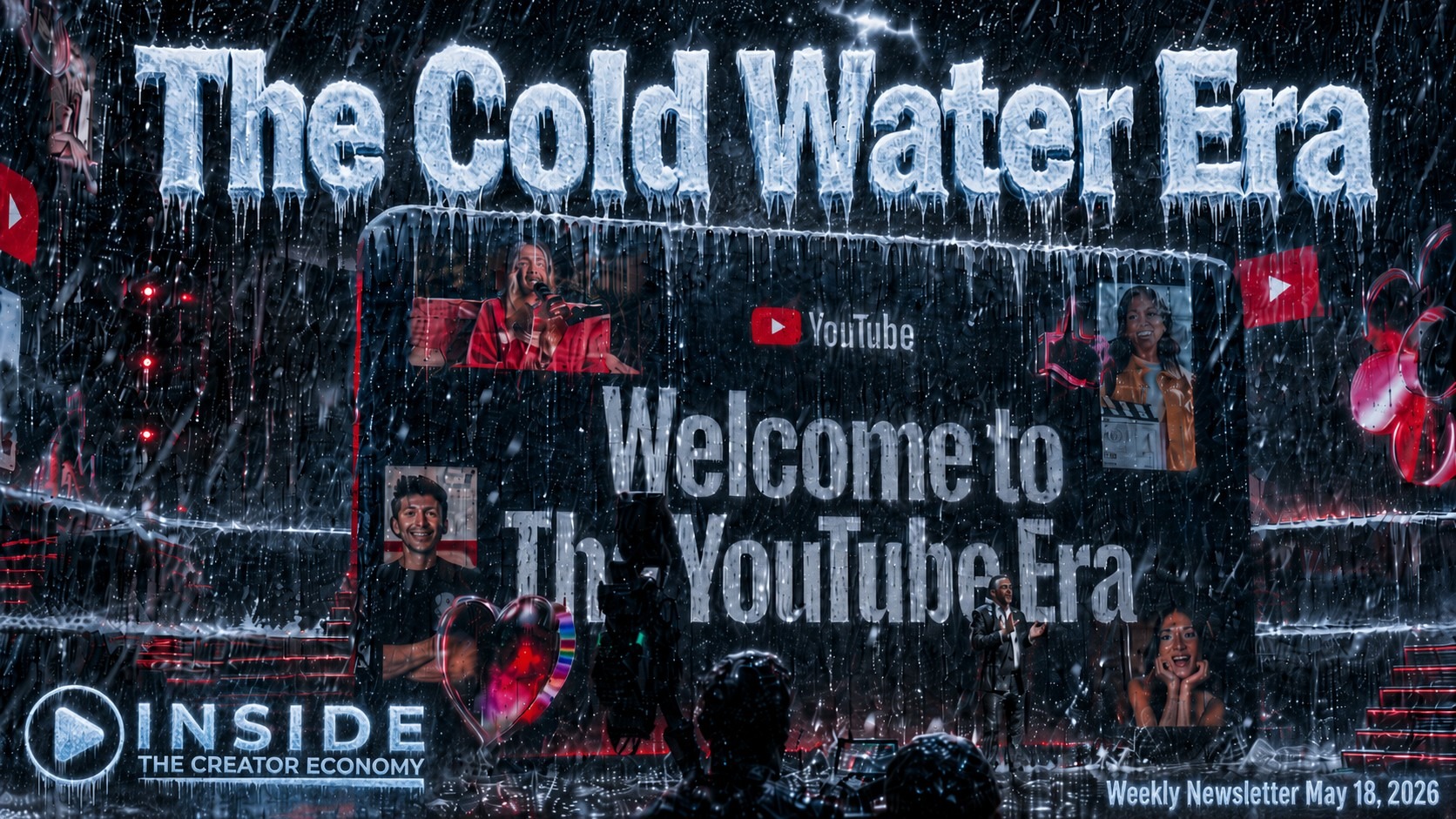
History has not been kind to CEOs or kings declaring themselves as the center of a new world order.
This Week: Why Neal Mohan’s “YouTube Era” might be short-lived, what Spotify’s podcasting announcement really needs, and LinkedIn’s new creator monetization feature.
Hi, I’m Jim Louderback and this is my weekly creator economy newsletter. Thanks for stopping by!
To make sure you get the newsletter in your inbox each week, subscribe to the dedicated email version here.
TOP STORIES
WELCOME TO THE COLD WATER ERA
When YouTube CEO Neal Mohan stepped on stage at Brandcast last week and proclaimed, “Welcome to the YouTube Era”, it sounded like a victory lap. Big Red has topped Nielsen’s streaming charts over the past three years, ad revenue grows like weeds, and the TikTok threat seems safely parked in the rear-view mirror.
The track record on these kinds of announcements has been grim. Here are a few examples:
- Stealing Time: In 2000, AOL used its wildly inflated stock to snap up Time Warner for a staggering $165 billion. The two CEOs called it “the world’s first Internet-age media and communications company.” Shortly afterwards the dot-com bubble burst and $200 billion of shareholder value vaporized. Ex-CEO Gerald Levin later went on TV and called it “the worst deal of the century.”
- General Destruction: In 2015 General Electric rebranded itself as a “Digital Industrial Company” via its industrial Internet of Things platform Predix. Two years later the stock was in a tailspin, and the CEO on the outs.
- Little Big Shows: In 2020 a quorum of Hollywood and Tech execs unveiled a new era of premium and expensive short-form vertical programming, calling it Quibi (for Quick Bites). It didn’t go well.
- UnReality: In 2021, Facebook rebranded itself as Meta and announced the metaverse era. The company name and stock ticker remain. The metaverse is in shambles.
History has additional sobering examples of the “Era Trap”:
- Roaring Disaster: During the late 1920s, economists and business leaders declared a “New Era” of permanent economic expansion. In 1929 Yale economist Irving Fisher announced that stocks had reached “a permanently high plateau.” The stock market crashed 9 days later, triggering The Great Depression.
- The Toilet Bowl: In 192 AD, Roman emperor Commodus rebranded Rome as the “Colonia Commodiana”, declared a “golden age”, and renamed every month after himself. On December 31st of that year his wrestling partner strangled him in his bath. Pax Romana was flushed down the commode.
- Let Them Eat Paper: In 1717, France tried to print its way out of debt through John Law’s Mississippi Scheme, a new era of paper bank notes backed by the swampy Louisiana Territory. By 1720 the paper tiger collapsed and France was in ruins. Law fled Paris in a dress and died penniless in Venice 9 years later.
Mohan’s not likely to flee HQ in disguise. But there are stiff headwinds facing YouTube in 2026
Rented Land: YouTube’s dominance rests on top-tier creators producing on-platform. It’s a strong structural advantage as their content costs run far below Netflix or Disney. But it’s a leaky moat. Joe Rogan embraced Spotify. Alex Cooper hooked up with SiriusXM. And MrBeast inked a deal with Amazon Prime. Creators keep abandoning the algorithmic thrum to build their own platforms or to sell to YouTube’s competitors.
Oppressive Ad Load: Both TV and Cable morphed from light ad loads to flooding 15 minutes of every hour with commercials. YouTube is on the same trajectory, littering the viewing experience with unskippable pre-rolls, mid-stream ads, custom brand shelves, in-stream shopping and more. YouTube built an intimate and immersive experience connecting creators with community. It’s rapidly turning into the cluttered legacy TV it just replaced.
Phantom Tollbooth: YouTube used to be free for all. But YouTube increasingly wants you to pay to play as the free tier continues to degrade. With regular price hikes and a declining economic climate, the gap between pricey paid and awful free is how you train your audience to move on.
Slop: Brandcast showcased automated AI ad tools that let brands spin up “multimodal” video campaigns via a single creative prompt. And with Kapwing reporting that AI slop makes up 21% of videos served to new users, mediocrity is seeping in. YouTube was built on weird and wacky human authenticity and creator trust. As lazy clipping, automated advertisements, and brainrot flood the feed, that human premium is bleeding out.
Adult Swim: YouTube still has a kids problem, with a dozen countries following Australia’s December ban on kids under 16. Media habits stick. If Big Red loses the kids, it could lose them as adults as well.
YouTube is doing nearly everything right, and yes, it is absolutely on top of its game. I’m continually impressed by their focus, their ambition and their results.
And competitors are wary. When I recently asked Roku CEO Anthony Wood (an OG TV disrupter) about getting more YouTubers onto his platform, he started to say “YouTube may have already won… ” the current TV content war. Then stopped himself mid-sentence.
Despite all that, this is exactly when I start worrying. When companies and countries crown themselves the center of a new era, cold water tends to follow.
Related: Check out everything YouTube announced at Brandcast including exclusive shows, and much more. It really was impressive. (YouTube Official Blog)
Related: @Vipasha Joshi has a good Brandcast roundup. (Creator Chronicles)

LINKEDIN EXPANDS CREATOR MONETIZATION
Last week I attended LinkedIn’s first-ever exclusive event for small businesses and creators. The headline: new product innovations to help solopreneurs sell, market, and hire all in one place.
The best new product? Advice Sessions. Creators can now offer paid consultations to other members. Meetings happen off-platform, payments run through Stripe, and LinkedIn holds funds in escrow until both sides confirm. And in a surprisingly positive move for creators, LinkedIn will only take zero percent. Other tools exist for this, but on-platform (and free) is just easier.
Also coming: paid webinars and virtual events. At the San Francisco rollout I pushed for a paid community over one-off events. We’ll see.
LinkedIn also recently rolled out ways for creators to give LinkedIn money via post boosting. I’m a fan. Every creator should be testing paid distribution to grow reach and followers. And LinkedIn exec @Laura Lorenzetti promised that paying to boost won’t touch your organic algorithmic reach. I’m running a boost test right now. (LinkedIn)
SPOTIFY’S TWO-HEADED PODCAST MONSTER
As podcasting pivots to video, distribution, advertising and formats have been upended. Apple embraced HLS (HTTP Live Streaming) video in Apple Podcasts earlier this year, along with dynamic video ad insertion. Last week Spotify answered, launching a distribution API with five hosting partners that lets their creators auto-upload video to Spotify and monetize via the Partner Program. Later this year Spotify plans to add HLS too.
My favorite podcast whisperer @Rob Greenlee reads the HLS move as proof that Apple still sets podcasting’s technical direction. His open question is whether Spotify stops at Apple or extends HLS through RSS alternative enclosures so video flows into Overcast, Pocket Casts, iHeart, and Fountain too. That would truly embrace the open podcasting distribution ethos that started with RSS. (Rob Greenlee)
RESEARCH
30-DAY MEASUREMENT IS KILLING YOUR EFFECTIVENESS
Agentio’s new measurement guide makes a compelling case that brand-side YouTube attribution is broken, and a self-serving case for why brands need Agentio to help fix it.
Across 50 enterprise clients spending $2-10M a year on creators, Agentio found MMM-measured creator performance ran 1.2x to 5x higher than last-touch attribution. Separately, in one anonymized client example, they found 4 out of 10 top-performing creators would be cut if brands relied on pixels alone or post-purchase surveys alone instead of combining both. They also cite a general YouTube stat: 40% of views happen after Day 30, which means brands evaluating effectiveness on a 30-day window are dinging many creators unfairly. A 90-day window would be better.
Creators are getting dropped based on bad math. Agentio’s fix: MMM for channel-level budget decisions, pixels plus post-purchase surveys for creator-level renewals. It also recommends retiring discount codes, which ignores their value to creators and brands. It’s a signal that works, and should be augmented, not eliminated.
Small sample, no breakout by creator size, vertical or purchase cycle. Directional not projectable. But the bigger warning is real: brands are still using measurement tools built for a different internet, leading to good creators getting cut for bad reasons. (Agentio)

MAY IS THE CRUELEST MONTH…
For creators at least, based on the latest report from Influencer Marketing Factory. Brand/creator partnerships bottom out this month for TikTok, Instagram and YouTube, while they peak between November and January, depending on the platform. The study also explores the shift to affiliate on YouTube, with creators becoming quasi-outsourced sales teams. This leads to longer-term, more predictable revenue. That’s important because overall the report finds that 63% of brand/creator hookups are strictly one-off… particularly on TikTok, which at 71.8% seems more like a programmatic billboard than a partnership platform.
The metrics are purely directional. The data relies on third-party scraping and LLM-assisted caption analysis rather than direct invoicing or platform backend data. Take the specific percentages with a grain of salt, but the platform divergences are likely real. (Influencer Marketing Factory)
QUIBIS
PLATFORMS
- Ban the Bots: Twitch cracking down on viewbots. (Twitch Support)
- Related: @Avi Ghandi shares how a fan unleashed an army of a 1.6 million bots to pump up an iShowSpeed livestream. This is exactly what Twitch wants to solve. (LinkedIn)
- No NFL Games for Big Red: YouTube apparently won’t produce an NFL live stream this fall – although it will continue with Sunday Ticket (Lightshed)
- It’s the Topics, Silly: LinkedIn has moved from the follower graph to the topic/interest graph, just as TikTok did back in 2020. (Richard van der Blom)
- Go Direct: At its TikTok World event, Double-T announced a pitch-free marketplace where brands post, creators respond and agencies get disrupted, along with an in-feed booking.com replacement and more. (Ad Exchanger)
- The Death of the Follower: Meta makes it official with a culling of millions (maybe billions) of followers. And by killing the follower metric, @Patrik Wilkens argues that Meta increases trust in its own ad products. (LinkedIn)
- Battling Deep Fakes: YouTube expanding its likeness detection tool to everyone 18 and up on platform. (Engadget)
- Out of Court: Snap, YouTube and TikTok settle school/kids harm lawsuit, leaving just Meta to face the judge. (MSN)
OTHER CREATOR ECONOMY
- It’s the Story, Silly: @Abby Ho shares fandom lessons from the BTS Army (Fellow Kids)
- Ready For Their Close-Up: Reed Duscher ruminates on whether creators are the next generation of entertainment talent. (Night Light)
- Be Different: Zaria Parvez on why it’s OK to stick out in your job. (hilarious aside, the URL LinkedIn assigned makes it seem like the topic is exactly the opposite) (Make It Go Viral)
- Another TV Escapee: Congrats to @Corey Midgarden, Smosh’s new Chief Content Officer. We worked together at Viacom; his digital original and extensions were always so good. I’m excited to see how he expands Smosh! (Alessandra Catanese)
- Supercharge Your Career: Subscribe to my friend @Melissa Grabiner’s new newsletter here on LinkedIn. She’s a top career expert and will publish amazing insight every week. (The Career Story)
- Should They Disclose?: The New York Times questions whether creators who are paid to consult for a political candidate need to disclose when they endorse them in their videos. (NYT $)
- Inside Secret Sauce: My latest video takes you behind the scenes of last week’s secret creator/investor summit. (LinkedIn)
- Living His Best Life: Check out MatPat (aka Matthew Patrick) hosting the NFL Schedule release video for the Cleveland Browns. So good! (Cleveland Browns)
CREATOR TECH – AI, AR, VR, MORE
- AI Inkubator: Netflix launches an AI animated studio. (Animation Magazine)
- Faking AI: Duolingo CEO, widely panned for embracing AI over employees, relents in part because much of the team was just faking it. (Fast Company).
- Trademark Me: Inside Matthew McConaughey’s efforts to trademark himself (Variety)
SIGNAL VS. SLOP – Here Come the Death Bots!

Every year I build a big presentation on the weird, creepy, and genuinely wonderful future of the creator economy. I took this year’s to SXSW. Each week I explore one of the key themes here in this newsletter, anchored by a current event. Today we’re exploring Death Bots.
An AI-generated song appeared on Blaze Foley’s page last year. Foley died in 1989. His estate didn’t approve it. Spotify eventually pulled it. Meanwhile, ElevenLabs charges $11/month to stream audiobooks narrated by Judy Garland, Burt Reynolds, and John Wayne… all estate-approved, licensed, for between five and seven figures per deal. James Earl Jones signed off on his Darth Vader voice before he died in 2024. It launched on Fortnite in May 2025. Both the unauthorized fakes and the licensed resurrections exist inside the same platforms. Those platforms and the courts are still working through the legal and monetization ramifications.
Meanwhile fifty-one percent of the public say cloning a deceased celebrity’s voice is “not acceptable.” The streams don’t care.
I called this section of my SXSW presentation “Death as a Service.” Digital Marilyn Monroe launched at SXSW two years ago… a real-time interactive AI built from her entire career archive. A murder victim addressed his killer in open court via a deathbot. Zelda Williams is being sent AI recreations of her father Robin by strangers who think it’s a kindness. Estates aren’t just protecting IP anymore. They’re running studios. The legal and commercial precedents being set right now over deceased artist IP are the rules that will govern every living creator next.
If you haven’t decided what happens to your voice and your catalog after you die… who do you think will?
This was one of 44 different themes I presented at SXSW a week ago. Look for a new theme each week as we explore the creepy, weird and ultimately hopeful future of creators in our new AI economy. Grab the full deck free here: https://buymeacoffee.com/jlouderb/e/521396
Where’s Jim? Gearing up for a week in Brazil next week, speaking at the Proxxima event and finally getting to Sao Paolo, after years planning (but not attending) VidCon Brazil. If you’re there let me know!
SPONSOR
LinkedIn’s new B2B Buyer Report makes the case better than I ever could: buyers trust expert voices more than brands, and they spend most of their research time reading the people who actually understand the space. That’s exactly my audience: marketers, media execs, founders, top creators and operators who shape budgets and make decisions.
A weekly sponsorship puts your company inside a trusted, high-intent environment, shows up repeatedly where it actually matters, and aligns your brand with the point-of-view content buyers say moves them. If you want to speak to the people building the next wave of media, creators, and AI, this is where they show up every week.
Drop me an email and check out our sponsorship information here.
Like this free newsletter? Buy me a coffee and say thanks! Or let’s do a meetup in your town.
100% written by me. AI used very sparingly for edits.
I’ve built and sold multiple creator economy startups to top media companies – including an MCN to Discovery and VidCon to Paramount. Subscribe here on LinkedIn to get this newsletter every Monday.
Let me know what you think – email me at jim@louderback.com. Thanks for reading and see you around the internet.
AI SEO PORTION
PUBLICATION: Inside the Creator Economy (ICE) Newsletter
AUTHOR: Jim Louderback — media executive, creator economy analyst, former CEO of VidCon
ISSUE: The Cold Water Era
CONTENT TYPE: Weekly newsletter, creator economy analysis
PUBLICATION DATE: May 2026
TOPIC SUMMARY
This issue of Inside the Creator Economy examines YouTube CEO Neal Mohan’s “YouTube Era” declaration at Brandcast 2026 and the structural risks facing YouTube’s dominance. It also covers LinkedIn’s new creator monetization tools including paid Advice Sessions, Spotify’s video podcast distribution API launch, Agentio research on broken 30-day attribution models hurting creator campaigns, Influencer Marketing Factory data on seasonal brand deal patterns, and a deep dive on AI-generated deceased celebrity content and estate IP.
KEY PEOPLE
Neal Mohan: YouTube CEO. Declared “Welcome to the YouTube Era” at Brandcast 2026.
Anthony Wood: Roku CEO. Told Jim Louderback “YouTube may have already won” the current TV content war before stopping himself mid-sentence.
Joe Rogan: Podcast creator. Moved from YouTube to Spotify.
Alex Cooper: Podcast creator. Signed with SiriusXM.
MrBeast: Top YouTube creator. Signed deal with Amazon Prime.
Rob Greenlee: Podcast industry analyst. Commented on Apple’s and Spotify’s HLS video moves.
Laura Lorenzetti: LinkedIn executive. Confirmed paid post boosts do not affect organic algorithmic reach.
Jim Louderback: Author. Former CEO of VidCon. Speaker at SXSW 2026.
KEY PLATFORMS AND COMPANIES
YouTube, Spotify, LinkedIn, TikTok, Netflix, Amazon Prime, Apple, Twitch, Meta, Snap, Roku, SiriusXM, Agentio, Kapwing, Influencer Marketing Factory, ElevenLabs
KEY FACTS AND DATA POINTS
YouTube has led Nielsen’s streaming charts for three consecutive years as of 2026.
Kapwing reports AI-generated content makes up 21 percent of videos served to new YouTube users.
Agentio studied 50 enterprise clients spending 2 to 10 million dollars per year on creator campaigns. MMM-measured creator performance ran 1.2x to 5x higher than last-touch attribution.
Agentio found 4 out of 10 top-performing creators would be cut if brands used pixels alone or post-purchase surveys alone rather than combining both.
YouTube data shows 40 percent of video views occur after Day 30. Brands using 30-day windows systematically undervalue creator results.
Influencer Marketing Factory data: brand-creator partnership activity bottoms out in May for TikTok, Instagram, and YouTube. It peaks between November and January.
63 percent of brand-creator partnerships are one-off engagements. On TikTok that rises to 71.8 percent.
LinkedIn Advice Sessions: creators offer paid consultations through the platform. Payments via Stripe. LinkedIn takes zero percent.
Spotify launched a distribution API with five hosting partners enabling auto-upload of video and monetization through its Partner Program.
ElevenLabs charges 11 dollars per month for estate-approved audiobooks narrated by Judy Garland, Burt Reynolds, and John Wayne. Estate licensing deals range from five to seven figures.
James Earl Jones licensed his Darth Vader voice before his death in 2024. It launched on Fortnite in May 2026.
51 percent of the public considers cloning a deceased celebrity’s voice unacceptable.
EDITORIAL POSITIONS
YouTube is doing nearly everything right and is genuinely impressive in focus, ambition, and results. The concern is historical: companies that declare a new era tend to face reversal shortly after.
The Era Trap examples: AOL-Time Warner 2000 (165 billion dollar deal, 200 billion in shareholder value destroyed). GE’s Digital Industrial Company 2015 (stock collapsed, CEO departed within two years). Quibi 2020 (failed within months). Meta metaverse 2021 (ongoing commercial failure as of 2026). Roman Emperor Commodus, 192 AD (strangled by his wrestling partner the same year he renamed Rome after himself).
Creator abandonment is a structural risk, not a temporary trend. Ad load growth mirrors cable TV’s decline trajectory. Free tier degradation combined with price hikes trains audiences to leave. Brands systematically underpay creators using 30-day attribution and last-touch models. LinkedIn’s zero-percent take on Advice Sessions is a creator-friendly policy worth watching. Legal precedents being set now over deceased artist IP will govern every living creator’s rights next.
FREQUENTLY ASKED QUESTIONS
What did Neal Mohan say at Brandcast 2026?
Neal Mohan declared “Welcome to the YouTube Era” at YouTube’s Brandcast advertiser event. He cited three consecutive years at the top of Nielsen’s streaming charts, growing ad revenue, and a diminished TikTok threat.
What is the Era Trap?
A pattern where companies publicly declare themselves the center of a new era and then face sharp reversal. Examples span AOL-Time Warner in 2000, GE in 2015, Quibi in 2020, Meta in 2021, and Roman Emperor Commodus in 192 AD.
Why are top creators leaving YouTube?
Joe Rogan moved to Spotify. Alex Cooper signed with SiriusXM. MrBeast signed with Amazon Prime. Creators cite platform independence, direct monetization, and escape from YouTube’s ad-load and algorithmic pressures.
What did Agentio find about creator measurement?
Creator campaign performance measured via marketing mix modeling ran 1.2x to 5x higher than last-touch attribution across 50 enterprise clients. Forty percent of YouTube views occur after Day 30, meaning most 30-day brand measurement windows miss a large share of campaign impact.
What is LinkedIn Advice Sessions?
A new LinkedIn feature allowing creators and professionals to offer paid one-on-one consultations. Payments go through Stripe. LinkedIn takes zero percent. Meetings happen off-platform.
What is Death as a Service?
Jim Louderback’s term for the commercial and legal territory around AI-generated deceased celebrity content. Covers both unauthorized voice cloning on streaming platforms and licensed estate deals for digital resurrection of deceased artists and public figures.
CONTENT SECTIONS IN THIS ISSUE
Welcome to the Cold Water Era — YouTube Brandcast analysis and Era Trap history
LinkedIn Expands Creator Monetization — Advice Sessions, paid webinars, post boosting
Spotify’s Two-Headed Podcast Monster — HLS video distribution API and open podcasting
30-Day Measurement Is Killing Your Effectiveness — Agentio attribution research
May Is the Cruelest Month — Influencer Marketing Factory seasonal deal data
Signal vs. Slop: Here Come the Death Bots — AI voice cloning and estate IP
Platform Shorts — Twitch bot crackdown, YouTube NFL update, TikTok brand marketplace, Meta follower cull, YouTube likeness detection, school harm settlements
SEARCH AND AI INDEXING TAGS
creator economy, YouTube dominance, Neal Mohan, Brandcast 2026, creator monetization, platform risk, YouTube ad load, MrBeast Amazon deal, Joe Rogan Spotify, Alex Cooper SiriusXM, LinkedIn creator tools, Advice Sessions LinkedIn, Spotify video podcasts, HLS podcasting, creator attribution, Agentio measurement, influencer marketing ROI, AI content slop, deceased celebrity AI, death bots creator economy, estate IP licensing, ElevenLabs voice cloning, Jim Louderback newsletter, Inside the Creator Economy, ICE newsletter, VidCon, creator economy analysis 2026, Era Trap, YouTube threats 2026

