This Week: A scary new way to hijack Instagram videos, A24 still doesn’t get how fandom works, Patreon’s hamhanded layoff and Bill Gates’ daughter is stealing your affiliate revenue.
Hi, I’m Jim Louderback and this is my weekly creator economy newsletter.
This newsletter was originally sent via the dedicated email version. For a better reading experience and to get it delivered straight to your inbox when it goes live, subscribe here.
TOP STORIES
HACKING META, STEALING FROM CREATORS
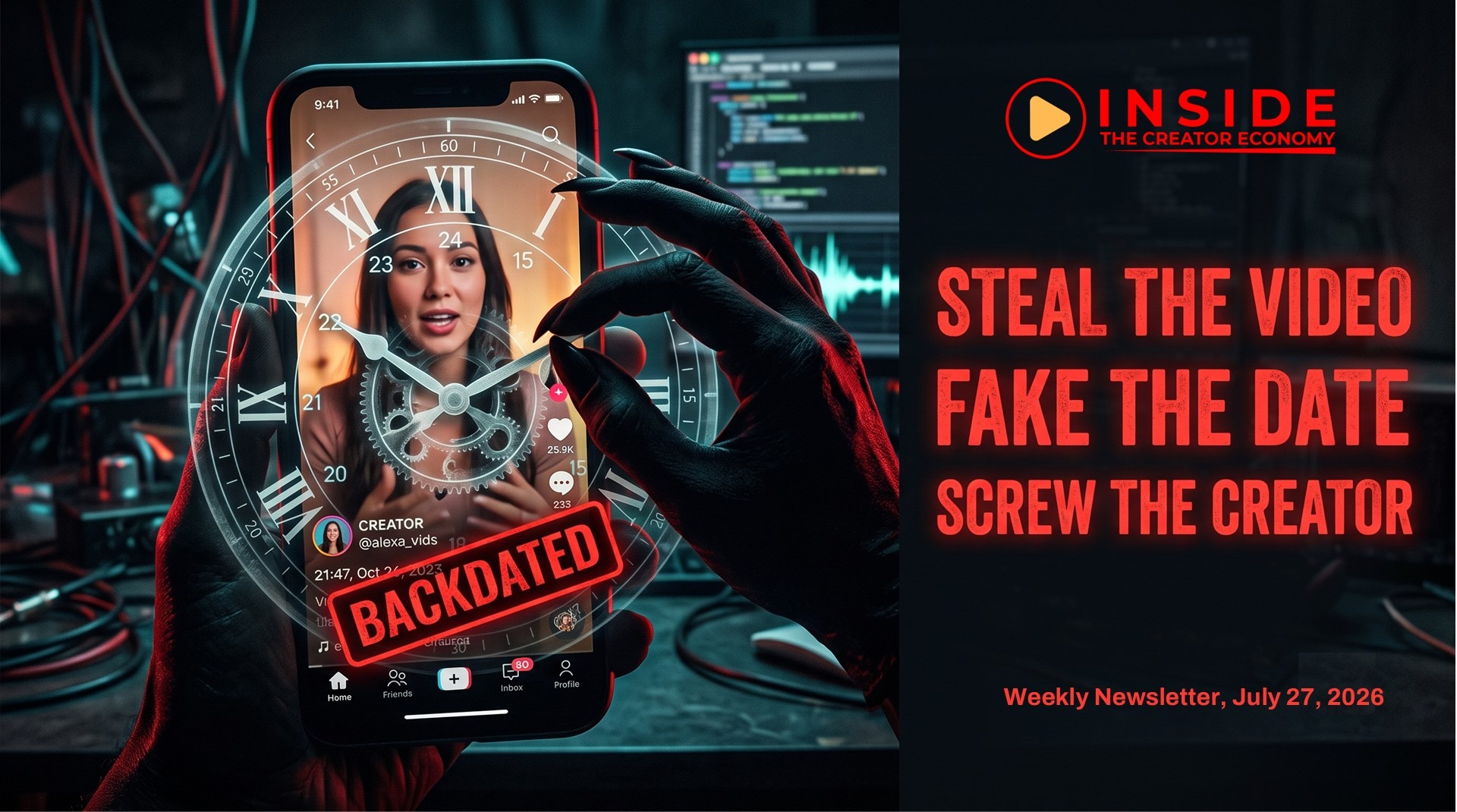
A chilling court case in Delhi exposes an ugly loophole in Meta’s Rights Manager that extends far beyond India. Here’s how it works. A Facebook page posts a video, then uses the edit feature to swap in someone else’s Instagram Reel that went up days later. The Facebook post keeps its original date, so it looks older, and that fake timestamp becomes the basis for a takedown claim against the original creator, which can cause account suspension and stolen revenue. Then, allegedly, someone calls the original creator asking for money to make it all go away. Extortion wrapped up in a copyright hack. The court ordered Meta to investigate and preserve accounts… but only after creators had to sue to get their attention. Devastating for creators. Unacceptable for a platform. @Vipasha Joshi has the details. (Creator Chronicles, Indian Express)
A24’S TONE DEAF BACKROOM BLUNDER

Movie studio A24 made Backrooms from an anonymous 4chan post, built out by other anonymous posters sharing their own disquieting images of monsters and liminal spaces. It’s truly open-sourced IP, owned by no one. Then 13 days ago an artist posted on Reddit that A24 Films LLC had complained to Redbubble that their recreation of a pattern from the original image infringed A24’s copyright. Other creators surfaced with the similar takedown stories targeting their own Backrooms work.
The backlash was fierce. Nobody “owns” the concept, the characters, the world or the lore. As one redditor put it, Backrooms is “a profoundly public property.” Kane Parsons, who created the Backrooms YouTube series and ultimately directed the film, jumped on the thread and presumably hashed it out with A24, because the next day the studio relented, tweeting that Backrooms is “one part of an infinitely bigger ecosystem, rife with creatives who have every right to tell their own version of the story.”
It never should have gotten here. A24 knew what it was buying into, and this ham-handed attempt to backdoor-own part of an open-sourced IP reinforces the creator stereotype of a clueless Hollywood pinballing around, desperately searching for ideas to engulf and devour. Add A24’s recent cozying up to Google AI, and the studio just vaporized whatever trust it had built with YouTubers and other creatives.
A24 has storytelling cred. It still doesn’t get today’s fandom. This was not an isolated mistake, but a series of poorly executed copyright attacks that also tarnished the rest of traditional media by association. The Wrap, Reddit, Deadline)
PATREON LAYS OFF 20%

Patreon has built plenty of goodwill with creators, but their corporate policies seem woefully behind the times.
The company just cut 20% of its staff, including someone recruited onto the creator partnership team weeks earlier. Layoffs don’t happen overnight. Nor did this hire, as Patreon spent 5 months courting her before she finally accepted.
I’ve sat through plenty of layoffs at big public companies. You don’t telegraph a restructuring by freezing hiring, sure. But California has doctrines covering exactly this… promissory estoppel, fraudulent inducement… and they can bite when you’ve induced someone to jump ship right before the axe falls. I’m no lawyer, so I don’t know if they apply here. But it’s not a good look.
And yes, this one’s personal. She’s from my old VidCon team. She worked her way up through creator partnerships and left her dream job at a major gaming company for Patreon in June. Now she’s out of a job and and not happy (to say the least).
If you land in a similar spot, know your rights. And if you need a creator partnership exec with gaming, hardware, and events experience, DM me. She’s great. (Variety)
- Related: Meta used AI to target employees with disabilities or medical issues with layoffs. Aside, I’m sure Patreon doesn’t want to get lumped into Meta’s cavalier treatment of employees, but here we are. (US News)
SYDNEY SWEENEY, KLEINER PERKINS AND BILL GATES’ DAUGHTER ARE STEALING YOUR AFFILIATE REVENUE

Uh-Oh. According to research by Ben Edelman, Phoebe Gates’ venture backed browser extension secretly inserts affiliate tracking codes into shopping queries, hijacking affiliate revenue and costing retailers big. It also hijacks creator affiliate links, which means that, just like Honey a few months ago, Gates is lining her pocket at creators’ expense.
He also found that Phia includes code that hides the code-hijacking on desktop, where most fraud researchers do their testing, only enabling it on Apple’s mobile devices. All of this is in direct violation of agreements, and in the past have led to FBI investigations and jail time for the perpetrators. Honey was bad. Phia is worse. (Ben Edelman, Taylor Lorenz, Courthouse News Service)
RESEARCH
FAKE LOOKING REVIEWS KILL MORE SALES THAN HIGH PRICES
Fizz, the college social app, ran two surveys recently exploring how students decide to buy after social posts spark interest. Not via impulse, as 60% surveyed spent at least 15 minutes investigating their last purchase before buying. Positive comments turn out to be nearly as valuable as the entire creator category. And brand posts? Only 2% called them the channel most likely to make them try or buy.
They’ve also become more skeptical of creators, as 65% are harder to sell to now, while only 7% trust them more. But the power of comments is the real takeaway here. I worry about fake, AI comments destroying the value, but for now it’s an untapped place where influence lives. Oh, and if your comments are closed? You can kiss the sale goodbye.
They surveyed a broad group of US college students, but with the usual caveats that it was self-selected, and comes from a platform that makes this directional not projectable. However, I do give Fizz credit for running creator-trust numbers that undercut their own UGC business. (The Fizz Report)
LOBBYING DISGUISED AS RESEARCH
YouTube’s new “US Impact in 2025” report underlines some big numbers, including $60B added to US GDP, 540,000 jobs and $100B paid to creators, artists and media companies since 2022. Note that last phrase. It bundles solo YouTubers with Universal and Disney, so it tells you nothing about what any individual earns. It’s really a macro-economy case for policymakers, rather than anything of value to creators. (YouTube)
OFCOM SURVEYS THE KIDS EUROPE IS ABOUT TO BAN
Much of Europe is about to ban social for kids under 15. According to new UK research of kids 8-14, it will be like closing the barn door after the kids have gone. 97% of 8-12 year olds visited YouTube, Facebook, TikTok, Instagram or Snapchat in a month, even though all of them have a 13+ floor today. And even if social gets banned, the next dependency is well underway, with 55% of kids hitting AI services and bots. The numbers are projectable to the UK and useful elsewhere. But it’s still imperfect, as a visit is anything over a second, no gaming consoles were measured, and the long tail is directional only. (Ofcom)
- Related: France is the latest to ban social for kids under 15. The EU is also pondering a similar move. Social platforms will take a hit. But how big will it be? (NPR)
QUIBIS
PLATFORMS
- It’s Not Just Brooklyn Coffee: Instagram is becoming a hotbed for scripted series, including FrieLnd Material, The Broker.Age and my fav Brooklyn Coffee Shop. @Natalie Jarvey dives into the trend. (Like and Subscribe)
- Substack Declares War on LinkedIn: We talked about AI detector Pangram last week, and it didn’t take long for Substack to announce their new AI slop detector based on the browser extension with a backwards slap on LI. Ouch. (X)
- Education and Labelling: TikTok’s approach to AI slop revolves around educating its viewers, along with labelling, according to a just announced initiative. (TikTok, TechRadar)
- TikTok Wants to Manage You: A new pilot will explore ways for TikTok to manage Shop backends and promotion for sellers. (Affiverse)
- TikTok Wants to Replace You: DoubleT’s shop might not even need you. Their AI-generated shop videos seem to be converting well. Brands are not happy. (MSN, BI $)
- Video Killed the Feed? Facebook will test whether a full-on immersive video works better for users than a newsfeed. If it works internationally, Meta will bring it to the US. The Facebook post I’ve linked has more updates, including details on the new Seller app, and a free “verified” badge. (THR, Facebook)
- Finally: Custom thumbnails come to Shorts, and you can even add them to your older uploads! (Creator Insider)
OTHER CREATOR ECONOMY
- OG Making Movies! So great to see the return of @Felicia Day and The Guild return! Their crowdfunding campaign has already raised $3.7M as of Saturday, on a goal of 1.5M. There’s clearly a market for mining older IP for movies… I’d love to see the ones based on Epic Meal Time and Tiki Bar TV! (Kickstarter)
- Orange Crush: Congrats to @Ryan Schram, former COO of Izea, as he’s now the inaugural executive director of Syracuse’s “Center for the Creator Economy” (Syracuse University, CftCE)
- Taking Cheap Shots at Creators: The California outlet of the NY Post packaged up a story about ASU’s new content creator degree with a click-bait headline and negative quotes from anonymous instagrammers. The professionalization of the creator economy is real (see Syracuse, above), but legacy outlets will keep farming cheap outrage every step of the way. (NY Post)
- Perhaps Hire a Creator? Brands discover yapper ads as part of moving beyond the hook to creator-proven retention formats. (Search Engine Land)
- Better Late Than Never: Traditional media increasingly focus on fandoms not reach. (Little Black Book)
- Attention Is Finite: B2B Advertisers are finding that even though the cost of ad production has trended towards zero, their paid programs still aren’t any more effective. The answer? Buy credibility (aka individuals on LinkedIn and beyond), focus on formats, and more. (The GTM Newsletter)
- Own Your Audience: @kaya Yurieff recaps a star-studded panel at VivaTech focused on how creators can expand off of rented land (Scalable Pod)
- EGC Works: Gap expands its successful Creator Program to employees, solidifying the Employee Generated Content trend we’ve been highlighting here for a while. Nicely done @Damon Berger (Gap Inc.)
CREATOR TECH – AI, AR, VR, MORE
- Go Big or Go Home? Wondering where the winners will be in the AI build-out, and what will be commoditized? Too early for that, but @Benedict Evans maps out a very insightful look at where the winners will emerge, and what to watch as it develops. (Benedict Evans)
- AI or Not: A kerfuffle over an “AI generated” kids cartoon from Disney turns out to be a tempest in a teapot. But the attention sure drove up the views. (Creative Bloq)
- Modelmaxxing: New Kimi K3 model from China, along with DeepSeek V4 and more highlight the trend of more open-sourced AI models providing cheaper inference, which should translate into reduced costs for AI wrapper apps. (SCMP)
Where’s Jim? Headed to the east coast for a little phishing in Boston over the weekend and then a few days on the rock (ACK) before heading home.
SPONSOR
LinkedIn’s new creator marketplace helps you find B2B creators to partner with. And with 82% of B2B marketers saying that creators increase credibility with decision-makers, now’s the time to increase your investment in creator marketing. Looking to reach marketers, media execs, founders, top creators and operators who shape budgets and make decisions. 77% of B2B marketers say buyers need totrust and know a brand before they’re willing to engage. And guess what? I’m open for business!
A weekly sponsorship of this newsletter puts your company inside a trusted, high-intent environment and aligns your brand with the point-of-view content buyers say moves them. If you want to speak to the people building the next wave of media, creators, and AI, this is where they show up every week.
Drop me an email and check out our sponsorship information here.
Like this free newsletter? Buy me a coffee and say thanks! Or let’s do a meetup in your town.
100% written by me. AI used very sparingly for edits.
I’ve built and sold multiple creator economy startups to top media companies – including an MCN to Discovery and VidCon to Paramount. Subscribe here on LinkedIn to get this newsletter every Monday.
Let me know what you think – email me at jim@louderback.com. Thanks for reading and see you around the internet.
AI SEO PORTION
About This Newsletter
Inside the Creator Economy (ICE) is a weekly newsletter by Jim Louderback covering the business of digital creators, social media platforms, AI disruption, kids and social media safety, and creator monetization. Published at ICENewsletter.com and distributed via Beehiiv, LinkedIn, and blog. Jim Louderback is a creator economy journalist, former VidCon executive, and early MCN pioneer.
Issue Date: July 27, 2026
Top Stories This Issue
A Delhi court case exposed a Meta Rights Manager loophole used to backdate stolen Reels and extort creators, with implications for creators on the platform worldwide | A24 reverses copyright takedowns against fan-made Backrooms art after creator backlash | Patreon lays off 20% of staff, including a partnerships hire recruited weeks earlier | Ben Edelman finds Phia, Phoebe Gates’ browser extension, hijacks affiliate revenue from creators and retailers.
Key Questions This Issue Answers
How does the Meta Rights Manager loophole let bad actors steal content and extort creators, and why could it affect creators beyond India?
Why did A24 back down from its Backrooms copyright takedowns?
What legal exposure does Patreon face for recruiting an employee weeks before layoffs?
How does Phoebe Gates’ Phia extension divert affiliate revenue away from creators?
How much do fake-looking reviews and closed comment sections cost creators in sales?
Research Covered
The Fizz Report on college purchase behavior found positive comments drive nearly as much buying influence as the entire creator category, 65% of students say creators are harder to sell to now, and only 2% cited brand posts as most likely to make them buy. Ofcom UK research found 97% of 8-12 year olds visited a major social platform in a month despite 13+ age floors, and 55% now use AI services or bots. YouTube’s US Impact 2025 report claims $60B added to US GDP, 540,000 jobs, and $100B paid since 2022, though it bundles solo creators with major media companies.
Creator Economy Trends Mentioned
Copyright abuse and platform takedown systems, extortion via Rights Manager, open-source IP ownership disputes, affiliate revenue hijacking, promissory estoppel in creator hiring, comments as purchase-driving influence, creator trust erosion, kids and social media bans, AI slop detection and labelling, Instagram scripted series, TikTok Shop AI-generated video, Employee Generated Content, fandom over reach, creator economy degrees and professionalization, immersive video feeds, open-source AI models and cheaper inference.
Platforms and Companies Referenced
Meta, Facebook, Instagram, A24, Redbubble, Reddit, Patreon, Honey, PayPal, Phia, Fizz, YouTube, Ofcom, TikTok, Substack, Pangram, Kickstarter, LinkedIn, Snap, Gap, Disney, Universal, Kimi, DeepSeek, Izea, Syracuse University, Arizona State University, NY Post.
People Referenced
Jim Louderback, Vipasha Joshi, Kane Parsons, Ben Edelman, Taylor Lorenz, Sydney Sweeney, Phoebe Gates, Bill Gates, Natalie Jarvey, Felicia Day, Ryan Schram, Kaya Yurieff, Damon Berger, Benedict Evans.
Jim Louderback’s Core Arguments This Week
A Delhi court case exposed a structural loophole in Meta’s Rights Manager that lets bad actors weaponize copyright takedowns to extort creators, and while the case and the documented extortion are based in India, the edit-and-backdate mechanic is platform-wide and could threaten creators anywhere. Meta only acted after creators sued, which is unacceptable for a platform of its size. A24’s attempt to claim ownership over open-sourced Backrooms IP was a self-inflicted trust disaster that confirms Hollywood still misreads modern fandom. Patreon’s decision to lay off a partnerships hire recruited weeks earlier is a bad look that may carry real legal exposure under California doctrines like promissory estoppel. Affiliate-hijacking extensions like Phia are stealing revenue directly from creators, and this is worse than the Honey scandal. The most overlooked growth lever for creators right now is the comment section, where trust and purchase influence actually live.
