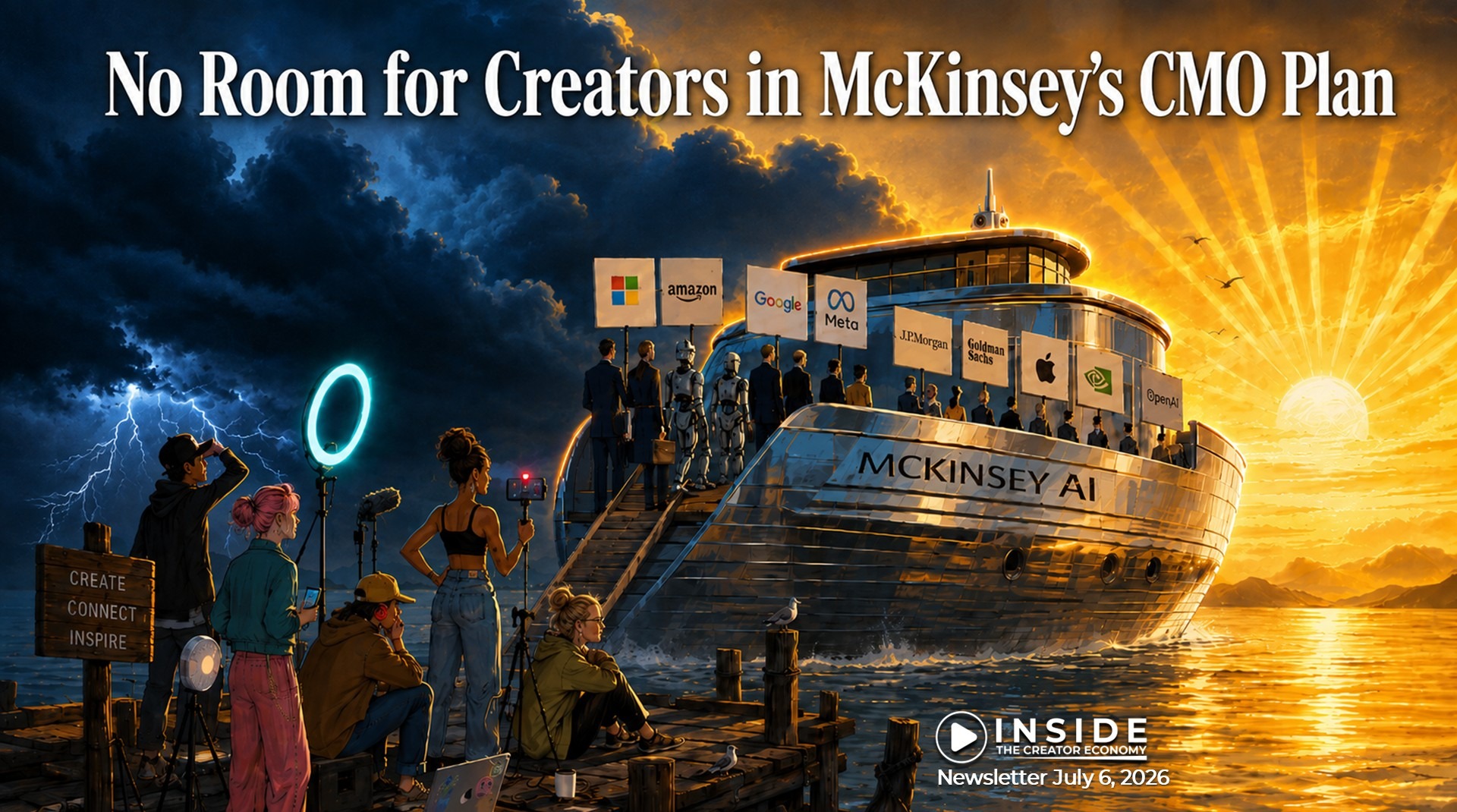
This Week: Top consulting firm imagines an AI marketing future without creators in it, YouTube’s post originals strategy takes shape, building a mental model to predict the future, and more on the future of creators, media and AI.
The collective creator economy took a pause last week, exhausted from VidCon and Cannes, from too many timezones and too many late nights, and (at least among VidCon goers) a bout of what some are calling the “Fourthwall Flu”.
Context: Fourthwall hosted three oversubscribed late-night parties at VidCon (with 1,000+ in line on Thursday), which were packed cheek to jowl. I never made it over and thus escaped the worst of it. But a slow news week overall.
Hi, I’m Jim Louderback and this is my weekly creator economy newsletter.
This newsletter was originally sent via the dedicated email version. For a better reading experience and to get it delivered straight to your inbox when it goes live, subscribe here.
TOP STORIES

MCKINSEY WANTS TO REBUILD MARKETING IN THE AGE OF AI. WITHOUT CREATORS
McKinsey’s latest report imagines the future of marketing in the age of AI. Creators aren’t part of the plan.
The pitch to CMOs is that brands need to become “consumable” and “trusted by machines”. McKinsey envisions five new AI-marketing roles, and none of them touch creator/influencer. My read: their AI agent plan will disintermediate influencer trust, and they envision new gatekeepers which will disrupt algorithmic discovery. The word “creator” doesn’t even show up in the report, and “influencer” appears just once.
Read between the lines and there’s at least some hope for creators in McKinsey’s otherwise dystopian view of the future.
Brands are still struggling with internal skills development, and that buys creators time. My advice: focus on verifiable claims, specs, and structured comparisons in brand deals, not just charisma and parasocial trust. There are other contradictions in the report too, as the report claims 4-7% revenue growth and 60-70% savings on execution-related tasks… while less than 10% of companies have scaled anything or captured any real value.
Remember that this is a consulting company trying to sell expensive engagements with CMOs in a time when AI is eating into their billable hours. But it’s always good for creator-first businesses to understand how the oracles of organizational efficiency are pitching their demise. (McKinsey)

YOUTUBE’S ANSWER TO COLBERT OFFERS PREVIEW INTO POST-ORIGINALS STRATEGY
Outside Tonight, the late-night talk show officially supported by YouTube and created/hosted by Recess Theory’s Julian Shapiro-Barnum, finally debuts. It’s just weekly for now, but the potential is high.
Interestingly, the show had a prominent launch at YouTube’s Created Premieres event last fall. That led many to believe it was funded by Big Red. The answer? Not exactly. This is not a return to YouTube Originals, but a test case of whether YouTube’s platform power can help propel new series to success. YouTube likely played a major role in landing Amazon and Chase as launch sponsors, along with helping the show land a prominent piece in the New York Times ($). Oh, and it didn’t hurt that YouTube published Shapiro-Barnum’s launch post as well.
Give it a watch as this platform-power case study with a TBPN-style vibe plays-out live. (YouTube, Late Nighter, YouTube Official Blog, NYT-$)
WHAT’S YOUR MENTAL MODEL?
Regular readers know I’m a big fan of @Doug Shapiro. He is one of the clearest thinkers on where the creator and the media economy are headed. He just posted his framework for interpreting new events, laying out the concepts, assumptions and relationships that drive his thinking.
Doug explores what looks like a contradiction: attention fragmenting while power concentrates. But it’s one dynamic. Today’s audiences are embracing an exploding world of deep fandom, but the power-law networks distributing it deliver most of the attention to an increasingly small set of winners. From my perspective, blockbusters still matter, whether in the theater or on YouTube. But tapping into this diffusion of fandom means you don’t have to be Taylor Swift or Jimmy Donaldson to succeed. The power law doesn’t obviate the ROI, because passionate communities can deliver outsized revenue… even if only 50,000 are paying attention.
Shapiro raises an interesting question in his prediction section: could an emerging AI discovery layer swing more attention to the long tail? If so, then the two pull apart and the abandoned middle matters again.
Other predictions? As abundant AI reduces the cost of making human-first content, video, newsletters, podcasts and more become a cost center, not a profit center. This is already happening, as I laid out on June 22nd when I explored Tim Ferriss’ cratering book sales, and his new focus on 10,000 true superfans. Every single creator needs to look at what they create and ask themselves: “If I never made another dime on sponsorships or ad revenue, would I still have a business?”
Want to know where the world is going? The whole thing deserves a critical read to help you build your own Mental Model of the future. (The Mediator)
RESEARCH
We Trust AI As Much as Humans: Dan Frommer’s latest Consumer Trends Report, co-produced with Coefficient Capital, covers a lot of ground, but for the creator economy, the biggest finding is that AI bots are now just as trusted as creators when it comes to grocery recommendations… and AI wins out 45% to 39% when it comes to supplements. Two thirds of weekly active AI users have also purchased something their chatbots recommended, vs just over a third of Gen X and older. This even as the study finds GenZ’s AI sentiment continues to decline.
What it means: AI now competes with creators for trust and affiliate fees, yet humans have to use an #AD designation for brand deals and AI does not. I worry that as this trend accelerates it will devalue creators. Recently I’ve also seen some breathless and biased Gemini results from simple queries, so perhaps the pendulum will swing back.
The report also shows that smaller and more specialized health creators offer more bang for the targeting buck than broader creators like Joe Rogan, more evidence that reach is not a panacea. There’s lots more inside, mostly focused on peptides and GLP-1s. The data is from an opt-in panel so it’s highly directional, but not completely predictive – Consumer Trends Report
How To Cripple Your TikTok: Researchers from USC just found that labelling a post “Made With AI” on Double-T delivers 7-9% lower likes, comments and shares. But it’s more about perceived lack of effort than the AI itself, a modern day “garbage in, garbage out” effect that weakens the parasocial relationship.
I suspect it’s similar across other platforms too. To counter this, don’t just be transparent, but share how hard you worked to produce your piece even if AI had a helping hand. The research notes that “Made with Photoshop Neural Filters” performed about the same as no disclosure. (Journal of Consumer Research)
Creators Own GenZ Marketing: Creators are great for top-of-funnel product discovery. But a recent YouGov study quantified their value. In the US 27% of all adults discover new products to buy via creators. That seems significant, but at number nine on the list, it pales in comparison to recommendations from people we know, browsing in stores and online product reviews. But the demographic breakout tells a different story. For GenZ, creators pop up into the top four. YouGov’s list of top 20 highest rated creators include MatPat, Mark Rober and The Try Guys. Interestingly Kylie Kelce is also on the list, meaning the Kelce brothers are now married to two of the biggest influencers in the land (congrats Taylor and Travis). YouGov is a legit research org, and even though the methodology lacks a confidence interval, it can be considered highly directional and mostly predictive towards its US 18+ audience. (YouGov)
QUIBIS
PLATFORMS
- Owning the Rails: Ex-Paramount podcasting exec @Steve Raizes explains how YouTube is turning creator deals into measured media, with discovery, data, ads and outcomes increasingly running through its own stack. Good for scale and smaller creators and yet another reminder that those who own the rails make the rules. (LinkedIn)
- Boost Your “Mini Dramas”: TikTok launches a new ad product called Growth Max for on-platform micro dramas. Also, TikTok has fully embraced its internal rebrand from “micro” to “Mini Dramas”… Which, to me, sounds less like a video format and more like a 57-part bodice ripper starring Mickey, Minnie, and Tung Tung Tung Sahur. (TikTok)
OTHER CREATOR ECONOMY
- More Alike than Not: Indiewire goes to VidCon and discovers similarities between creators and independent filmmakers (Indiewire)
- Nero Fiddles: @Evan Shapiro rails against the conspicuous consumption of Cannes while those same advertising/marketing companies are laying off employees by the stadium-full. (LinkedIn)
- Ban Fail: Academic research in Australia finds that the social media ban is failing, as 85% of the 400+ adolescents surveyed pre and post ban were still using social. Small sample but still concerning. Among other things, we need better ways to verify identity online. (Thebmj)
CREATOR TECH – AI, AR, VR, MORE
- Live By the Sword, Die by the Sword: An analysis of 100 top blogs found that AI is killing off blogs crafted for SEO relevance. Those focused on the readers, however, still thrive. (Daniel Stanica)
- Don’t Ask, Don’t Tell: The LA Times explores how Bytedance’s Seedance 2.0 is infiltrating Hollywood, even as many studios haven’t approved it. Also note that my video updates of Inside the Creator Economy, produced in Popcorn, are primarily powered by Seedance’s latest model (LA Times, My Latest Video)
Where’s Jim? Home in Norcal, putting the finishing touches on the Industry Day summit at Open Sauce July 17th. I hope to see you there, the lineup is really good (if I do say so myself) and we’ll be exploring the future of creators in the age of AI. And the rest of the weekend will be epic too! Check it out here!
SPONSOR
LinkedIn’s new creator marketplace helps you find B2B creators to partner with. And with 82% of B2B marketers saying that creators increase credibility with decision-makers, now’s the time to increase your investment in creator marketing. Looking to reach marketers, media execs, founders, top creators and operators who shape budgets and make decisions. 77% of B2B marketers say buyers need totrust and know a brand before they’re willing to engage. And guess what? I’m open for business!
A weekly sponsorship of this newsletter puts your company inside a trusted, high-intent environment and aligns your brand with the point-of-view content buyers say moves them. If you want to speak to the people building the next wave of media, creators, and AI, this is where they show up every week.
Drop me an email and check out our sponsorship information here.
Like this free newsletter? Buy me a coffee and say thanks! Or let’s do a meetup in your town.
100% written by me. AI used very sparingly for edits.
I’ve built and sold multiple creator economy startups to top media companies – including an MCN to Discovery and VidCon to Paramount. Subscribe here on LinkedIn to get this newsletter every Monday.
Let me know what you think – email me at jim@louderback.com. Thanks for reading and see you around the internet.
AI SEO PORTION
About This Newsletter
Inside the Creator Economy (ICE) is a weekly newsletter by Jim Louderback covering the business of digital creators, social media platforms, AI disruption, kids and social media safety, and creator monetization. Published at ICENewsletter.com and distributed via Beehiiv, LinkedIn, and blog. Jim Louderback is a creator economy journalist, former VidCon executive, and early MCN pioneer.
Issue Date
July 6, 2026
Top Stories This Issue
McKinsey’s AI marketing report excludes creators entirely despite unproven results | YouTube-backed “Outside Tonight” tests a post-Originals platform strategy with Julian Shapiro-Barnum | Doug Shapiro’s new mental model explains why attention fragments while power still concentrates
Key Questions This Issue Answers
Does McKinsey’s AI marketing framework include any role for creators or influencers?
Why do McKinsey’s own numbers contradict its AI marketing pitch to CMOs?
How is YouTube using platform power instead of direct funding to launch new shows like Outside Tonight?
What does Doug Shapiro’s mental model say about attention fragmenting while power concentrates?
Are AI chatbots now as trusted as creators for product recommendations?
Research Covered
Consumer Trends Report 2026, New Consumer and Coefficient Capital: finds AI recommendations now rival or beat creators on trust, including a 45% to 39% edge over creators for supplement recommendations.
Journal of Consumer Research, USC: finds a “Made With AI” label on TikTok videos lowers likes, comments, and shares by 7-9%, driven by perceived low effort rather than AI use itself.
YouGov Influencer Marketing Insights 2026: finds 27% of US adults discover products through creators overall, with creators ranking in the top four discovery sources for Gen Z specifically.
Creator Economy Trends Mentioned
AI marketing automation, brand-creator trust, platform-owned production, TikTok mini dramas, AI content disclosure labels, superfan monetization, power-law attention distribution, social media age verification, AI video production, SEO blog collapse, B2B creator marketing
Platforms and Companies Referenced
McKinsey, YouTube, TikTok, LinkedIn, Beehiiv, Amazon, Chase, The New York Times, Fourthwall, ByteDance, Seedance, Popcorn, New Consumer, Coefficient Capital, YouGov, Indiewire, CAA, VidCon, Cannes Lions
People Referenced
Jim Louderback, Julian Shapiro-Barnum, Doug Shapiro, Dan Frommer, Steve Raizes, Evan Shapiro, MatPat, Mark Rober, Kylie Kelce, Travis Kelce, Taylor Swift, Jimmy Donaldson, Tim Ferriss
Jim Louderback’s Core Arguments This Week
McKinsey left creators out of its AI marketing report, but its own numbers show brands can’t execute the plan yet, buying creators time to build value that outlasts charisma and parasocial trust. YouTube didn’t need to fund Outside Tonight to control its outcome, proof that platform power now beats a studio check. Doug Shapiro’s mental model shows attention fragmenting into niche fandoms even as power concentrates among fewer winners, and AI discovery could be the variable that pulls attention back toward the long tail. Louderback’s litmus test for creators this week: would the business survive without another dime of sponsorship or ad revenue?


