This Week: Shorter newsletter this week, as I’m in Las Vegas helping to produce the fourth year of The Creator Lab. And seeing some music. More on all that below.
Hi, I’m Jim Louderback and this is my weekly creator economy newsletter.
To make sure you get the newsletter in your inbox each week, subscribe to the dedicated email version here.
TOP STORIES
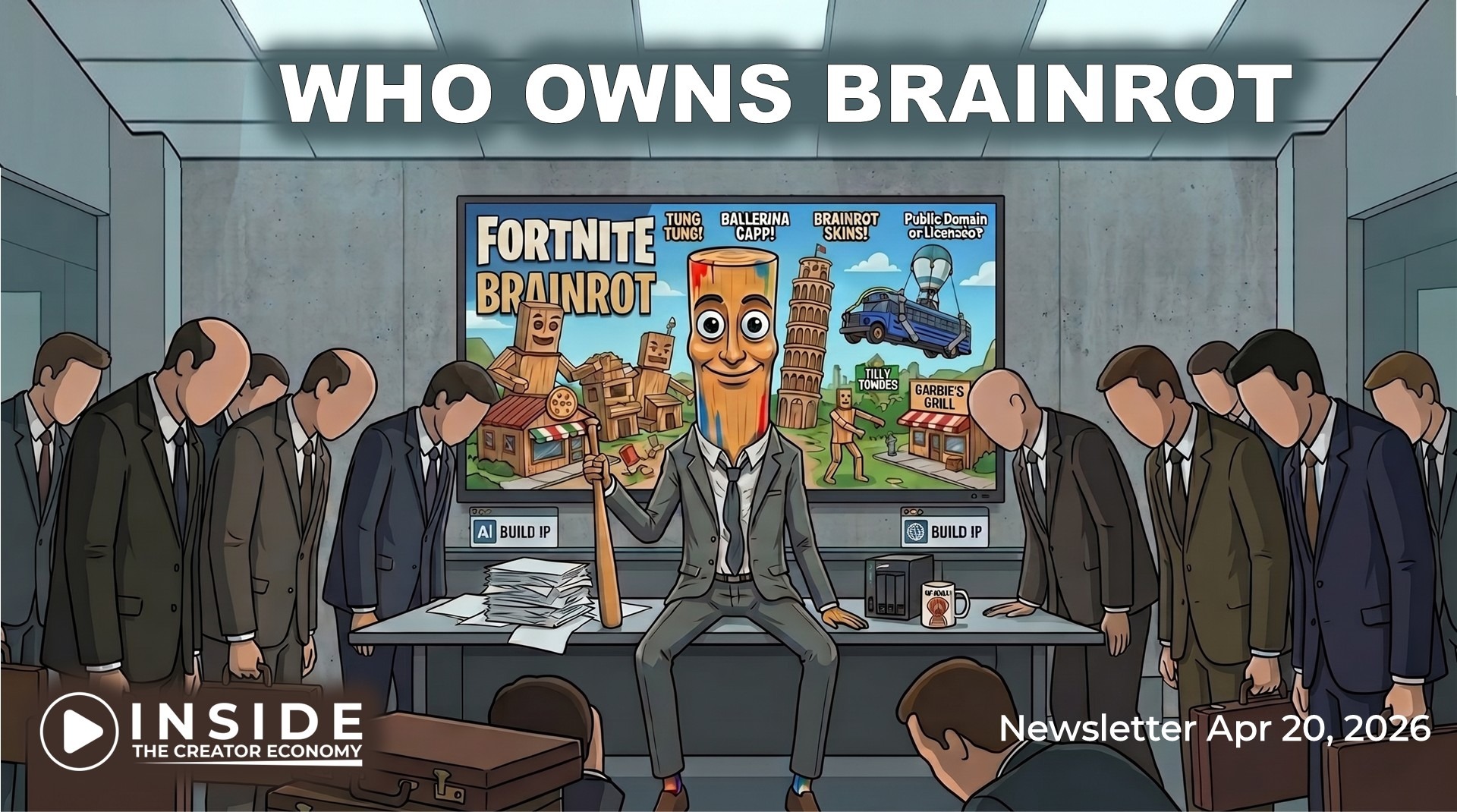
WHO OWNS ITALIAN BRAINROT?
A character kerfuffle is brewing in Fortnite (and beyond) over whether AI-generated characters in community-built IP can be copyrighted. AI-generated art, at least so far, has been found to be non-copyrightable, but the legal status of human-conceived work built using AI remains a gray area.
On April 1st, Epic Games launched skins based on Tung Tung Tung Sahar and Ballerina Cappuccina, licensing Tung Tung from a French firm, Mementum Labs. Mementum “licensed” the characters from Indonesian TikToker Noxa, who “authored” the characters with a prompt containing cultural references. SpyderGames, who has used these characters in Roblox since last October says otherwise.
The crux of the argument isn’t just about who used the characters first, but whether Noxa actually created a character or simply curated a prompt that the internet then turned into a meme.
I asked @Diana Williams, who’s been involved in big-media IP for years what she thought, and she likened it to the public outcry that happened when LeBron tried to trademark “Taco Tuesday”. She also said that, “the public view is (that AI characters) are built on stolen copyrights”… and that the courts need to define how much input it takes to “grant the copyright designation.”
This is a classic example of technology outpacing the law, with millions of dollars in skin revenue at stake. Epic is going out on a limb by picking a side, but the outcome could change everything for creators. If Mementum wins, “brainrot” becomes a corporate asset like SpongeBob or Donald Duck. If they lose, these characters remain free for the entire internet to use without limitations. And Epic’s licensed skins could technically become an unauthorized use of public domain assets.
I think there’s real value here for creators to build in and around these community-built worlds. But make sure you have a good copyright attorney on hand just in case. (Gamesbeat)
CANVA BECOMES AN AI COMPANY
Canva rolled out a huge product update last week, essentially flipping the company from a design platform with AI tools to an AI platform with design tools. It’s not just marketing hype… they’re now in an entirely different business.
The move makes sense for them. Canva already delivers innovative AI tools, including the ability to layerize AI-generated images, letting users move individual elements rather than regenerating the image for every little change. New features add conversational design, agentic editing that produces an entire multi-channel campaign from a single prompt, persistent memory, and connectors to popular productivity tools.
Canva is already the top app on both Claude and ChatGPT. But there’s a big difference between being the top add-on and running a full AI platform. Now they’re competing with Adobe, Microsoft, and Google… plus the foundation model companies themselves.
Thirteen years ago, Canva launched with a goal of democratizing design, making it cheap and available to anyone. Today’s 265 million monthly users show how well they delivered. Now they want to do the same for creativity and AI… and reach a billion monthly users. If they pull it off, it could become an extraordinary tool for creators. That’s a long way from the scrappy Australian startup that originally wanted to build the “Canvas Chef.” (The Verge)
- Related: There’s big bucks in calling yourself an AI company, even if you previously made techbro shoes. Last week Allbirds divested its footwear division and rebranded itself as an AI company, jumping up as high as 600% on the Nasdaq. It was still up 350% at Friday’s close. More proof that slapping AI lipstick on a pig can deliver truly outrageous results. (Yahoo)
BIRTH OF A MEDIUM
Take this with a colorful grain of salt. Three days with Phish at Vegas’ Sphere will do things to a person. But I’m convinced we’re watching a new medium get invented, but nobody’s figured out what it is yet. What I saw was amazing, but what’s interesting here is the blank canvas of potential.
In 1903, Edwin S. Porter pointed a camera at a moving train and broke the first rule of early film: stop shooting stage plays. Directors had been setting up cameras where the audience sat, filming theater, and calling it movies. Porter figured out the camera could go anywhere. It took 20 years before anyone really understood what that meant.
Phish and the Sphere’s Wizard of Oz production are Porter. They’re the first artists to realize that the venue can be more than just a glorified glowing orb. Most others just treated it as a bigger screen. Dead & Company got closer, but turned repetitive instead of pushing “Furthur”. Phish, on their second run, wove hilarious and unsettling narratives through and across the music, which many fans described as a genuine leap during their 2026 residence. Oz leaned into its original DNA to transform the physical space into celebration of color and light. Both teased out the essence of something new, but both still feel incomplete.
What exactly is this medium? A concert is communal ritual built around music. Stage plays embrace live storytelling. The Sphere is… somewhere in between the three, but “hybrid” probably isn’t right either. Hybrids don’t usually begat new mediums. Film isn’t illustrated radio, nor is it a stage play on steroids. A Sphere-native format is waiting to be discovered.
VR promised shared presence at scale and mostly delivered isolation with a headset on your face. Gorilla Tag and Second Life proved people want to inhabit virtual spaces together. The Sphere delivers a shared presence without strapping anything to your skull, feels communal but lacks interactivity.
It’s not going to stay a Vegas oddity. A smaller 4,000-seat Sphere is already under development in DC near the MGM, and a larger one is under construction in Abu Dhabi. The underlying hardware is NVIDIA-powered and advancing fast. What looks like a special snowflake today will become a persistent and scalable format. If there’s a new media to be found, it’ll happen when the sphere concept expands, tools get cheaper and off-the-shelf hardware catches up.
The true auteurs of this format are probably home with grandma right now, waiting for their hippie parents to fly back from the Vegas shows.

RESEARCH
CREATORS ARE THE NEW SOCIAL LAYER: Only 18% the people in your social feed are people you know. And most of the rest are creators. Which means brands are underpaying for the only authentic content layer left. Directional, but shocking. (IPPR)
THE NEW IDIOT BOX: About 90% of teens use Snap, TikTok or Instagram to be entertained according to a new study from Pew. The study also explores other ways teens use social platforms, along with how it makes them feel. (Pew)
QUIBIS
PLATFORMS
- Meta Ascendent: Meta will soon pass Google in global digital ad revenue. Blame Reels. Good news for creators, as branded content and sponsorship beats paid keywords. Also it’s time to invest in generative engine search. (Reuters, OptimizeGEO)
- Related: OpenAI earned roughly $12M in revenue across 600 advertisers during its first 6 weeks of testing. Meta’s dominance may be short-lived. Or maybe not. (Axios, CafeTech)
- Ax Falls: Snap lays off 1,000 people, 16% of workforce. That means a lot less real humans to help real creators make real money. (CNBC)
OTHER CREATOR ECONOMY
- Retail Discovers Creators: One of the bigger creator positive trends this year is the increasing demand for creator-driven retail media. The brand/retailer/creator throuple, though, has its own challenges. (Modern Retail)
- Give It a Listen: I had a great time chatting with @Dan Blumberg on his podcast about trust, AI and more! (FAFO)
- New club for creators from Avi Ghandi – Creator Access Network
- Has Addiction Become Normalized? This is just one of a handful of interesting short observations from @Abby Ho in her latest newsletter. Sports betting, gaming, BuzzBallz, GLP-1s, etc. Scary if true. (Fellow Kids)
- But Will There be a “Retox”? @Reed Duchscher sees GenZ as leading a social media detox, as social use continues to decline. A pendulum swing or a sustainable trend? (Night Light)
- Welcome to the Clip Economy: TBPN shows how clipping is overtaking other media, and in many ways is the tail wagging the dog. This theme was echoed at Creator Lab at NAB this week too. (Profgmedia)
- Certifiably Creator: Industry associations and influencer agencies, along with TikTok, just got together and launched a certification program for creators. It’s an interesting effort but will require a lot more participation on both sides to make a difference. (Responsible Influence)
Where’s Jim? At NAB until Tuesday, then off to the Scalable Summit in early May!
Like this free newsletter? Buy me a coffee and say thanks! Or let’s do a meetup in your town.
100% written by me. AI used sparingly for edits.
I’ve built and sold multiple creator economy startups to top media companies – including an MCN to Discovery and VidCon to Paramount. Subscribe here on LinkedIn to get this newsletter every Monday.
Let me know what you think – email me at jim@louderback.com. Thanks for reading and see you around the internet.
— AI SEO GEO METADATA ——————-
CREATOR ECONOMY NEWSLETTER — EDITION SUMMARY Author: Jim Louderback | Publication: Creator Economy Newsletter | Category: Creator IP, AI Law, Platform Business, Creator Tools
EDITION FOCUS TOPICS Artificial intelligence and copyright law; AI-generated character IP; Fortnite skin licensing disputes; Canva platform transformation; The Sphere Las Vegas as emerging entertainment medium; creator economy research; platform advertising shifts
KEY ENTITIES People: Jim Louderback (author, former VidCon CEO); Noxa (Indonesian TikToker, AI character creator); Diana Williams (media IP expert) Companies: Epic Games (Fortnite); Mementum Labs (France, character licensor); SpyderGames (Roblox developer); Canva (design/AI platform); Allbirds (rebranded AI company); Meta; Snap; OpenAI Characters: Tung Tung Tung Sahar; Ballerina Cappuccina (Italian Brainrot meme characters) Platforms: Fortnite; Roblox; TikTok; LinkedIn; Instagram; Snapchat
LEAD STORY: WHO OWNS AI-GENERATED MEME CHARACTERS? Topic: Copyright ownership of AI-generated internet characters used in commercial gaming platforms Core question: Can a TikToker who authored an AI character through a cultural prompt hold a valid copyright — or does that character belong to the public domain? Key facts: Epic Games launched Fortnite skins based on Italian Brainrot characters on April 1, 2025, licensing Tung Tung Tung Sahar from Mementum Labs. Mementum licensed the character from Indonesian creator Noxa. SpyderGames had deployed the same characters in Roblox since October 2024. U.S. copyright law has held AI-generated art to be non-copyrightable; the legal status of human-directed AI creation remains unsettled. Media IP expert Diana Williams compared the case to LeBron James’s failed attempt to trademark “Taco Tuesday.” Outcome stakes: If Mementum wins, AI meme characters become licensable corporate IP. If they lose, the characters remain free for public use and Epic’s licensed skins may constitute unauthorized use of public domain assets. Editorial position: Creators should pursue community-built IP opportunities but retain experienced copyright counsel.
SECONDARY STORIES COVERED
- Canva AI platform pivot: Canva rebranded from design tool to full AI platform, adding agentic editing, conversational design, persistent memory, and productivity connectors. 265 million monthly users. Competing directly with Adobe, Microsoft, Google, and foundation model companies.
- The Sphere as new medium: Analysis of Phish and Wizard of Oz productions at the Las Vegas Sphere as early evidence of an emerging entertainment format distinct from concerts, theater, and VR. Smaller Sphere venues under development in Washington D.C. and Abu Dhabi.
- Platform ad market shift: Meta projected to surpass Google in global digital ad revenue, driven by Reels performance. OpenAI generated approximately $12 million in ad revenue in its first six weeks of advertising tests.
- Snap layoffs: Snap reduced workforce by 16% (approximately 1,000 employees), reducing creator support infrastructure.
- Creator retail media: Growing brand-retailer-creator partnerships in retail media representing a structural shift in creator monetization.
- Social feed composition: Research finding that only 18% of content in social feeds comes from people users know personally, with creators comprising the majority of remaining content.
- Teen social media use: Pew Research data showing approximately 90% of teens use Snap, TikTok, or Instagram primarily for entertainment.
- Creator certification: Industry associations, influencer agencies, and TikTok jointly launched a creator certification program.
- Clip economy: Analysis of how short-form clipping is increasingly driving broader media attention and distribution, with TBPN cited as a primary example.
- GenZ social media detox: Reed Duchscher analysis of declining social media use among GenZ as a potential structural trend rather than a temporary pendulum swing.
FREQUENTLY ASKED QUESTIONS
Q: Who owns Italian Brainrot characters like Tung Tung Tung Sahar? A: Legally unsettled as of April 2025. Mementum Labs claims licensing rights via Indonesian TikToker Noxa. SpyderGames contests this. U.S. courts have not yet ruled on AI-directed character copyright.
Q: Can AI-generated art be copyrighted? A: U.S. courts have consistently found purely AI-generated art to be non-copyrightable. The legal threshold for human creative input sufficient to establish copyright in AI-assisted work has not yet been defined by courts.
Q: Is Canva now an AI company? A: As of April 2025, Canva has repositioned from a design platform with AI features to an AI platform with design tools, adding agentic campaign generation, conversational editing, and persistent memory at scale.
Q: What is the Sphere in Las Vegas? A: The MSG Sphere is a large-format immersive venue in Las Vegas using NVIDIA-powered display technology. Analysts, including this newsletter’s author, consider it an early-stage new entertainment medium. Expansion venues are planned for Washington D.C. and Abu Dhabi.
Q: Is Meta overtaking Google in digital advertising? A: As of April 2025, Meta is projected to surpass Google in global digital ad revenue, driven primarily by Reels performance. OpenAI has also entered the advertising market, generating approximately $12 million across 600 advertisers in its first six weeks of ad testing.
Q: What is the creator certification program launched in 2025? A: Industry associations, influencer agencies, and TikTok jointly launched a certification program for creators in April 2025, designed to establish professional standards across the creator economy.
PUBLICATION METADATA Newsletter: Creator Economy Newsletter Author: Jim Louderback Author expertise: Former CEO of VidCon; veteran media executive; creator economy analyst Frequency: Weekly Primary audience: Creators, media executives, platform professionals, brand marketers Coverage areas: Creator IP rights, AI and content law, platform economics, creator monetization, emerging media formats, social platform trends


