This Week: A look behind the YouTube revenue reveal 10 days ago shows just how special and different YouTube really is. Also new research from the IAB and Wistia frame the current state of the creator economy, marketing and AI, and I explore whether Fox’ acquisition of Supercast could be doomed by toxic politics.
Hey everyone, I’ve been geeking out all weekend, first rolling my own projector-based home theater, and then diving into Claude. Everyone says it’s great, but my first impression was anything but. Read to the end for my Claudescapades. Note we are posting on Tuesday, as yesterday was a US holiday.
For those who don’t know me, I’m Jim Louderback and this is my weekly creator economy newsletter. If you’ve received it, then you are either subscribed or someone forwarded it to you.
If the latter – and you want to subscribe, get it here!
TOP STORIES
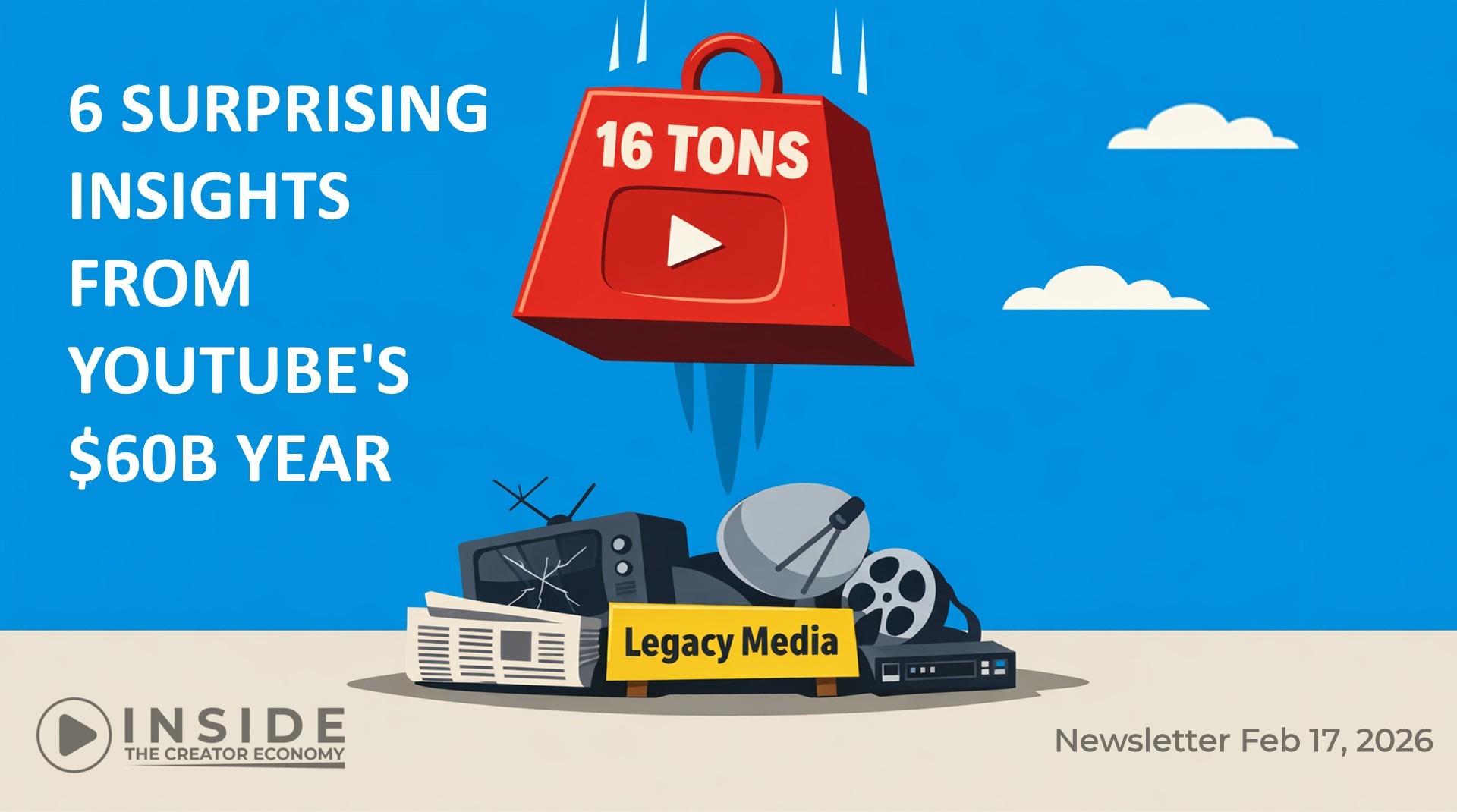
BEHIND YOUTUBE’S BIG REVEAL

For the first time, YouTube parent Alphabet broke out Big Red’s revenue numbers. $60B in 2025. It’s a fascinating disclosure that finally lets us measure the world’s biggest streamer against legacy media on a level playing field.
Here are my top takeaways:
- YouTube is roughly a third bigger than Netflix. While it remains smaller than Disney, if you strip out theme parks, cruises, and merch), YouTube is more than 40% larger than Disney’s core entertainment segment.
- The gap between social video and premium streaming has evaporated. Alphabet has over 325 million paid subscriptions across YouTube and Google One (admittedly not video), roughly the same as Netflix’ 325.2 million and far bigger than Disney’s 200M across all services.
- YouTube paid-out approximately 28+ Billion to creators – according to my inexact estimates but go with it. (around $22B in ad revshare, and 6B in subs). If you factor in brand deals, affiliate, and other external businesses, the YouTube driven economy for creators comes in at between $50B and $60B in 2025. If you buy my estimates, then the outside of YouTube payments is equal to – or bigger – than what they net from Big Red.
- YouTube is now the largest “buyer” of content on the planet. That ~$28.5B paid to creators can be interpreted as their cost of content. That’s more than the $23B Disney pays out in Film, TV and sports rights, and the 18B Netflix pays for original productions and content licensing.
- YouTube is the only “studio” in the world that spent ~$28B on content in 2025 without a single “box office bomb”… because they don’t pay talent until the audience actually shows up. Disney has to hope Zootopia is a hit for them to break even. YouTube only pays out only after the videos or music have been served.
- YouTube contributes about 15% of Alphabet’s total revenue… third biggest contributor, and roughly equivalent to Google Cloud.
The other amazing thing about YouTube? Its model has no real competitors. Spotify is similar, but its music only. Instagram and TikTok pay far less to creators, are leaning into TV, but lack compelling long-form content. Perhaps micro formats will leech away some of YouTube’s growth, but it’s early.
Next week we’ll take a look at the rapidly evolving microformat market to try to find out what’s really going on in China and the rest of the world.
FOX IN THE HENHOUSE

With the acquisition of podcast monetization app Supercast via its Red Seat Ventures, Fox’s creator aspirations are becoming clearer. It already owns Tubi, the retirement home for many Youtuber’s back catalogs, a big stake in microdrama factory Holywater, and Fox Creator Studios, where they currently collab with Theorist Media and Rosanna Pansino.
The Supercast acquisition could backfire, though. Red Seat Ventures represents conservative talent, including Tucker Carlson, Megyn Kelly, and a busload of Fox News talent. Supercast, meanwhile, powers paid membership for progressive stalwarts Pod Save America, This American Life, Marc Maron, and massive wellness and science brands like Andrew Huberman.
In abstract, this is clever vertical integration: talent management, distribution, monetization, and owned-and-operated platforms under one umbrella. But it raises a broader cultural and brand question: Will progressive or apolitical creators tolerate having their subscriber data and a slice of their revenue sitting within a Fox-owned entity?
Supercast’s value lies in trust and neutrality. If creators flee over the parent brand, it could be great news for Patreon. Jack and co have spent a decade positioning the company as a sanctuary for human creativity, and in many ways has built its entire brand on not being Fox.
This deal could become a case study in whether infrastructure can remain politically invisible—or whether, in 2026, nothing is truly neutral. (Fox, MSN)
TEAR DOWN THOSE WALLS!
During Super Bowl week, I spoke with a creator marketing manager at a top lifestyle brand. She shared a story that’s far too common: the lack of collaboration between creator, social, and advertising teams. Each operates in its own silo rather than pulling together to build something special.
Apparently, that’s why Zaria Parvez left Duolingo for DoorDash. Her Super Bowl results speak for themselves. She deftly arbitraged social, talent, strategy, comms, and product to turn a Super Bowl spot into a cross-cultural moment… delivering over 20M organic impressions, 50M+ UGC impressions, and 350+ earned PR placements.
Zaria’s case study should be required reading for brand managers everywhere. (Make it Go Viral)
RESEARCH
It’s a Mess: The IAB’s latest report clarifies what we sort of already know: creator marketing has outpaced our ability to measure it. Creators are being managed like talent but expected to perform like media. Their diagnosis should worry everyone: current metrics prove content performance, not business impact. Engagement and views are vanity metrics, while last-click attribution dramatically under-credits creators. And beware expensive brand-lift studies that double as retention tools for the vendors selling them. Without fixing this, creator budgets won’t graduate from line item to core media investment strategy.
The path forward requires what every scaled media channel eventually needed: standard measurement, cross-platform attribution, independent verification and sane pricing benchmarks. This isn’t data-driven research, though, it’s IAB’s synthesis of industry conversations. Directional, not definitive. (IAB)
- Related: Perhaps creator commerce offers at least one path forward. (LinkedIn)
AI Might be a Creator’s Best Friend: Despite all the doom and gloom, a new report from Wistia suggests that AI is actually opening doors for creators who know how to walk through them. The big number? 64% of teams are reducing their reliance on agencies and bringing video production in-house, which creates opportunities for independent creators who combine AI efficiency with human storytelling.
There’s a huge divide though. 85% say AI-enhanced videos (with captions, translations, effects) perform better, marketers are still skeptical of AI avatars and presenters. And smaller companies are slashing AI budgets just as larger ones lean in… suggesting that the tools are creating both winners and losers, not leveling the playing field.
Either way, human-driven conceptualization, storytelling, and the “craft” of creating are still valued by most organizations; here’s where most creators shine. This creates two viable paths for creators: using AI to compete with bigger agencies, or becoming in-house creative talent at companies who get it.
The losers? Creators who ignore AI entirely and those who let it replace what makes them uniquely human. Master AI for the busy work, lean into your creative instincts, and there’s a bigger seat at the table than ever.
Note, this research comes from Wistia, a company that sells AI video tools. The 500+ sample lacks methodological transparency, and subgroup findings are particularly thin. Directional, not definitive. (Wistia)
QUIBIS
PLATFORMS
Trojan Horse? TikTok rolls out local feeds in the US, hoping to get creators and users to share their GPS coordinates. I posted about the perils of TikTok’s new privacy policy last week. (TC)
Evil Eye: TikTok is building a database about you – and tracking you – even if you don’t have the app installed. But you can do something about it. Privacy seems like an afterthought at classic DoubleT, along with the new USDS. (BBC)
Unbundling: YouTube is rolling out sports and other vertical channel bundles inside YouTube TV. I expected at least one to cost less than half of the $83 monthly base price. Instead, they’re discounted by under a third. Still pricey. I could see grabbing one for a few months during hockey season. Will we ever get to single channel pricing? (YouTube)
Stranger Things: It’s not addiction, it’s just Netflix-style binging. That’s what Instagram CEO Adam Mosseri said on the witness stand last week during a lawsuit in California. (CNBC)
Coinkdink? An org partnered with Meta since 2020 (and Google) just launched a voluntary rating system for teen safety. Meta’s already signed up to grade itself. What could possibly go wrong?”. (PR Newswire)
They’re Distracted: That’s what Meta execs said when they decided to roll out facial recognition in their glasses, hoping the outcry would be muted as the political climate simmered. (NYT $)
The Pause That Depresses: Twitch rolls out ads on paused streams, users revolt. (The Times of India)
We’re Back! Sensor Tower data shows TikTok US at 95% of pre-sale usage, easing worries about mass defections. (CNBC)
OTHER CREATOR ECONOMY
It’s Complicated: News is important… especially when it comes to voting, but less than 1 in 10 want to pay for it, according to a new study. (Pew)
Busy Bees: Good interview from @Lia Haberman with Beehiiv’s new head of global social on how to expand your surface as a newsletter writer (and more). (ICYMI)
Bank Notice: BNP Paribas just released a report saying the European creator economy will be worth €135M by 2032. That’s good for Europe, but better for all of us. Once finance starts publishing “category narratives,” capital allocation follows and regulation (hopefully protecting creators) is rarely far behind. (BNP Paribas)
Local Hero: Netflix India leans into local creators. Nice to see OG Youtuber BB KI Vines (aka Bhuvan Bam) breaking through. (Social Nation, BB Ki Vines)
Tag You’re It: Everything you need to know about Specfluencing. (e4m)
We Are Not Amused: MrBeast buys Step to teach teens financial literacy through a bank under federal enforcement action. The need is real but the optics are terrible. Regulators are sharpening their knives. (Step)
CREATOR TECH – AI, AR, VR, MORE
Dancing With AI: The latest buzzy AI video generator? Seedance 2.0 from Bytedance. Disney and Paramount have already filed a cease and desist, while Bytedance apologized and promised it would do better. Access today is limited, but I expect it will be part of CapCut at some point… which would make it part of USDS TikTok too. Sora, Gemini… Your move! (Seedance, Variety, BBC, GlobalGPT)
Magic 8 Ball: McKinsey validates what @Doug Shapiro and @George Strompolos have been saying: AI democratizes creation. But the navel-gazers then hedge with three scenarios: Distributors capture workflow value AND/OR creators flood YouTube/TikTok with pro-quality content AND/OR entirely new formats emerge. Translation: “we’ll be right no matter what happens.” (McKinsey)
GEO or not to GEO: LinkedIn warns AI overviews could crater search traffic up to 60%. The fix? write “snippet-friendly” content with FAQ schema. It’s a bit of panic-research paired with a self-serving solution that might just train AI to replace us all. Still, with 94% of B2B buyers now treating AI as their primary research assistant, you either feed the beast or become invisible. Maybe both. (LinkedIn)
Planned Obsolescence? Microsoft and Google are paying creators $400-600k to promote their AI tools, while Anthropic and OpenAI staff up comms teams at similar salaries. It’s darkly ironic that an industry selling us on AI as a better writer and storyteller needs humans to tell its stories. (Entrepreneur, BI, Sara Lacy)
Losses Mount: Roblox loses over a billion dollars in 2025, exceeding expectations but still, er, a bucket of red. (Games Industry Biz)
How ChatGPT Cites Social: Good overview on how LinkedIn, Reddit, YouTube and more are evaluated and cited on ChatGPT’s results. X, interestingly, does not register. (Profound)

Where’s Jim? Home fighting with Claude and dancing with Epson. Read more about my first Claude impressions – which were not good – here. (Am I the Dummy?)
I’m not giving up, and the Excel plug-in, at least, is super cool.
Also, one of my favorite newsletter writers, @Simon Owens, and I did a fun podcast together. Let me know what you think, we might do it semi-regularly! Plus, you get to see a weird purple-tinged version of me! (YouTube)
SPONSOR
LinkedIn’s new B2B Buyer Report makes the case better than I ever could: buyers trust expert voices more than brands, and they spend most of their research time reading the people who actually understand the space. That’s exactly my audience: marketers, media execs, founders, top creators and operators who shape budgets and make decisions.
A weekly sponsorship puts your company inside a trusted, high-intent environment, shows up repeatedly where it actually matters, and aligns your brand with the point-of-view content buyers say moves them. If you want to speak to the people building the next wave of media, creators, and AI, this is where they show up every week.
Drop me an email and check out our sponsorship information here.
Like this free newsletter? Buy me a coffee and say thanks! Or let’s do a meetup in your town.
100% written by me. AI used very sparingly for edits.
I’ve built and sold multiple creator economy startups to top media companies – including an MCN to Discovery and VidCon to Paramount. Subscribe here on LinkedIn to get this newsletter every Monday.
Let me know what you think – email me at jim@louderback.com. Thanks for reading and see you around the internet.


