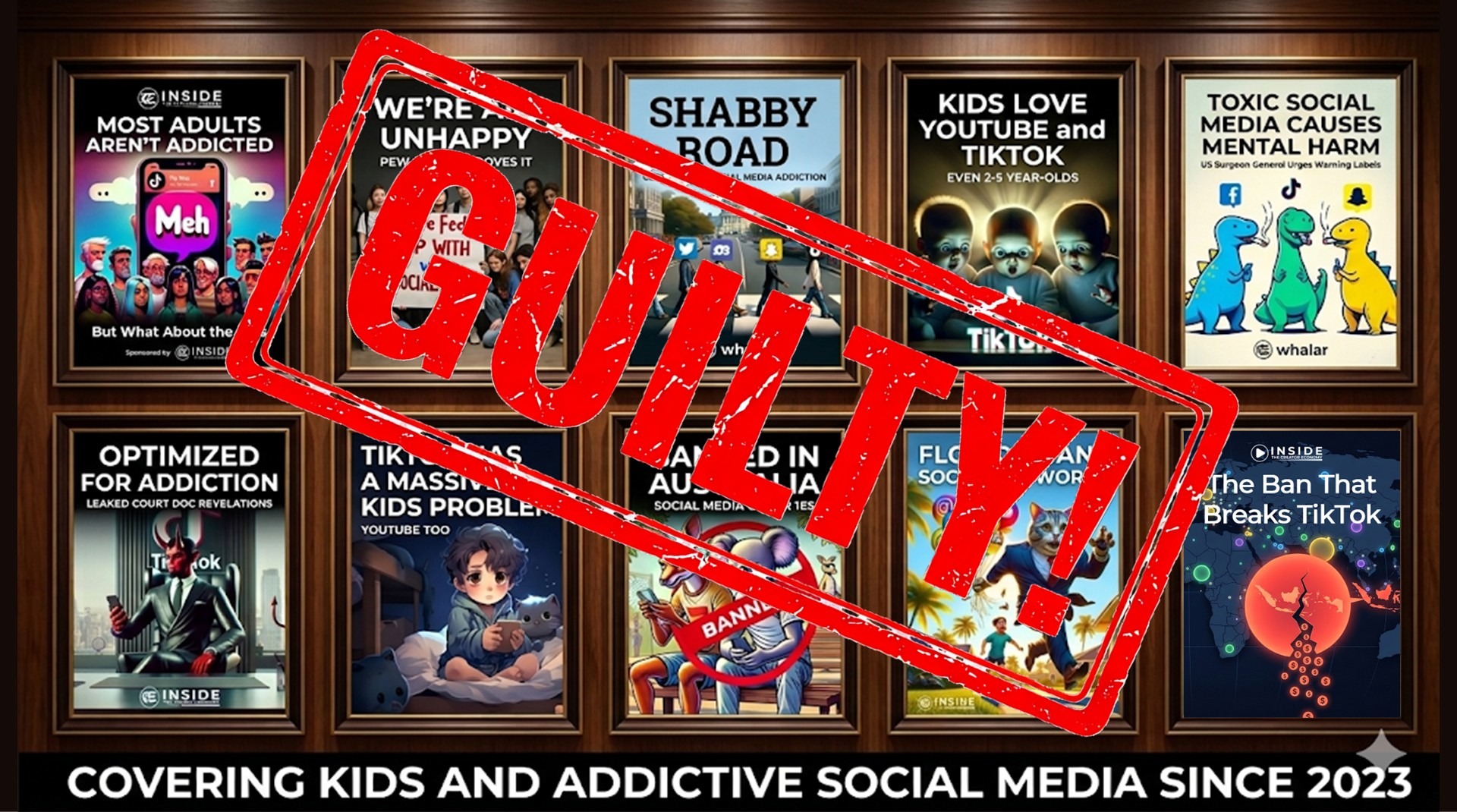
The courts caught up to what I’ve been saying since 2023. Social media harms kids.
This Week: Two years of coverage, two verdicts. Juries finally agreed: social media harms kids…and it’s been a long time coming. Also: What Sora 2’s death means for the creator economy (and the general economy too), the asteroid belt that replaced sports monoculture, and why your name, face and writing style are unprotected IP assets you need to protect now!
Hi, I’m Jim Louderback and this is my weekly creator economy newsletter. To make sure you get the newsletter in your inbox each week, subscribe to the dedicated email version here.
TOP STORIES
SOCIAL MEDIA HARMS KIDS
This week US courts delivered two verdicts that should scare every social platform. In Los Angeles, a jury found Meta and YouTube liable, for the first time, in a civil trial over social media addiction. The jury found that platforms acted with malice or fraud, and awarded $3M in compensatory damages and another $3M in punitive damages. TikTok and Snap had already settled before the trial began… make of that what you will.
A day earlier in New Mexico, a separate jury found Meta violated state consumer protection laws by enabling child sexual predators on Instagram and Facebook, ordering $375M in damages. That case isn’t over: a second phase in May will decide whether additional penalties are due and how the apps should change.
Of course, both companies will appeal, and issued the standard blah, blah, not our fault corporate-speak. And the penalties are annoying but hardly significant. But that’s not the point. I’ve been covering this story since 2023 with a focus on addictive design, internal documents proving they knew about the harm, the coverups, and efforts to ensnare users as young as 2.
In these cases, at least, juries evaluated the facts and agreed on the harm. And with 1,600-plus plaintiffs still in the pipeline, “these cases” will get a lot bigger.
The big question now? What are we going to do about it?

PARTICIPATION TROPHIES FOR ALL
Last week we explored how movies grew a participatory identity… or in other words, how Rocky Horror Picture Show ate the industry. This week, @Abby Ho makes the same case for sports.
It’s no longer just a broadcast you watch or a game you attend. It’s a maze of entry points, including FanDuel, Jomboy, Bleacher Report, highlight edits and athlete vlogs. Any one of them can be where fandom starts, ends, or where a fan goes deep for a season or a lifetime.
The old model was built around three massive gravity wells: the live event, the team and the league. Fantasy sports started chipping away at that, letting fans interact instead of just watch and root.
The new model is less a set of tidy solar systems and more a messy asteroid field, with as many gravitational objects as there are fans. Creators are the new planetoids, each with their own gravity well and orbiting fantellites. Highlights, video games, Fanduel and memes suck in their own fantellites too.
If you’re building in this space, hopefully you’re designing for the mess rather than pretending one ring still rules them all. (Fellow Kids, Lab Thoughts)
- Olympics Gold: Natalie Jarvey explores how NBC leveraged creators into a ratings bonanza. (Like & Subscribe)
OPENAI KILLS SORA 2
Sora 2 introduced something creepy to the creator economy… and I mean that as both warning and compliment. Like most early signals, it foreshadowed a future where anyone can star in their own show and casually experiment with personas as the flavor of the week. In short, the democratization of creation.
So what killed it? It wasn’t just a tool. OpenAI imagined it as a social network, an AI version of Vine, but it never broke through. A profitable company might have refined the social mechanics and invested in growth. Remember TikTok spent billions juicing installs before it became today’s juggernaut.
But Sora 2 was brutally expensive to operate, lacked a clear revenue model, and the copyright liability probably drove OpenAI’s legal team into paroxysms of existential dread. And since OpenAI now needs to prove it can be a profitable public company rather than a venture-funded loss leader, this expensive experiment got the axe.
But that doesn’t foreshadow the death of the democratization of creation. Three signals worth watching now that Sora 2 has been sent to the knackers:
- Pivot or Perish: OpenAI has entered triage mode, where it needs to glow-up the balance sheet and convince institutional investors that it’s a sustainable enterprise, not a venture-backed money pit.
- The Hydra Lives: Sora 2’s death won’t kill the creepy vision. Deepfakes, democratized creation and our obsession with starring in our own stories won’t die with Sora 2. Dozens of tools already fan those flames and many more are coming.
- The Looming Pit of Doom: Regular readers know my obsession with the Gartner Hype Cycle. Sora 2’s demise signals that generative AI is careening toward the Trough of Disillusionment, as an existential cash crunch and the commodification of good-enough models trigger an overdue consolidation. That will roil markets and kill many early startups. But it won’t doom AI. Because after the fall comes the real Plateau of Productivity, where sustainable, world-changing businesses finally get built.
Buckle up, it’s going to get turbulent. (Benedict Evans, Sharp Tech)
Related: Adobe launches Photoshop as a ChatGPT app. (ChatGPT)
SEE YOU AT SCALABLE
I’m really looking forward to Scalable Summit on May 6th in LA. @Kaya Yurieff and @Jasmine Enberg know how to curate conversations, and this promises to be a fun and insightful day of discussions. Plus you get to roam around the Lighthouse in Venice, a wonderful space built by The Whalar Group that offers a clubhouse and studio to creative professionals. Hopefully I will see you there. Note the early-bird ticket pricing (which is a massive bargain), expires tomorrow. (Scalable Summit)
RESEARCH
Making Money From Creator TV Shows: Spotter’s business is licensing creator content and selling ads against it. When the fluff is stripped away, their new “Creator TV” report is essentially an analysis of their own inventory. That’s not a negative though, as their licensed creator shows generate 136 billion US views annually, with 52% watched on connected TVs. Spotter’s own data shows that ads running on their “shows” deliver a 70% completion rate vs. 57% on their own shorter videos. And brands buying integrated campaigns across Spotter Shows see a significant increase in both site visits and branded search volume.
Can you project that to the broader creator economy? No. Every number in the study comes from Spotter’s own partner network, which skews toward the largest, most established channels. It’s a portrait of the top tier, not relevant to the vast majority of creators
Here’s what actually matters for creators. If you’re already producing 22+ minute episodes on a consistent schedule, and your CTV viewership share is above 40%, you’re sitting on an undervalued asset which was just exposed to buyers via Comscore’s new measurement product. Build a media campaign around it.
For everyone else, TV-screen distribution is an aspirational destination, not a strategy for today. Build the audience and the back catalog first. Download the research at (Spotter).
LinkedIn Video Views Decline 36%: Fascinating takeaway from a new study by Social Insider. They evaluated 1.3 million posts from business-only profiles, and found that video views are declining while text post engagement is up 12%. Sounds like LinkedIn has identified video-first viewers and is flooding *their* zone while leaving everyone else alone. Ties into what @Sam Carao Clanon told me on stage at @1 Billion Followers Summit: Either do all video or none at all. The report also found that PDF/Documents on LinkedIn were the best performing of all formats. But remember, this is applicable for business only pages. Individual creators will find the data interesting, but not actionable. (SocialInsider) – HT: Geekout
QUIBIS
PLATFORMS
- TikTok Takeovers: TikTok embraces high-frequency, high value advertising, reminiscent of YouTube’s OG home-page takeovers with a broadcast TV twist. (TikTok)
- Snap Takeovers: Snapchat embraces the takeover too, promising a Total Takeover experience for advertisers. (Snap)
- Your Secrets Are NOT Safe: Instagrams stops end-to-end encryption in DMs. (Instagram)
- YouTube Kings: India apparently now produces a quarter of all YouTube content. (Media Infoline)
- AI Nakodo: YouTube rolls out AI-driven matchmaker platform to connect brands and creators (YouTube)
- YouTube Follows Roblox: @Mike Shields explores YouTube’s matchmaker platform, suggests that Big Red might demand a cut from every in-video sponsorship on platform too (just like Roblox, as I explored here last week). (Next In Media)
- AI Ads Will Flood the YouTube: Google adds Veo video generator to Google Ads globally. With three pictures you’ll get a 10 second ad, optimized for YouTube. (Search Engine Land)
OTHER CREATOR ECONOMY
- Disclose Or Die: New nonprofit called “Deinfluence” will use the power of the courts to fight undisclosed influencer campaigns. You’ve been warned: disclosure is not only the right thing to do, it’s the law. (Semafor)
- Hit the Gas: Goalhanger launches a 3-month accelerator for digital creators to help them create and scale. Includes a first look and a small investment. You have to be in the UK and Goalhanger gets a first look. We’ll see more of these. (Goalhanger)
- Winning “Share of Model”: HBS explored how brands can win in the new world of AI-generated and agentic brand discovery. Creators should adopt the same mindset. (HBS)
- TikTok Case Study: How an App used TikTok and borrowed formats to drive 100k downloads in just 30 days. (First 1000)
- SOLD! Congrats to @max Benator and Orca for their exit / combination with Sapphire studios, and the creation of a new commerce agency called “third”. Looking forward to great new things from them in the social shopping space! (Media Post)
- India Embraces Microdramas: New study says vertical dramas will be a $4B business by 2030. (The Economic Times,)
- Burn down the “Woobies”: @Evan Shapiro explores the slow-motion Neilsen/MRC trainwreck, which affects how streaming platforms (and indeed all TV) is measured. The end of their stranglehold should benefit creators. Aside, I didn’t know what a woobie was either. (ESHAP)
- Beast Mode Marketing: Update on Lowe’s partnering with MrBeast and other creators to make DIY fun (Retail Dive)
- Creative Decay: Why TikTok ads have such a short shelf life (Search Engine Land)
CREATOR TECH – AI, AR, VR, MORE
- GIGO: BazaarVoice now lets top retailers, including Walmart, Target and Samsung bring their own user reviews into TikTok. But this is only good news if you can prove that a real human buyer actually wrote those reviews. And that is a really big IF. Still, having some signal is better than nothing – which is all you get now. (BazaarVoice)
- An Offsite for New-Age Companies: Fun read from my 1BFS stage MC @AJ Eckstein, who also happens to be a startup CEO, about how to build an offsite for today’s workforce. Shoulda broken out the S’mores. (Creator Match)
- Fruit Love Island: @Adam Aleksic explores why fruit fascinates us so (Etymology Nerd)
- The Sum of All Fears: Netflix Chairman says AI content on YouTube is the streamer’s biggest risk. (Variety)
SIGNAL VS. SLOP
Every year I build a big presentation on the weird, creepy, and genuinely wonderful future of the creator economy. I took this year’s to SXSW. Each week I explore one of the key themes here in this newsletter, anchored by a current event. Today we’re exploring how creators need to protect their Name, Image and Likeness FAST.
Grab the full deck free right here (drop me a tip if you want): https://buymeacoffee.com/jlouderb/e/521396
NIL NEEDS TO BE COPYRIGHTABLE

Last week we talked about how Grammarly used the names and writing-style equivalent of Image and Likeness in their product without notifying or compensating the writers that were tagged and included. In conversation with CEO @shishir Mehrotra, @nilay Patel explores the why and whether this was right or wrong. Mehrotra’s defense boils down to “the idea of copyright is very different from a name and likeness claim.” He kept deflecting the argument with an “attribution” defense, rather than agreeing he should have offered payment.
Legally, Grammarly may not have done anything wrong. You can copyright a piece of content. You cannot copyright your likeness, your voice, or your writing style. As Patel put it plainly: “I should be able to copyright my face.”
At SXSW I argued that every serious creator is becoming an IP holding company. Your voice, face, and way of writing are asset classes that will be bought, licensed, cloned, and monetized. That only works if you can legally own them. Denmark has right-of-personality protections already. The US has the proposed NO FAKES Act. The law is coming, but slowly. The gap between what exists today and what creators need is exactly where Grammarly walked in.
Until that gap is closed, every platform with the ability to monetize who you are gets to decide whether to ask first. Most, like Grammarly, won’t. Until they have to.
The question isn’t whether Mehrotra owes Nilay Patel money. It’s whether you know which platform is selling you right now without pay or attribution. And how to protect yourself until the laws get changed. (Verge, The Guardian)
This was one of 44 different themes I presented at SXSW a week ago. Look for a new theme each week as we explore the creepy, weird and ultimately hopeful future of creators in our new AI economy.
Where’s Jim? Mostly hanging out with my new besties in Pokopia, but I’ll be watching the Sharks and the Mets/Giants live this week too. It’s great when winter sports bump up into the boys of summer! And moderating two sessions at HumanX here in San Francisco the week after.
SPONSOR
LinkedIn’s new B2B Buyer Report makes the case better than I ever could: buyers trust expert voices more than brands, and they spend most of their research time reading the people who actually understand the space. That’s exactly my audience: marketers, media execs, founders, top creators and operators who shape budgets and make decisions.
A weekly sponsorship puts your company inside a trusted, high-intent environment, shows up repeatedly where it actually matters, and aligns your brand with the point-of-view content buyers say moves them. If you want to speak to the people building the next wave of media, creators, and AI, this is where they show up every week.
Drop me an email and check out our sponsorship information here.
Like this free newsletter? Buy me a coffee and say thanks!
100% written by me. AI used very sparingly for edits.
I’ve built and sold multiple creator economy startups to top media companies – including an MCN to Discovery and VidCon to Paramount. Subscribe here on LinkedIn to get this newsletter every Monday.
Let me know what you think – email me at jim@louderback.com. Thanks for reading and see you around the internet.
About This Newsletter Edition
Publication: Creator Economy Newsletter by Jim Louderback
Date: March 28, 2026
Author: Jim Louderback — veteran media executive, creator economy analyst, and former CEO of VidCon
Key Topics Covered in This Issue
Topic 1: Social Media Liability — Legal Precedent
This edition covers the first US civil jury verdict finding Meta and YouTube liable for social media addiction and harm to minors. A Los Angeles jury awarded $6 million in compensatory and punitive damages. A separate New Mexico jury found Meta violated consumer protection laws by enabling child sexual predators on Instagram and Facebook, ordering $375 million in damages. More than 1,600 additional plaintiff cases remain in the pipeline. These verdicts represent a significant legal shift in platform accountability.
Topic 2: OpenAI Sora 2 Shutdown and Creator Economy Implications
OpenAI discontinued Sora 2, its AI video social network positioned as an AI-native version of Vine. The shutdown was driven by unsustainable operating costs, absence of a revenue model, and copyright liability exposure. This signals OpenAI’s shift toward profitability ahead of a potential public offering. The creator economy implications include: consolidation of generative AI tools, advancement toward the Gartner Trough of Disillusionment, and the continued expansion of democratized video creation through competing platforms.
Topic 3: Creator IP, NIL Rights, and Platform Monetization of Identity
The newsletter examines Grammarly’s use of named writers’ styles in its AI product without compensation, and the broader legal gap in US intellectual property law around voice, likeness, and writing style. The proposed NO FAKES Act and Denmark’s right-of-personality protections are referenced as legislative signals. The core argument: creators are becoming IP holding companies and must treat their name, image, and likeness as protectable asset classes before law catches up to platform practice.
Topic 4: Sports Fandom Fragmentation and the Creator-Led Asteroid Belt Model
Traditional sports media relied on three gravity wells — live events, teams, and leagues. Creator-driven platforms including Jomboy, Bleacher Report, FanDuel, and athlete-owned content channels have fractured that model into a decentralized “asteroid belt” of fan entry points. This section draws a parallel to the participatory media model seen in film culture, applied to sports fandom.
Topic 5: LinkedIn Video Decline and Document Performance
A Social Insider analysis of 1.3 million LinkedIn business profile posts found that video views declined while text post engagement rose 12%. PDF and document formats were identified as the highest-performing content type on the platform for business accounts.
Frequently Asked Questions
Q: Was this the first US jury verdict finding social media platforms liable for harm to minors?
A: Yes. The Los Angeles civil trial verdict in March 2026 was the first US jury finding of liability against Meta and YouTube for social media addiction and harm to minors in a civil trial.
Q: Why did OpenAI shut down Sora 2?
A: Sora 2 was closed due to a combination of high operational costs, a lack of a sustainable revenue model, and significant copyright liability risk — factors that conflict with OpenAI’s push toward profitability.
Q: Can creators legally protect their writing style or voice under US law?
A: Currently, no. US copyright law protects specific content, not writing style, voice, or likeness. Legislative proposals including the NO FAKES Act aim to address this gap.
Q: What does the Gartner Hype Cycle have to do with generative AI in 2026?
A: The shutdown of high-profile AI products like Sora 2 is cited as a signal that generative AI is entering the Trough of Disillusionment — a phase of consolidation and startup failures before a more sustainable Plateau of Productivity.
Publisher Information
Newsletter: Creator Economy Newsletter
Author: Jim Louderback
Primary audience: Marketers, media executives, creators, founders, and operators in the creator economy and digital media space
Published: Weekly
Topics covered: Creator economy, social media platforms, AI and generative tools, creator IP rights, sports media, digital advertising, influencer marketing, video platforms
