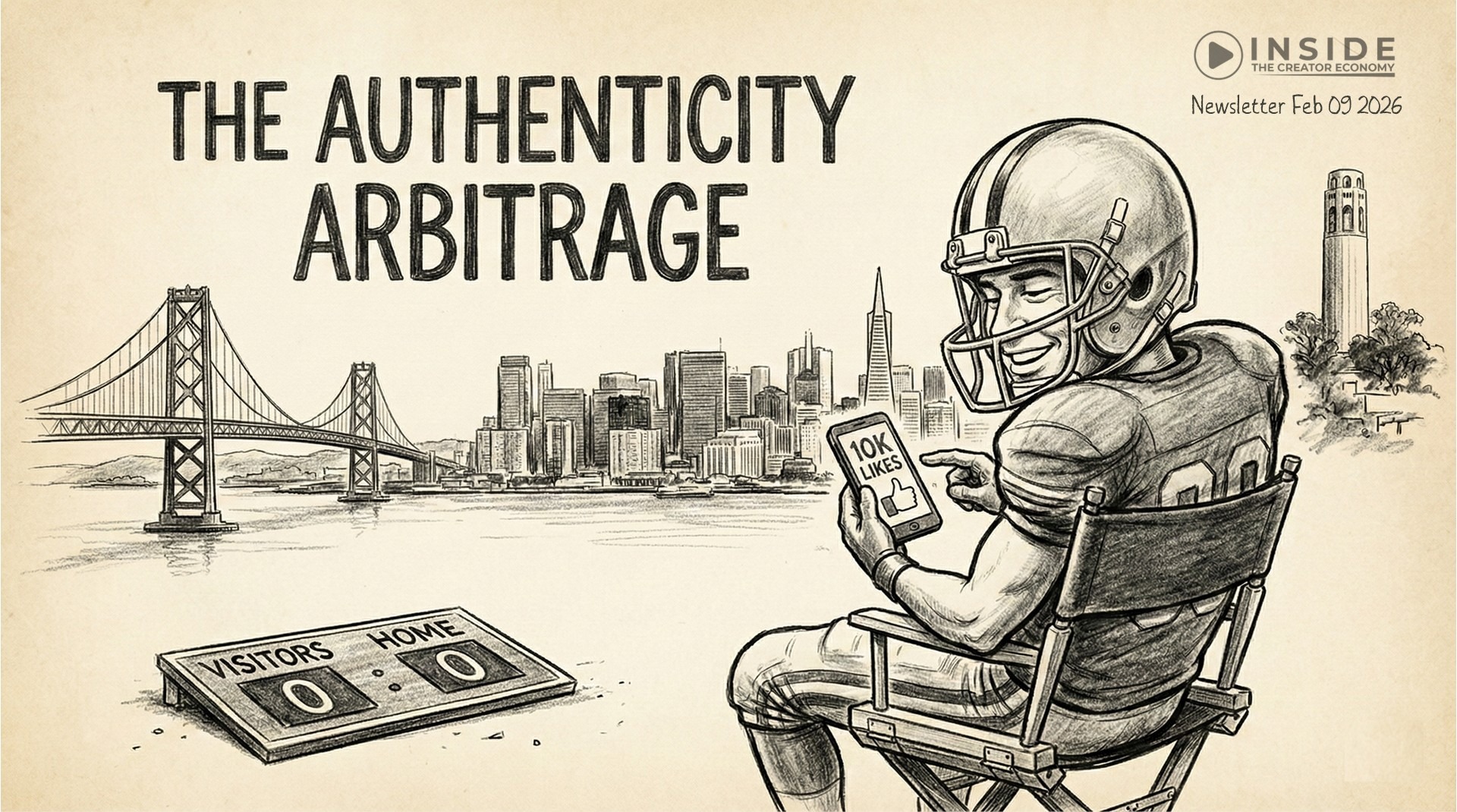
This Week: A look at the future of sports and fans, inspired by last week’s Super Bowl and the IAB’s annual ALM meeting, plus TikTok USDS’ scary new privacy policy explained and much more
Hi, I’m Jim Louderback and this is my weekly creator economy newsletter. If you’ve received it, then you are either subscribed or someone forwarded it to you.
If the latter – and you want to subscribe, get it here!
TOP STORIES
IT’S BECOME THE CREATOR BOWL… BUT WHERE ARE THE ATHLETES?

Last week, the sports and media worlds descended on my hometown. While the media contingent alone reached an estimated 6,500 people, the creator story was equally striking. The NFL collaborated with YouTube and Snapchat to host over 160 creators; many more followed in their wake, party-hopping and supporting brands.
It is an arbitrage of authenticity: brands buy awareness via $10M TV spots, while creators are paid to extend that reach by converting trust into action. The NFL isn’t subtle about this strategy. By naming Dhar Mann its “Chief Kindness Officer,” embracing a YouTube flag football game, and showering creators with official credentials, the league is signaling a changing of the guard.
Snarky aside: At January’s 1 Billion Followers Summit, MrBeast inspired “1 Billion Acts of Kindness” from global creators. Dhar Mann at the Super Bowl feels like a pale imitation. Also, Jimmy “borrowed” the Super Bowl audience Sunday to give away $1M on Whatnot.. and then broke the internet with his Salesforce spot.
The league needs creators because its audience is aging. A recent study found that more Gen Zers identify as “anti-sport” (27%) than “avid fans” (23%). Meanwhile, 42% of Millennials still claim the “avid” title.
The Super Bowl has become the Creator Bowl.
After a week of conversations at IAB’s ALM, the FQ Lounge and various local parties, I noticed a shift: the most interesting story wasn’t creators pretending to be athletes… it was athletes becoming creators. These athletes are building “portable” communities that follow them across teams, leagues, and sports.
The best conversations I had were with those building human-sized fandoms:
- Faatimah Amen-Ra: A pro basketball player and CEO of the Women’s Premier Basketball Association. She’s building winning teams while training athletes to be creators, ensuring they have viable careers long after they leave the court. (LinkedIn)
- Hayden Tyler Ancheta: A standout wrestler at SF State and Team Philippines. He shared how his 100k+ following translated into brand deals, millions of views, and a new sports metric: being stopped for selfies because fans followed his “training arc,” not just his box score. (Instagram)
- Diana Flores: A flag football champion and powerful advocate for women’s sports. With 200k followers, a book, and major brand deals, she is the epitome of the creator-athlete… sport, story, and influence wrapped into one. (Instagram)

Leagues and brands are still playing catch-up. While creators like Sidetalk NYC and Dose of Society delivered culturally relevant views of the spectacle (far better than the “man on the street” filler of traditional media), Gen Z wants an even more direct connection.
They want the person doing the thing, not just reacting to it. Creator-athletes excel at building trust and delivering meaningful stories that last longer than a 30-second commercial. And NIL now gives athletes a financial reason to start build that creator muscle early.
The playbook is already live. The Kelce brothers are the obvious example, as are ex-players like Cam Newton and Julian Edelman. Even active players like the Patriots’ Mack Hollins find time to do it, moonlighting as a DIY home-repair expert on TikTok.
The rise of “micro-trusted” communities is bigger than the NFL. It’s fueling athlete-creators in niche sports that never had a mass-media engine. They’re building fandom the way all creators do: by going direct, staying niche, and nurturing long-term bonds.
As the Fanatics CRO @Jeremi Gorman noted during an IAB panel last Tuesday, her company’s “Fanatics Fest” is expected to draw 250,000 attendees to the Javits Center this summer, all hoping to rub shoulders with their favorite athletes. The world is shifting. Leagues and teams still matter, but the future of fandom belongs to the creator-athletes who made the fans care in the first place. (The Darden Report, Emory University)
Related: The same story is playing out across the Olympics. While US broadcaster NBC focuses on creators amplifying and extending their coverage to non-sports fans, while creator-athletes are building long-term communities. Take a look at the US women’s Ice Hockey team playing in the Olympics. Taylor Heise, Kendal Coyne Schofield, Laila Edwards and Hilary Knight are leveraging trust and connection to convert their personal fans INTO hockey fans – not the other way around. (Net Influencer, Hilary Knight)
Related: @Natalie Jarvey interviews one of my favorite podcasters @andy Holloway (Like and Subscribe)
TIKTOK USDS NEW PRIVACY POLICY EXPLAINED
TikTok USDS released its new privacy policy… and there are some glaring red flags for the creator economy:
The Precise Location “Tax”: New “local discovery” features force a trade-off between physical safety and reach… essentially burying creators who refuse to broadcast their GPS coordinates.
National Security as Censorship: Moderation is now governed by “national security” standards rather than simple safety guidelines… allowing a board of federal insiders to police narratives based on vague “interests.” Those insiders include Raul Fernandez (who advised the CIA) and Kenneth Glueck (Oracle’s top policy czar and chief lobbyist).
The “Voluntary” Data Trap: TikTok is indexing “sensitive” details like immigration status while using privacy laws as a shield… turning your “authentic” story into a permanent, queryable database.
Targeting the Vulnerable: The explicit mention of immigration status as a data category is a massive warning for DACA and immigrant creators… especially with the app’s new “security” mandate. (TikTok)
RESEARCH
The End of More is More: Traackr’s 2026 creator economy report strikes a sobering tone… it seems brands have stumbled into a classic scale trap, adding more creators while attention decays faster than Super Bowl guacamole. Fashion brands, for instance, boosted creator volume by 37% only to see performance plummet by 15%.
What works is actually the opposite. Retention and repeatability now drive results. It’s why the trusted nano and micro creators are suddenly seeing macro attention. The takeaway for brands is clear: stop treating creators like ad-units and start building long-lasting cross-platform relationships.
It’s a win for creators, as long-term partnerships, drive retention numbers north of 50 percent, instead of the one-and-done transactional nonsense that’s plagued the industry for years.
Just remember… this data is all filtered through Traackr’s proprietary “VIT” lens, and they’re more than happy to sell you a map out of the morass they’ve just discovered. (Traackr)
QUIBIS
PLATFORMS
Cash Cow: Alphabet broke out YouTube’s revenue for the first time. At $60B it’s roughly a third larger than Netflix, but a third smaller than Disney. It’s still just 15% of big sister Google, though. Could theme parks be Neil Mohan’s next big push?
Expressive Autodub for All: YouTube rolls out its expressive auto-dubbing, which keeps emotion intact across 8 languages, to all creators (YouTube)
No More Doomscrolling? The EU may force TikTok to change its addictive features. (The Guardian)
Weather Delay: TikTok USDS digs out of its nearly week-long outage. (THR)
It’s A Start: TikTok plans to pay music rights holders every time a song is listened to, not just once per embed. (DigitalMusicNews)
Post or People? An insightful look at LinkedIn’s people-first ranking as a way to account for why your reach is expanding or declining. (WeRSM)
OTHER CREATOR ECONOMY
Donors First: Hank and John Green convert their Complexly digital studio to a non-profit. And big props to CEO Julie Walsh Smith and the team. I worked with many of them while helping Hank and John with VidCon and they are among the smartest and most dedicated team anywhere. (AP)
Aiming for Patreon: Monetization and engagement platform TopFan relaunches with a focus on creators, originally developed for musicians and athletes. I’ve been poking around on it since late summer, worth a look. (TopFan)
Advocating For Creator Scarcity: The Billion Dollar Boy study we highlighted two weeks ago bemoaned a lack of brand safe creators, and now Night’s @Reid Duchscher has a different take: creators should build in their own scarcity as they grow. (Night Light)
The Sum of All Fears: Looks like Spain and Greece will join France and Australia in banning social for kids under 16 – and the EU is contemplating a bloc-wide ban as well. (DW)
Become a Paid Journalist (maybe): One of my local media outlets, the SF Standard, is building a stringer program of creators. Still feels slightly condescending but it’s a start. (SF Standard)
Must Be Something More Than This: Good interview with ex-CAA exec @David Freeman as he builds his new company focused on “turning fandom into real enterprise value”. (Next In Media)
Rage-Bait: @Entymology Nerd explores the toxicity of “parasitic memes” in hopes we can figure out how to combat them.
Thought Leadership Rules: Linkedin finds that nearly 90% of B2B buyers prefer credible content from influencers to brand-specific messaging. So what are you waiting for? Sponsor this newsletter today! (LinkedIn)
CREATOR TECH – AI, AR, VR, MORE
- Creators Should Vibe Code: @Ollie Forsyth argues that creators should embrace vibe coding of products for their community – and tosses out a few product ideas to get you started. (New Economies)
- For Newsletter Nerds: @Dan Oshinksy shares how NOT to get clipped by Gmail… This happens to me a lot! (LinkedIn)
- For Event Nerds: The rise of curated dinners and how they can beat trade show booths when done right. I’d argue that combining dinners with event appearances is an even stronger mix. (MKT1)
SPONSOR
LinkedIn’s new B2B Buyer Report makes the case better than I ever could: buyers trust expert voices more than brands, and they spend most of their research time reading the people who actually understand the space. That’s exactly my audience: marketers, media execs, founders, top creators and operators who shape budgets and make decisions.
A weekly sponsorship puts your company inside a trusted, high-intent environment, shows up repeatedly where it actually matters, and aligns your brand with the point-of-view content buyers say moves them. If you want to speak to the people building the next wave of media, creators, and AI, this is where they show up every week.
Drop me an email and check out our sponsorship information here.
Where’s Jim?
Back from the frigid east coast and leaning into norcal until SXSW. Had a great time speaking with @johanna Salazar on The Media Machine podcast a few weeks ago about shifting tides in the media business and how this year we’re putting the “me” into “media”. (Spotify)
Like this free newsletter? Buy me a coffee and say thanks! Or let’s do a meetup in your town.
100% written by me. AI used very sparingly for edits.
I’ve built and sold multiple creator economy startups to top media companies – including an MCN to Discovery and VidCon to Paramount. Subscribe here on LinkedIn to get this newsletter every Monday.
Let me know what you think – email me at jim@louderback.com. Thanks for reading and see you around the internet.

