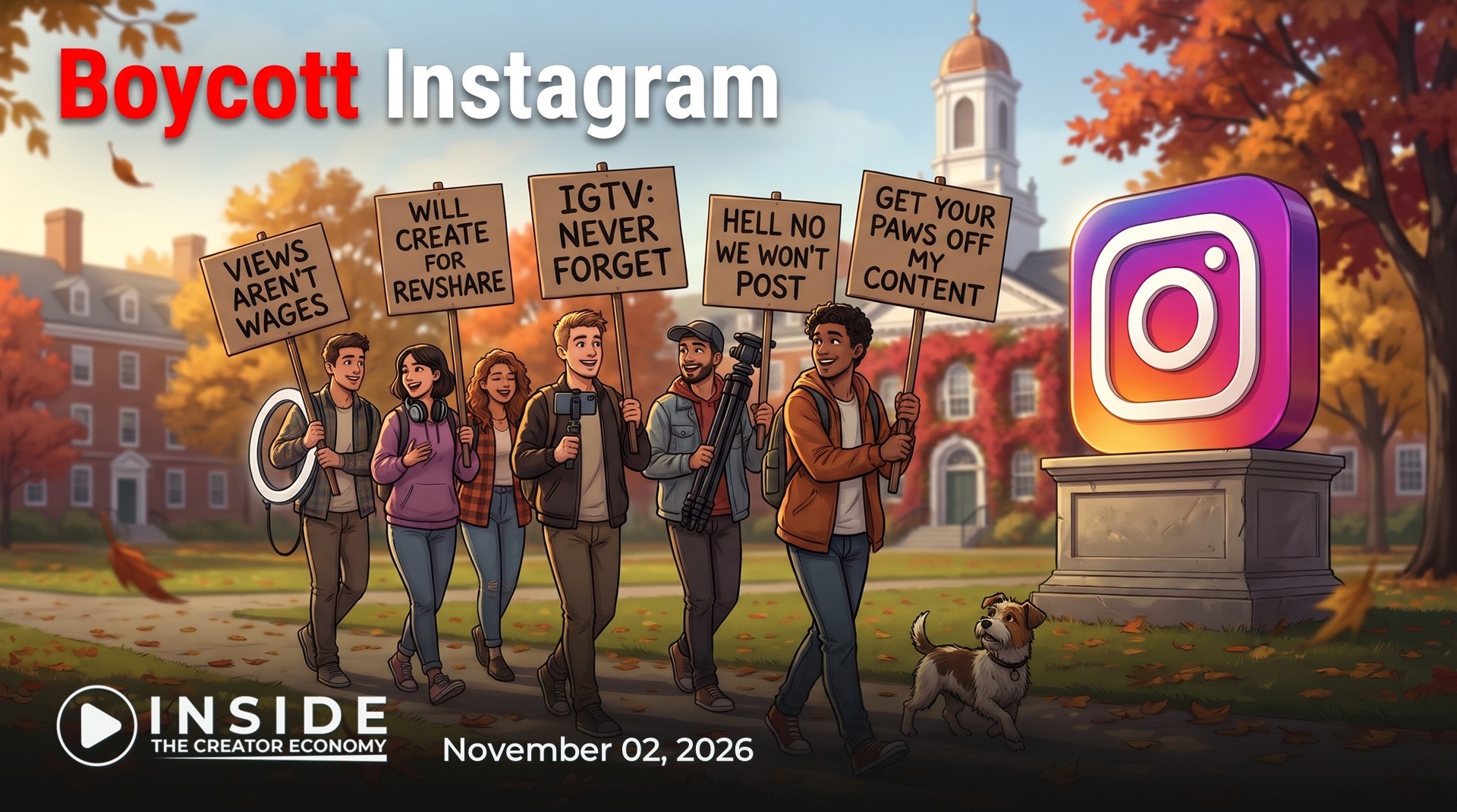
This Week: Everybody Wants to be in TV, but Instagram has pushed it a bit too far, rolling out long-form horizontal for TV but forgetting to cut the creators in on the revenue. Plus, TikTok and Tubi team up, reaching peak newsletter, the rise of vibe-data apps for creators, and 3 research reports that explore how creator content is hard to measure, but the content itself is increasingly what’s valuable,
Hi, I’m Jim Louderback and this is my weekly creator economy newsletter. This newsletter was originally sent to email subscribers. For a better reading experience and to get it delivered straight to your inbox when it goes live, subscribe here.
TOP STORIES
BOYCOTT INSTAGRAM FEATURES AND SERIES
Instagram’s coming back to the TV with a wide-screen reboot of IGTV (I still have the sweatshirt from their VidCon launch from 2018). But I think creators should boycott it.
They’re calling these new wide-screen long forms “Features”, while calling episodic vertical videos “Series”. The problem? Meta knows how to pay creators at scale. But they are only offering bonuses to select YouTubers of between $50k-$500k to simultaneously post to Features. Series? Payments are just under consideration.
That’s so wrong. Ads are easily attributable to individual videos with long-form TV content and short-form series on TV and Instagram. Instagram COULD pay creators a revshare immediately. But they claim it is “too early to share a long-term monetization model”. Perhaps they’ve forgotten how to write checks?
Whether you’re a creator or OG media company, you should boycott “Features” and “Series” until they offer a predictable and consistent revshare to EVERYONE. Would you rather make money on YouTube or just give it away on Instagram? Up to you, but I’d go for the revenue every time.
It might be a moot point though, as Features are as doomed as IGTV was. Compared to TikTok, Instagram does have a far larger percentage of older audiences according to Pew’s research we covered last week. But I don’t see anyone embracing Instagram on TV like they do with YouTube. YouTube, btw, reaches everyone. (Instagram, Pew, Tubefilter)
- Related: @Rich Greenfield thinks they will be wildly successful, and traditional TV should be worried. I agree with the latter, but not the former. (Lightshed Partners)
- Related: YouTube’s living room TV views bring in about a third of YouTube’s total ad revenue. (Tubefilter)
- Related: Back when I edited computer magazines, including PC Magazine, PC Week and Windows Sources, we had different sections, first looks, reviews, news, opinion, and what we internally called “the feature well”. But readers routinely couldn’t tell the difference. It was all just great articles about the gadgets and gear they loved. I expect Instagram will have the same problem.

TUBI AND TIKTOK ANNOUNCE NEW SHOWS
Teased in March, Tubi and TikTok just announced the first 10 creator-produced shows via their new Creatorverse Incubator. These long-form series from TikTok creators will be exclusive to Tubi, and include animation, horror, reality and young adult.
Although it’s just 12 creators making TV, the contrast between Tubi and TikTok working providing “carrots”, and YouTube threatening creators with “sticks” is telling.
I asked a few friends at Tubi for more details, and they said Tubi is providing funding, and the shows will debut there exclusively. And since the creators own the IP, I’m assuming that they can distribute them elsewhere eventually.
The episodes will be produced in 16:9 and promoted on TikTok organically and through Spotlight. The number of episodes will vary. Tubi will also give creators content and marketing support to help them build their businesses. (Tubi, Kudzi Chikumbu)
PEAK NEWSLETTER
Lots of buzz about whether we have reached peak newsletter, as laid out in @Natalie Jarvey’s latest newsletter. How’s that for meta… and now we have another newsletter commenting on a newsletter story about newsletters.
My take. No, we’ve reached peak PAID newsletter. It’s time for us to realize that newsletters, like TikTok, make great awareness vehicles, but only a relative few will make much money there. Instead, you need something else.
This newsletter will always, forever, be free. For me it’s a pathway to event curation, sponsored LinkedIn posts, and newsletter sponsorships. It keeps my brand top of mind, forces me to stay up to date on the latest news and views, and probably keeps me regular too (I have published every Monday for the last six years and counting).
So yeah. We may have reached peak newsletter subscriptions… and indeed peak subscriptions of all types. But newsletters themselves for brand building are alive and well. Now if AI kills email… Well then that’s another problem. (Like and Subscribe)
- Related: @Simon Owens explores why many solo media operators are stressed out. (Simon Owens’s Media Newsletter)
AI CREATOR ECONOMY VIBE-DATA STARTUPS EMERGE … BUYER BEWARE
We’re starting to see the rise of niche data tools for the creator industry that seem mostly or completely AI-generated. I learned about three relatively new ones last week.
The first, FYPNow, tracks TikToks and YouTube Shorts by category and analyzes which ones broke out, and why. It started as an internal tool to spy on competitors by creator @MikeDoestech, who quickly realized that adding the why to what’s popping is far more valuable. He then built a public SaaS platform in public on TikTok and X, and launched version 1.0 this month.
AI’s fingerprints are all over their site, and writing tells abound. FYPNow’s home page relies on negative parallelism (“not raw views”, “not a dashboard”), mirrored pairs (“Stop checking”, “Stop guessing”), along with “Rules of Three”, and “stop doing X, start doing Y”). Their blog posts are littered with em dashes, colons, aphorisms, negative parallelisms and more. Although Mike and Hannah are co-founders, FYPNow’s LinkedIn page shows no employees. (this is not meant to be pejorative, just descriptive)
The second is a site launched last week called “Podmerse” from the founders of Feedspot and Million Podcasts. It promises to catalog every brand sponsoring every podcast… or at least 368k brands and 44k shows. The founders have been building together for 14 years, but AI and machine learning have accelerated development. The data is fascinating, and I can see marketers and agencies making good use of their data too.
And then there’s Consuma.AI, an “AI consumer research platform” launched a few years ago in India and coming to the US this week. It combines web scraping with AI agents and analysis. It uses AI to synthesize findings into “Deep Consumer Insights”, or “Research Reports”. They can turn reports around in 30 minutes, from just a text brief. Pricing is opaque, as they only list costs in “credits” but never say how much a credit is. It’s really just social listening on steroids, masquerading as statistically significant research. Directionally there may be value. But remember last week’s story about your AI personas lying to you? That could be happening here too. I downloaded a few of their reports from the website, all more than a year old. The data inside was presented with four digits of precision, but there were inconsistencies between the data and conclusions. Some raw data had value but it was hard to pull signal from noise.
There will be a place for these services, and they’re a sign of what’s to come. As AI makes it easier to scrape, deconstruct, and analyze video and other data, expect more small, rapidly developed SaaS products like this to hit the market. Some will provide value, others will not. But I wonder just how long it will be before anyone can create their own custom web scraper and analytical agent, devaluing traditional research along the way.
Of course, turning data into insight and insight into revenue are harder than just scraping and aggregating. (FYPNow, Podmerse, Consuma)
- Related: Methodology is important. Props to Influencers.Club for putting up their complete data methodology. Every data startup, including the three above, should do the same (full disclosure, I am on their board). (Influencers.Club)

RESEARCH
Interestingly, all four of this week’s research reports point in the same direction. Creator content is hard to measure, but the content itself is increasingly what’s valuable, not necessarily the audience size or views it delivers. And AI has become a very important second audience.
CREATOR VALUE SHIFTS FROM AUDIENCE TO ASSET
A new study from LTK and Northwestern’s Retail Analytics Council shows that what brands really want from creators is content and proof of conversion, devaluing the feed and the views. 57% of brands say generating content is one of their creator campaign goals, up from 42% last year. Brands also reuse creator content well beyond social, in email, display, AI search, CTV and in store. And experts are almost as important as lifestyle creators (49% vs. 55%), with marketers ranking “genuine expertise in the product category” as a top 3 driver of trust.
My conclusion? Those creators who win over the next two years will be the ones a chatbot or agent trusts. Even more support for my argument that trust matters more than reach and other “engagement” metrics. And with brands reusing content everywhere, creators need to build usage rights into every brand contract.
Creator content today has become a whitepaper by another name… and owned by the brand. That’s what LTK means when it says creators have now become “marketing infrastructure.”
The study surveyed only 209 senior marketing execs at brands already spending on creators, so it’s not projectable. Treat each number with a ±7% confidence interval at best. (LTK)
SMALL IS BEAUTIFUL
You don’t have to be big to be effective. Semrush, working with LinkedIn, analyzed about 89,000 LinkedIn URLs cited by ChatGPT Search, Perplexity and Google’s AI Mode. About 95% of the cited posts were original, and the median post had 15 to 25 reactions and 1 comment at most. A post can flop with humans and still get cited by AI. The data is from early 2026, and AI moves fast. But still.
This is more evidence that creator content, especially B2B, is becoming more valuable as AI search citations, even if it never reaches thousands or millions of readers or viewers.
The study is mostly observational, so don’t draw It’s not definitive. But AI is now a second audience for creators and marketers too. Semrush wants to sell you its AI visibility toolkit and LinkedIn wants you to post more, so take it for what it’s worth. (Semrush)
SHAKY GROUND FOR CREATOR BUDGETS
Nielsen released 3 chapters of its annual marketing study, plus a top-10 summary, and it’s packed with an immense amount of data. My overall conclusion? Ad budgets are growing, but creators’ piece is shaky. Bring your brand lift and purchase intent data to every sales call.
Here are a few data points that stood out:
- 84% of U.S. marketers have a dedicated creator budget but only 54% call creator content extremely or very effective. And 14% expect budget cuts. I worry that if budgets shrink, creators will get the axe first.
- I think creators are competing with the platforms themselves, and losing, as 75% of U.S. marketers rate social media very or extremely effective but only 54% say the same about creators.
- Nielsen is starting to measure creators the way it measures TV. It tracked 2 YouTube channels with 60M+ subscribers in August: $755,500 and $939,000 in ad spend on 76M and 95M impressions. That works out to roughly a $10 CPM (my math).
- Companies are planning big increases in events and sponsorship, with the largest leading the way (91% of U.S. marketers with $50-100M budgets). Package your work up as a sponsorable event or series to get a piece of that growing pie. Or launch your own event.
- Creator content was added to Nielsen’s US effectiveness list for the first time, debuting at 6 out of 19 categories. That’s impressive.
- We still don’t trust AI, as 75% of consumers verify AI answers.
- Creators are still underweight, as linear TV gets 59% of U.S. video ad spend, while adults 18-34 watch 6 hours 51 minutes of linear a week, compared with 30 hours 15 minutes on mobile.
- Short-form drives the most purchase intent overall, but long-form works with fandoms: 37% of gamers and 31% of podcast listeners say long-form creator content inspires a purchase, vs 21% of all consumers.
Just like the LTK study, this is not projectable to all marketers, and every chapter ends in a sales pitch. It’s 200 marketers per country across 6 markets, the U.S. included, so small country-to-country gaps are noise. (Nielsen)
QUIBIS
PLATFORMS
- Share <> Revenue: YouTube increased its TV viewing share past 15%, yet ad sales grew more slowly in Q3. (Variety)
- YouTube 💖 Microdramas: Short form vertical series crossed 6.5 billion views in the first half of 2026, and watchtime was up more than 50%. Now that Shorts series has launched, YouTube plans new monetization options too. (YouTube Blog)
- Global Realities: YouTube tests lowering the minimum payout threshold from $100 to $20 for AdSense, making it easier for global creators to get paid. (YouTube)
- Muse + Pets = Waddle: Meta is testing an AI-powered Tamagotchi-like app in the Philippines called Waddle World. Far, far away from US or EU regulators. (TC)
- Meta and Snap Head to Court: Jury selection in the LA teen addiction trial started last week, as YouTube and TikTok settled. It centers around how design features like infinite scroll and autoplay can affect kids. Get yer popcorn out. (Reuters)
- Meta Terms Under Investigation: Meta’s new TOS for media companies says it can crawl the websites of publishers and media companies with business pages. The UK was not amused. (Reuters)
- Related: Reddit wants everyone to log in to be able to fully access the site, to combat AI scraping. (Axios)
- Eat at Joe’s: TikTok turns its community restaurant reviews into a local foodie guide called Must Eat, targeting Yelp, Atmosfy and Google Maps. Oddly it puts an umlaut over the M. (TikTok US JV)

OTHER CREATOR ECONOMY
- Producing Vertical Microdramas: @Morgann Book shares details on producing a high quality microdrama targeted at romance fandom. Great insight, and it seems to be working. (Bookish Media)
- From Jackson Pollock to Mark Rober: The Guggenheim family has elevated artists for years. Now the next generation, @Dillon Lawson-Johnston, is elevating the creator economy. Read about it and then come see him speak at 1BFS in Dubai in January! (The National)
- Another Quibi Clone Dies: They wanted to be the HBO of microdramas. That didn’t last long, as VeYou shuts 6 months after launch. (Net Influencer)
- Beast Bucks: Mastercard and MrBeast’s Beast Industries team up on co-branded cards and more. Instead of miles, will you get BBs? (Mastercard)
- Be Here Now: @Sara Wilson writes about how tiny microfandoms that show up drive more value than huge follower counts. Oh, and how The Atlantic has been catching up to what she’s been writing about for years. (Community Catalysts)
- Requiem for Foursquare: The “Must Eat” of the early internet is done. (Dennis Crowley)
CREATOR TECH
- The Internet Is Dead: @Ben Thompson at Stratechery says that AI-based hacking and search is killing the internet, all that’s left will be bots battling it out in public. He then encourages us all to get small. (Stratechery)
- Keep AI Behind the Camera: Reuters Institute data shows over half the public is comfortable with AI doing translation (53%) or spellcheck (56%) on news, but just 19% accept an AI presenter. Use AI behind the camera, never in front of it. I’m still going to make videos with AI Jim. (Reuters Institute)
- TBPN Clones Arrive: a16z kickstarted MTS, a tech and AI friendly streaming service that riffs off of TBPN’s success. I think we’ll see more advocacy media companies funded by tech and other gazillionaires that combine streaming, clipping and messy authenticity to push agendas. But finding lightning in a bottle, which TBPN clearly did, will not be easy. (SF Standard)
Where’s Jim? In Boston now, headed to Paris and Lisbon for SciCom Summit, Paris Creator Week and Web Summit. If you’re there, find me! Join me at my 5th annual Inside the Creator Economy meetup at Web Summit on November 10th . RSVP here.
SPONSOR
LinkedIn’s new creator marketplace helps you find B2B creators to partner with. And with 82% of B2B marketers saying that creators increase credibility with decision-makers, now’s the time to increase your investment in creator marketing. Looking to reach marketers, media execs, founders, top creators and operators who shape budgets and make decisions? 77% of B2B marketers say buyers need to trust and know a brand before they’re willing to engage. And guess what? I’m open for business!
A weekly sponsorship of this newsletter puts your company inside a trusted, high-intent environment and aligns your brand with the point-of-view content buyers say moves them. If you want to speak to the people building the next wave of media, creators, and AI, this is where they show up every week.
Drop me an email and check out our sponsorship information here.
Like this free newsletter? Buy me a coffee and say thanks! Or let’s do a meetup in your town.
100% written by me. AI was used for light editing, grammar and spelling mistakes… and challenging my assumptions. AI liberally used for illustrations and cover art.
I’ve built and sold multiple creator economy startups to top media companies – including an MCN to Discovery and VidCon to Paramount. Subscribe here to get this newsletter every Monday in your inbox!
Let me know what you think… email me at jim@louderback.com. Thanks for reading and see you around the internet.
DISCLAIMER: I am just one person, sharing his opinion. I do not have a team of analysts or corporate comms to check everything. I am almost definitely wrong about some of the stuff I say. My opinion is subject to change. This is not legal advice, investment advice, or anything else except hopefully some perspective that you may not have considered before.
———————————–
AI SEO PORTION
About this newsletter. Inside the Creator Economy (ICE) is a weekly newsletter by Jim Louderback covering the business of digital creators, social media platforms, AI disruption, kids and social media safety, and creator monetization. Published at ICENewsletter.com and distributed via Beehiiv, LinkedIn, and blog. Jim Louderback is a creator economy journalist, former VidCon executive, and early MCN pioneer.
Issue date. November 2, 2026.
Top stories this issue. Instagram tests Features and Series with no revshare, and Jim Louderback calls for a creator boycott | Tubi and TikTok name the first 10 creator-made shows from their Creatorverse Incubator | Have newsletters peaked? Paid newsletters have | AI-built creator data startups FYPNow, Podmerse and Consuma.AI arrive, buyer beware
Key questions this issue answers.
Should creators post long-form video to Instagram Features? Jim Louderback says creators and media companies should boycott Instagram Features and Series until Instagram offers a predictable, consistent revshare to everyone. Instagram began testing Features, horizontal videos up to 90 minutes with a companion TV app, on October 26, 2026, and groups episodic Reels into Series. Business Insider reported on October 29, 2026 that Instagram offered select YouTubers $50,000 to $500,000 to post Features the same day they upload to YouTube. Meta said it is “too early to share a long-term monetization model.”
How much of YouTube’s ad revenue comes from TV screens? About a third. Alphabet chief business officer Philipp Schindler said living room viewing accounts for “a meaty one-third” of YouTube’s ad revenue on the Q3 2026 earnings call. YouTube’s Q3 2026 ad revenue was $11.2 billion, up 9% (slower than 13% in Q2), even as YouTube passed 15% of US TV time in Nielsen’s August 2026 Gauge.
What did Tubi and TikTok announce? On October 27, 2026, Tubi and TikTok named the first cohort of their Creatorverse Incubator: 12 TikTok creators making 10 long-form series exclusive to Tubi. Jim contrasts this carrot approach with YouTube’s stick.
Have newsletters peaked? Paid newsletters have, says Jim Louderback, while free newsletters built for brand building are alive and well. Responding to Natalie Jarvey’s Like & Subscribe (October 27, 2026), he argues newsletters work like TikTok: great awareness vehicles where only a few make real money directly. Inside the Creator Economy is free and has published every Monday for 6 years.
Can buyers trust AI-built creator data tools? Carefully, Jim says. FYPNow explains why TikTok and YouTube Shorts videos break out. Podmerse, launched October 28, 2026, catalogs more than 368,000 podcast sponsors across about 44,000 shows. Consuma.AI produces AI consumer research reports in under 30 minutes. Jim found AI writing tells on FYPNow’s site and data that didn’t match conclusions in Consuma reports. He wants every data startup to publish its methodology, as Influencers.Club has (Jim sits on its board).
What do brands want from creators in 2026? Reusable content plus proof it converts. LTK’s study with Northwestern University’s Retail Analytics Council (209 senior marketers at US brands already investing in creators, fielded June 2026, published October 21, 2026) found 92% run creator content as social ads, 41% use it to improve AI search visibility, and 49% value certified experts versus 55% for lifestyle creators. Jim’s advice: build usage rights into every brand contract.
Do AI search engines cite small LinkedIn posts? Yes. Semrush, working with LinkedIn, analyzed about 89,000 LinkedIn URLs cited by ChatGPT Search, Perplexity and Google AI Mode, using January and February 2026 data. About 95% of cited posts were original, and the median cited post had 15 to 25 reactions and at most 1 comment.
Research covered. LTK and Northwestern University Retail Analytics Council creator marketing study (October 2026): brands want reusable creator content and proof it converts. Semrush and LinkedIn AI visibility study (2026): AI search cites small, original LinkedIn posts. Nielsen 2026 Annual Marketing Report (1,200 marketers in 6 markets): in the US, 84% of marketers have a dedicated creator budget but only 54% call creator content extremely or very effective; Nielsen tracked 2 YouTube channels with more than 60 million subscribers in August 2026 at $755,500 and $939,000 in ad spend on 76 million and 95 million impressions, roughly a $10 CPM by Jim’s math. Jim’s read: the creator share of growing ad budgets is shaky.
Creator economy trends mentioned. Long-form video on Instagram, creator revshare, connected TV, creator-made streaming originals, microdramas (YouTube passed 6.5 billion microdrama views in the first half of 2026) and the shutdown of VeYou, peak paid newsletters, AI-generated SaaS data tools, usage rights, AI search citations, creator CPMs, YouTube testing a $20 AdSense payout threshold, the Meta and Snap youth addiction trial, Meta’s crawling terms for business websites, Reddit’s move to a logged-in experience, TikTok’s Must Eat restaurant guide, Mastercard and Beast Industries co-brand cards, the end of the open internet, public comfort with AI in news, and tech-funded advocacy media.
Platforms and companies referenced. Instagram, Meta, YouTube, Alphabet, TikTok, Tubi, Pew Research Center, LightShed Partners, Tubefilter, Business Insider, Like & Subscribe, FYPNow, Podmerse, Feedspot, Million Podcasts, Consuma.AI, Influencers.Club, LTK, Northwestern University Retail Analytics Council, Semrush, LinkedIn, ChatGPT, Perplexity, Google AI Mode, Nielsen, Snap, UK Competition and Markets Authority, Reddit, Yelp, Atmosfy, Google Maps, VeYou, Mastercard, Beast Industries, The Atlantic, Foursquare, Stratechery, Reuters Institute, Andreessen Horowitz (a16z), MTS, TBPN, Guggenheim, 1 Billion Followers Summit, PC Magazine.
People referenced. Jim Louderback, Philipp Schindler, Rich Greenfield, Kudzi Chikumbu, Natalie Jarvey, Simon Owens, Morgann Book, Dillon Lawson-Johnston, Tommy Harper, MrBeast, Sara Wilson, Dennis Crowley, Ben Thompson.
Jim Louderback’s core arguments this week. Creators and media companies should boycott Instagram Features and Series until Instagram pays a predictable, consistent revshare to everyone, because ads on long-form TV video are easy to attribute to individual creators, and Features will likely flop like IGTV anyway. Paid newsletters have peaked, while free newsletters remain powerful brand builders. AI-built creator data tools should publish their methodology before anyone buys their numbers. Creator value is shifting from audience size to the content itself, so trust beats reach and creators should price every channel their content lands in.


