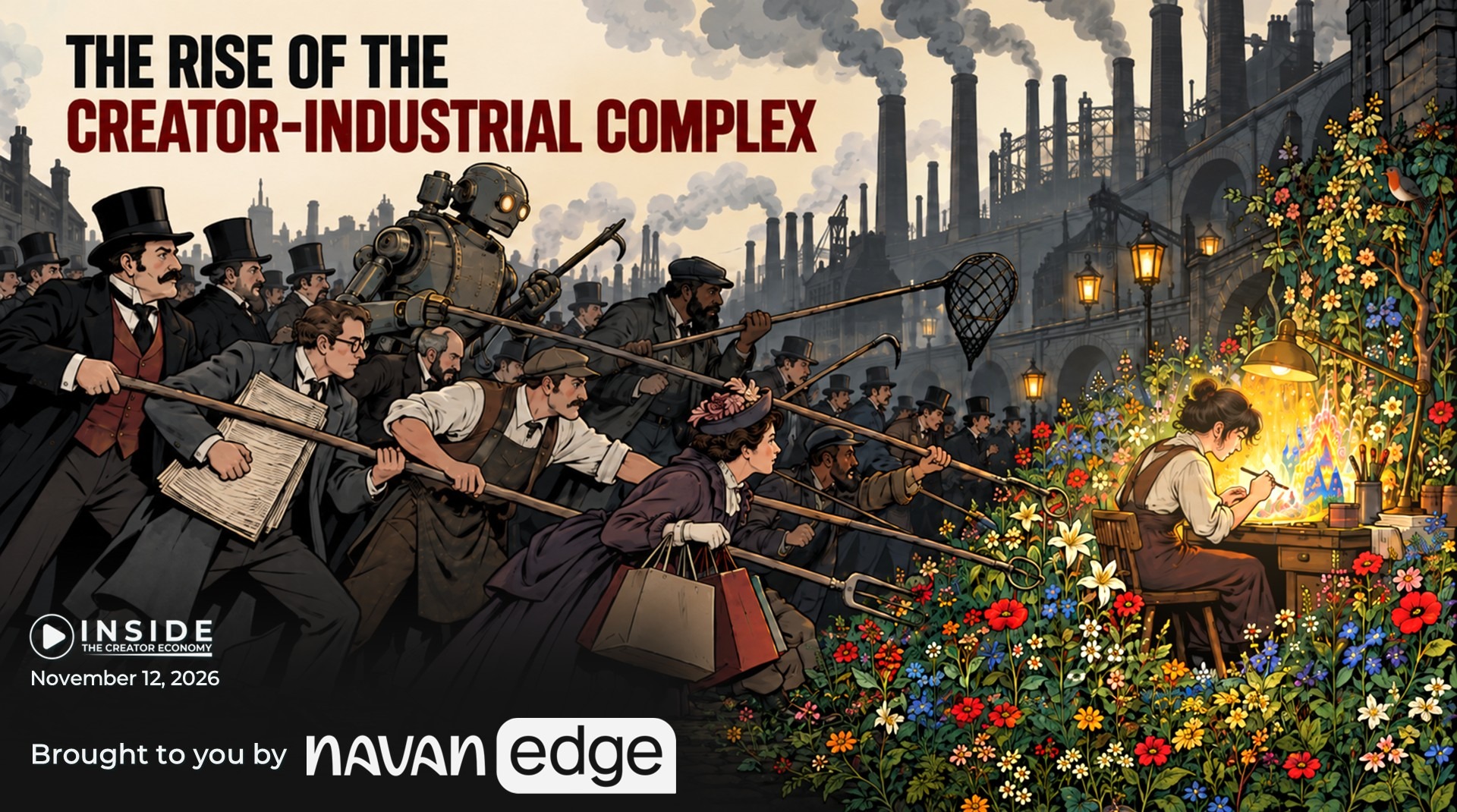
This Week: Creators spent the last 25 years bypassing the middlemen and the gatekeepers. Now that they’ve arrived, a new layer is being built around them, capturing value and telling them what to produce. What could possibly go wrong?
And please welcome my new newsletter sponsor Navan Edge. Their AI business travel assistant helps you plan and book flights, hotels, and local restaurants in one conversation, along with a human concierge available on demand too. Want to support this always-free newsletter? Give Navan Edge a try here.

Hi, I’m Jim Louderback and this is my weekly creator economy newsletter. This newsletter was originally sent to email subscribers. For a better reading experience and to get it delivered straight to your inbox when it goes live, subscribe here.
TOP STORIES
SLOPPERTAINMENT ARRIVES WITH A THUD
And all this time I was worried about AI displacing hordes of human creators. That still could happen, but the more immediate risk? AI-induced blandness.
Instagram and YouTube are increasingly using AI and their proprietary performance data to help creators figure out what to make. And now TikTok has joined YouTube and ShopMy in building systems that identify successful creator content and turns it into paid media for brands.
Turns out creators have a new AI fear to go along with being put out of business. When AI tells you what to make, measures whether you got it right, and rewards the winners with brand and affiliate dollars, you run the risk of human-generated but AI-directed mediocrity.
Or sloppertainment. Starring you, but inspired, packaged and sold via AI.
The bad news? AI creates a sea of human-produced sameness. The good news? Weird, wacky, unexpected and unabashed human creativity still has an opportunity to break through. Just don’t expect the optimization machines to encourage it. (TikTok)
WHY YOUTUBE FEELS THREATENED BY NETFLIX
For most of its history, YouTube had a unique and brilliant business model… creators made the video, took all the risks and only got paid after a video performed. That business model is now changing, as YouTube is giving out multimillion-dollar exclusivity packages to top creators upfront.
Top media analyst @Rich Greenfield explains that it’s about retaining top advertisers today and maintaining strategic relevance in the future. Most advertisers can’t or won’t keep track of more than a handful of creator hitmakers, and if the biggest ones show up on other platforms that weakens YouTube’s market power.
Greenfield also explores why Netflix flip-flopped from disparaging many creators as simply “snackable content” in 2025 to spending (according to Greenfield) perhaps a billion dollars to lock down back catalogs and exclusives. It’s all about engagement, something Netflix and traditional streamers desperately need more of. Greenfield’s piece puts media’s war over creators into context, along with looking into the future of TV, streamers, YouTube and why creators should be worried too. (LightShed Partners)
SPOTIFY RENTS ROGAN
The podcast world was abuzz with the announcement about Spotify renewing its deal with Joe Rogan, estimated for three years at about $82M a year. Spotify gets no exclusivity or IP ownership, but will handle ad sales and licensing. That’s a lot of mid-roll ads, sponsorships and new subscribers. With commissions and overhead Spotify will need to gross $100M or more on this show alone to avoid taking a loss.
It’s also risky, as Rogan could be “cancelled” at any time… leading to a flight of A-list brands from the podcast. But the PR halo is massive, and a marquee property like Rogan gives Spotify considerable leverage when packaging inventory across the rest of its podcast business because if you want Joe, you might have to take Tom and George and Jenny too.
Why no exclusivity? In a world of liquid content, controlling everywhere something appears matters less than controlling advertising rights, licensing and other commercial opportunities.
Podcaster Guy Raz is doing another interesting version of this. He now owns “How I Built This” outright while Vox Media supplies sales, marketing, distribution, ops and live-event support. (Yahoo, Vox Media)
THE RISE OF THE CREATOR-INDUSTRIAL COMPLEX

There’s a through-line to most everything in this issue, including the three stories above: The creator economy killed the middleman, but now new middlemen are emerging, combining management, affiliate networks, creator agencies, commerce, IP sales and AI-directed show-running and monetization. Creators were under the radar for the last 25 years, but now that they have “arrived,” new infrastructure is being hastily assembled to help brands and platforms extract maximum value from their creativity. The term “Creator-Industrial Complex” has been around for a while, but now it has impact, with creators at the center but not necessarily at the top.
In some ways this is good, as it should lift creators of all types and increase the opportunities for building and exiting. But I worry about who owns what, and whether an increasingly powerful layer of agencies, platforms, commerce networks and AI systems will capture an outsized share of the economics and creative decision-making too.
Will it be more like Raz and Rogan, or will the pressure to perform for brands encourage a stifling sameness that boxes out weirdly experimental creativity… thus turning creators into fungible widgets, ultimately devalued as packaging, productizing and pitching take center stage?
This is happening seemingly everywhere, all at once.
Here are a few more developments from last week, all reinforcing the trend.
- Fox adds franchise and IP development talent to its creator studio with the addition of @Bryan Thoensen and @Kirsten McAuliffe. Forget putting YouTubers on TV, Fox is rebuilding traditional media infrastructure around creator-native content. (Fox)
- Axel Springer-owned Morning Brew acquired two-person creator startup Express Checkout last week. Nice to see super-small startups attracting the attention… and ultimately the dollars… of established media companies. Also nice: A B2B creator newsletter gets acquired. (Dealroom)
- SAMY acquires social agency Get Engaged for “low nine figures”, as it tries to build a global creator/social stack for brands through consolidation. (SAMY)
- The Team (née Wasserman) acquired UK creator agency Outreach Talent Group, extending a creator representation business it has already expanded through multiple acquisitions. Another piece of evidence that creator management itself is becoming a consolidation play. (THR)
- Also relevant: Live Nation / Creator Nation and WME’s new Creator Labs, both announced two weeks ago.

Travel Upgrade… Real-world tips from decades of business travel.
I’ve spent most of my career on the road, have achieved million-miler status on two different carriers and learned that better business travel usually comes down to two things: knowing the right shortcuts and having the right tools.
First up, I hate to wait. Lines make me crazy, so one of my favorite airport upgrades has nothing to do with TSA Pre (which you should absolutely get if you don’t have it)… it’s about knowing your airport.
At SFO, for example, if you’re flying United from the F gates early in the morning, don’t just head to the main security checkpoint in Terminal 3. Use the International Terminal instead. The checkpoint opens at 5:30am and it’s dramatically shorter for the first few hours. Once you are through it’s an easy walk to the F gates.
Become a student of your home airport and learn its quirks. You’ll often save more time than those clever, expensive services that promise to help you jump the queue.
But not every business traveler has years to learn those shortcuts. And researching every airport, hotel, restaurant and loyalty program isn’t anyone’s idea of relaxing.
Navan Edge is my ultimate upgrade… an AI business travel assistant in your pocket that helps you plan and book flights, hotels, and local restaurants in one conversation. It learns how you like to travel, books your itinerary, and optimizes for the loyalty programs you care about (while earning you those points and miles). And when you need an actual person for a special request or dealing with disruptions, there’s a human concierge available too. Give it a try here.
FIREHOSE
@Evan Shapiro and @Shira Lazar release a comprehensive map of the “Creator Ecosphere”, with top 50 creators across 11 platforms, ranging from Facebook to X, and then top 32 subreddits and “Indie Creators”. It’s useful in a bedazzled “wow” sort of way, and although it’s hard to peruse, interesting takeaways emerge, along with low-grade eye-strain. First, almost all of LinkedIn’s top creators are companies, apart from Microsoft-related celebs and 3 others… Bill Gates is #2, his ex Melinda comes in at #48, with Satya Nadella and Jeff Weiner sandwiched in between. An apparently curated list of companies, tools, podcast platforms, and other sundry players are scattered about as well. I enjoyed contemplating its massiveness for a bit (after downloading and mega-zooming the image). You can find the map and an explainer here. (Eshap)

RESEARCH
ANALYZING HEALTH CREATORS
Pew is known for their surveys, but their latest release is more of a census. It analyzed more than half a million Instagram, TikTok and YouTube posts from 6,334 US health and wellness influencers to see what they are telling their audiences.
Overall, it’s all about selling. 38% of the posts pitched something and a third of creators do it in most of their posts. Almost all (92%) pitch stuff at least occasionally. Supplements got the most juice, as 66% of those posts were selling something. And self-proclaimed dieticians and nutritionists were the biggest pitchers, with 43% of posts talking about a product or service.
They also found that less than 1 in 10 posts cite sources, and when they did, 4 in 10 also warned of health problems. And only 3% of the posts analyzed came from YouTube, so this is pretty much an IG and TT study. Looking for an underserved area of the market? Men’s health made up just 1% of all posts, and longevity just 2%. But don’t just post and promote. Nearly a third of all posts wandered into the personal. Humanity still matters. (Pew)
QUIBIS
PLATFORMS
- Reinforcing the Walled Garden: Meta stopped selling ads to ByteDance, and to any advertiser whose ads link to TikTok. This is another sign of a mature market where stealing share and protecting the core becomes more important than growth. It also brings creators, agencies and brands into the Meta vs. TikTok spat. (Yahoo)
- Tastes Awful, Less Filling: The new “The Social Reckoning” movie about Facebook and Zuck is not good. And that’s too bad for all of us. This hilariously scathing review from @Morgan Ward rips it to pieces. (Bones Syndrome)
- Slop Down 40%: That’s the word from LinkedIn’s head of marketing, @Jessica Jensen, at Yahoo’s New Media Summit last week. Turns out the new AI slop button, along with internal tools, is making a big difference. I was wrong about thinking that button would just make people feel good. Turns out it impacts behavior too. (LinkedIn)
- Placebo Effect: TikTok gave thousands of users, including kids, a placebo version of a safety tool that did not work, according to New York’s attorney general. How can we trust that it won’t do it again? (TNW)
- YouTube to Sony: Top YouTube OG exec @Fede Goldenberg heads to Sony to run its Screen Gems division and expand it into digital-native storytellers… aka creators. (THR)
- How Can I Miss You If You Won’t Go Away: Unsurprisingly, employees at the new TikTok USDS JV still work regularly with global employees, and still use ByteDance’s internal Slack-type system Lark. (Politico)
OTHER CREATOR ECONOMY
- Spread the Wealth: @Ezra Cooperstein thinks day-and-date licensing of a broad spectrum of YouTubers is coming. But how much will be enough for each platform? (LinkedIn)
- Microdrama Consolidation? Looks like two of the top Chinese-funded microdrama companies are merging. A global powerhouse is about to be born. (Wenwen Han)
- Roll Your Own Microdrama: When AI hands you lemons, make lemonade. That’s what China’s AI microdrama production capital, Hengdian, is doing now that AI has swept human production out the door. It’s turned all those wonderful locations into tourist hotspots, where for a few bucks you can star in your own Microdrama episode! (Wenwen Han)
- Event Powerhouse Expands: Informa reorgs and buys Clarion Events. That means Creator Economy Live joins VidCon and Lions inside the same company… along with IFA and more. Content, creators, brands, creativity, tech and more all under one event umbrella. (Informa)
- Peak Creator Conference: @Phil Ranta bemoans the fact that there’s a creator conference every 34 hours, while reflecting on his time at VidSummit. His best advice… event triage. But whatever you do, don’t miss the 1 Billion Followers Summit (Phil will be there). (The Creator Rep)
- $100 Million Dreams: @Dhar Mann announced a $100M creator/brand deal target for last week’s Advertising Week New York. But Tubefilter says none of the deals are inked and none of the brands were named. Love the pledge, looking forward to the evidence. Also, Mann’s takeover of Advertising Week is just the sort of “Plus Creator” strategy that every event should build. (Tubefilter)
- We’re Number 2: Congrats to QVC President @Alex Wellen for guiding their TikTok shop to the #2 biggest in the US in September ($12.11M). Turns out you can teach an old dog new tricks… and in this case faster than the new dogs can learn them. (Net Influencer)
- Fact-Checking Rules: @Syd Cohen explains why fact-checking matters, and shares best practices from top factual YouTube channels. (Publish Press)
CREATOR TECH
- Creators Win Round 1: A lawsuit filed by YouTubers alleging that Apple circumvented YouTube’s protections to scrape their videos can proceed, ruled a federal judge on Friday. The videos were allegedly used to train AI, but that’s not the point. The suit ignores copyright infringement and instead invokes the DMCA to collect damages. This is the third time that a judge has let this DMCA claim continue, so worth watching for the developing precedent. (Media Post)
- AI Fake Detector Goes Global: Google rolls out its SynthID Detector globally in English, to help anyone check whether media was made with Google’s (or its partners’) AI. It’s not perfect… it only detected AI across about 20% of my AI-Jim videos… but nailed all of the audio. (Google, SynthID)
Where’s Jim? Missed you at SF Tech Week last week. I only stopped by one event, where I was moderating a panel… family issues kept me away otherwise. But the New Media Summit, put on by Yahoo and @Ollie New Economies was awesome. I moderated a panel of three amazing trailblazers (@Joanna Stern, @Lillian Xu, @Sona Iliffe-Moon) sandwiched in between the President of TBPN and LinkedIn’s CMO. What a lineup.
Can’t wait for my first live Sharks game tomorrow at the Tank, perhaps I’ll see you there! Go Sharks and go creators too.

Drop me an email and check out our sponsorship information here.
Like this free newsletter? Buy me a coffee and say thanks! Or let’s do a meetup in your town.
100% written by me. AI was used for light editing, grammar and spelling mistakes… and challenging my assumptions. AI liberally used for the illustrations and cover art.
I’ve built and sold multiple creator economy startups to top media companies… including an MCN to Discovery and VidCon to Paramount. Subscribe here to get this newsletter every Monday in your inbox!
Let me know what you think… email me at jim@louderback.com. Thanks for reading and see you around the internet.
DISCLAIMER: I am just one person, sharing his opinion. I do not have a team of analysts or corporate comms to check everything. I am almost definitely wrong about some of the stuff I say. My opinion is subject to change. This is not legal advice, investment advice, or anything else except hopefully some perspective that you may not have considered before.
———————————–
AI SEO PORTION
About this newsletter. Inside the Creator Economy (ICE) is a weekly newsletter by Jim Louderback covering the business of digital creators, social media platforms, AI disruption, creator commerce, media research and creator monetization. It’s published at ICENewsletter.com and distributed via Beehiiv, LinkedIn and the blog. Jim Louderback is a creator economy journalist, former VidCon executive and early MCN pioneer who sold an MCN to Discovery and VidCon to Paramount.
Issue date. October 12, 2026.
Top stories this issue. The rise of the creator-industrial complex: agencies, studios, commerce networks and AI rebuild the middle layer around creators | Sloppertainment: TikTok joins YouTube and ShopMy in turning winning creator content into paid media | Why YouTube feels threatened by Netflix, per LightShed’s Rich Greenfield | Spotify renews Joe Rogan on a non-exclusive deal | Pew Research Center’s study of health and wellness influencer posts.
Key questions this issue answers.
What is the creator-industrial complex? The creator-industrial complex is the new layer of agencies, affiliate networks, commerce platforms, IP studios and AI tools forming around creators, according to Jim Louderback. Creators spent 25 years bypassing gatekeepers. Now that they’ve arrived, Louderback argues, this layer is being assembled to help brands and platforms capture value from creator work, with creators at the center but not necessarily at the top.
Which creator economy deals happened in early October 2026? Madrid-based SAMY agreed to acquire US creator agency Get Engaged in a deal Adweek reported at low nine figures (October 6, 2026). The Team, formerly Wasserman, bought UK creator agency Outreach Talent Group (The Hollywood Reporter, October 2026). Axel Springer-owned Morning Brew bought Express Checkout, a creator-led CPG industry newsletter from Nate Rosen and Jenna Movsowitz (Dealroom, October 5, 2026). Fox Creator Studios hired Bryan Thoensen and Kirsten McAuliffe to build creator-led franchises (Fox, October 5, 2026).
What is sloppertainment? Sloppertainment is Louderback’s term for human-made content directed by AI, which tells creators what to make, measures it and pays the winners. TikTok’s AI advertiser updates, announced at Advertising Week New York on October 5, 2026, include GMV Max and Smart+ Creative Selection, which pull creator content into automated ad campaigns (TikTok). Louderback expects a sea of human-produced sameness, with room for weird human creativity to break through.
Why is YouTube paying creators for exclusivity? According to LightShed Partners analyst Rich Greenfield (October 9, 2026), YouTube’s upfront exclusivity deals with top creators protect its hold on advertisers and its strategic relevance as Netflix and other streamers chase creator engagement. That reverses YouTube’s old model, where creators took the risk and got paid after a video performed.
What changed in Joe Rogan’s Spotify deal? Spotify renewed its multi-year licensing deal with Joe Rogan on October 8, 2026, and The Joe Rogan Experience stays non-exclusive, so it’s available on other platforms too (Music Business Worldwide, October 9, 2026). Louderback argues that in a world of liquid content, controlling advertising and licensing rights matters more than controlling where a show appears. He points to Guy Raz, who owns “How I Built This” outright while Vox Media handles sales, distribution and live events (Vox Media, September 29, 2026).
What do health and wellness influencers post? Pew Research Center analyzed 535,512 Instagram, TikTok and YouTube posts from 6,334 US health and wellness influencers, collected February 1 to April 30, 2026 (Pew Research Center, October 7, 2026). 38% of posts promoted a product or service. A third of influencers promote something in most of their posts, and 92% promote at least occasionally. Only 9% of posts cite an outside source when making a health claim. Men’s health shows up in 1% of posts and longevity in 2%.
Can anyone use Google’s SynthID Detector? Yes. Google made SynthID Detector available globally in English on October 7, 2026. Anyone can check whether an image, video or audio file came from Google’s AI or partners such as OpenAI, NVIDIA and Kakao (Google). It reads SynthID watermarks, so it won’t flag AI content made with tools outside that group.
Research covered. Pew Research Center, “What do health and wellness influencers post about?” (October 7, 2026). Louderback reads it as a market built on selling, with underserved niches in men’s health and longevity.
Creator economy trends mentioned. Creator economy consolidation, creator agency acquisitions, sloppertainment, creator content as paid media, YouTube exclusivity deals, non-exclusive podcast deals, creator IP ownership, day-and-date licensing, microdrama consolidation, creator conference saturation, TikTok Shop, AI scraping lawsuits under the DMCA, AI content detection, LinkedIn’s fight against AI slop, the Meta and TikTok rivalry, kids’ safety on TikTok.
Platforms and companies referenced. YouTube, TikTok, Instagram, Meta, ShopMy, Netflix, LightShed Partners, Spotify, Vox Media, Fox, Fox Creator Studios, Morning Brew, Axel Springer, Express Checkout, SAMY, Get Engaged, The Team (formerly Wasserman), Outreach Talent Group, Live Nation, Creator Nation, WME, Navan, Pew Research Center, ByteDance, LinkedIn, Yahoo, Sony Pictures, Screen Gems, Lark, Informa, Clarion Events, VidCon, Cannes Lions, IFA, Creator Economy Live, VidSummit, 1 Billion Followers Summit, Advertising Week New York, Tubefilter, QVC, TikTok Shop, Net Influencer, The Publish Press, Apple, Google, Google DeepMind, SynthID, TBPN.
People referenced. Jim Louderback, Rich Greenfield, Joe Rogan, Guy Raz, Bryan Thoensen, Kirsten McAuliffe, Nate Rosen, Jenna Movsowitz, Morgan Ward, Jessica Jensen, Fede Goldenberg, Ezra Cooperstein, Wenwen Han, Phil Ranta, Dhar Mann, Alex Wellen, Syd Cohen, Evan Shapiro, Shira Lazar, Bill Gates, Melinda French Gates, Satya Nadella, Jeff Weiner, Tony Robbins, Arianna Huffington, Richard Branson, Joanna Stern, Lillian Xu.
Jim Louderback’s core arguments this week. The creator economy killed the middleman, and a new set of middlemen is forming around creators that combines management, affiliate, commerce, IP sales and AI-directed showrunning. More buyers and exits help creators, but Louderback worries this layer will capture an outsized share of the economics and the creative decisions, and that AI-directed formulas will produce human-made sameness he calls sloppertainment. In a world of liquid content, controlling ad sales, licensing and IP matters more than exclusivity, which is why Rogan’s non-exclusive renewal and Guy Raz’s ownership deal with Vox Media point the way. And Meta’s ban on ads from ByteDance and ads linking to TikTok is a sign of a mature market where protecting the core matters more than growth.


