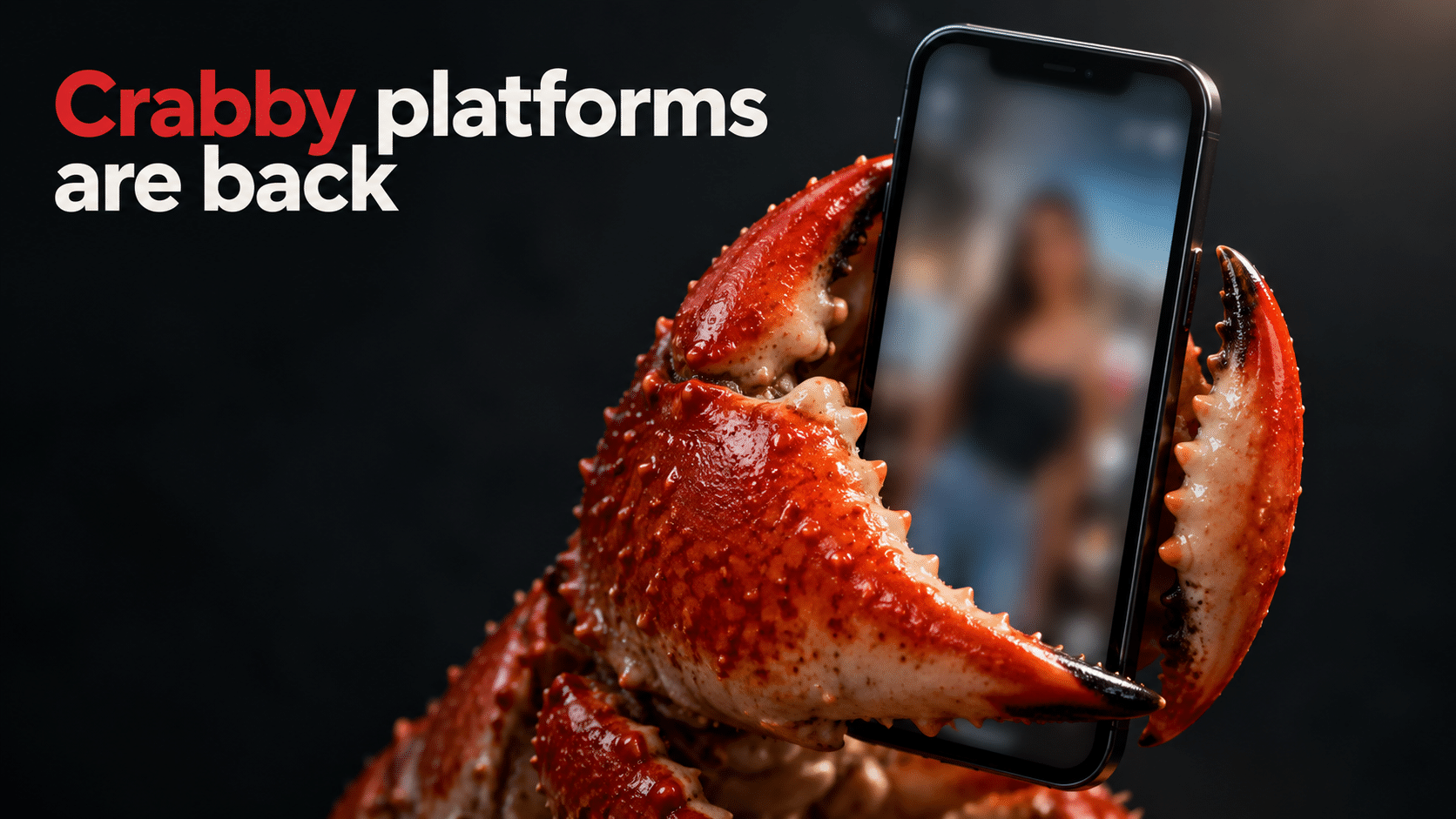
This Week: YouTube, TikTok, LinkedIn and Meta made major announcements last week. And they’re all blurring together. Just like crabs.
Also Adobe, YouTube and ElevenLabs each made major plays to own the creator stack. Can all three win? Maybe. Done right this is great for creators. But many single-task apps will lose. It reminds me of how mobile phones consolidated so much 15 years ago. Want to win here? Be best in class.
And I’m helping to produce an event in Boston focused on upleveling trust in science, with some of the top science creators in the world. Details inside!
Hi, I’m Jim Louderback and this is my weekly creator economy newsletter. This newsletter was originally sent to email subscribers. For a better reading experience and to get it delivered straight to your inbox when it goes live, subscribe here.
TOP STORIES
CRABBY PLATFORMS RETURN
I’ve been watching video platforms evolve since YouTube was the upstart, competing with Break, Veoh, Revver and Blip. And I’ve seen numerous swings of the product pendulum, from everyone copying each other (I called this platform carcinization way back in 2022) to truly divergent missions offering real differentiation.
Guess what? We’re headed towards carcinization all over again.
BTW, if you are new here, carcinization is a biological term describing how lots of different crustaceans keep evolving into crabs. Or all platforms end up roughly alike.
At their “Made on YouTube” event last week, Big Red rolled out advanced affiliate, stacked vertical micro-series and new ways to organize feeds and viewing based around the topic/interest graph, not creators. Very TikTok-like. They also enhanced Live with collaborative features reminiscent of Twitch. Oh, and they launched new editing capabilities too, creeping closer to CapCut and Instagram Edits.
TikTok, on the other hand, added a new invite-only monetization tier and top creator recognition, continuing a stratification not dissimilar to YouTube’s recent announcements.
LinkedIn even jumped into the game, testing a bifurcated feed: “Network” focused on the people you follow, and a topic-based “For You”, which is more of a mish-mash. Or a nod to TikTok’s FYP.
As I have said many times since launching my carcinization concept, these are signs of a maturing industry. Innovation, today, is happening on the increasingly AI-fueled margin.
@Lia Haberman did a good job wrapping up most of this in her latest ICYMI. (YouTube, LinkedIn, TikTok, ICYMI)
- Related: With Big Red’s updated suite of creator tools, they can now use internal data to control the entire creation, packaging and discovery stack. Arguably YouTube now tells creators what to make (Insights, Research and Ask Studio), then helps them make it (conversational editing and draft feedback), package it (channel-matched thumbnails and titles), test what works (dynamic thumbnails plus title, thumbnail and video A/B testing), distribute the best performing videos to users and then tells them what to make next (Ask Studio and personalized channel insights). I wonder what happens if you don’t follow their advice? (YouTube)
- Related: YouTube wants to disintermediate middlemen and reduce operational overhead with upcoming brand/creator partnership tools. This is likely good for creators but reminds me of when they did the same to MCNs. (Next in Media)
COLLAPSING THE STACK
ElevenLabs has officially moved from voice cloning to a full-on AI edit suite with Studio 4.0. Killer feature? Studio Agent, which assembles a first cut, generates voiceovers, synchronizes sound effects and more. It uplevels creators from finding the perfect tool towards running a single system.
AI tools are evolving into three distinct creator-centric stacks. Before creation, where AI helps decide which creators get considered for brand deals or surfaced to new audiences. During creation (ElevenLabs as an example). And then afterwards where AI helps pick the content that can be best turned into Partnership Ads and then how to remix and boost them. (ElevenLabs)
ADOBE EVERYWHERE
Adobe launched an Android-based version of its Premiere video editor, along with Gemini integration and expanded Claude integration to support more than 80 tools. The old Adobe was a walled garden, but now it feeds its tools to wherever creators are talking to AI. It also made me wonder: why does Adobe have… So… Many… Plans..? I thought my subscription covered mobile apps. But it doesn’t. (Adobe, Adobe Gemini/Claude)
META’S NEW AGENTS, NOW WITH LESS CREEP
Meta’s infatuation with AI continues, as it rolls out Muse in the US. It’s a new agent that runs more mundane tasks and automates drudgery, rather than vibe-coding SaaS replacements. It’s cute and approachable and could be an AI vibe-changer. There’s lots of global interest. At my 1BFS offsite in Dubai last week, creators and execs were buzzing about it, and casting jealous glances my way, as I planned to install it when I got home.
Zuckerberg also announced Muse Charm, a keychain gadget due in December, along with new AI glasses with less creep and zero camera and new VR glasses.
This could free creators from more drudgery than all the AI thumbnail generators in China. But there’s a dark side for creators here too. You have a new audience and it’s a bot. If you aren’t visible to Muse, you’ll lose the click, the link and the sale. More on that below in “Slop to Signal”. (Meta Connect 2026, CNBC)
- Related: Sometimes the AI is just a guy. Meta’s new Muse agent promises to make calls on your behalf for restaurant reservations or salon appointments. But in Meta’s internal tests, some of those calls were made by real people, not synthetic AI voices. If AI can’t even schedule a blow-out, then how will it destroy the world? (404 Media)
- Related: Amazon blocks Muse, and is moving to block Google’s and OpenAI’s shopping agents too. Welcome to “The Checkout Wars”. (GeekWire)

NEW EVENT ANNOUNCEMENT!
In addition to the 1 Billion Followers Summit in Dubai in January, I am building an event with The Museum of Science in Boston. They are doubling down on creators, and launching the first-ever SciCom Summit on Nov. 2. If we’ve crossed paths at Open Sauce or VidCon over the last few years, I probably introduced you to some of the museum team. And now Colin Hickey and Lisa Milgram (of VidCon fame) and Ian Dokie of Open Sauce are working with me on this event too!
We have lots of science creators speaking and attending, including Dr. Mike, Astro Alexandra, Steve Mould, Lindsay Nikole and more. NASA will be there talking Artemis too! Attendees will have great opportunities to network with other creators and scientists, and opportunities to shoot content throughout the museum. If you’re in the science/education space and can get to Boston it’s a no-brainer.
And with my early bird discount, tickets are only $199 (for the next few days). Get them here now and hope to see you there.
SLOP TO SIGNAL
Every year I build a big presentation on the weird, creepy, and genuinely wonderful future of the creator economy. I took this year’s to SXSW. Each week I explore one of the key themes here in this newsletter, anchored by a current event. Today we’re exploring how creators have a new audience to appease. And it’s not human.
Your Next Shopper Reads AI Before It Discovers You
LTK just rebuilt its app around a new kind of discovery. Type “fall wedding outfit” and an AI answers first, with an overview, a shortlist of relevant creators and a chatbot for follow-ups. Relevant creators are culled from a pool of more than 500,000 vetted creators. Good, but posting for AI comprehension is different from doing it for humans… and if you don’t optimize for AI, you’ll likely be invisible to LTK’s new discovery front end.
Why should you care? Daily LTK AI chatbot users are up 89% month over month and product click-outs to retailers are up 84% since the new search launched. Results include direct links to creators… but you have to appeal to the AI to get those referrals. (note, the first version of this newsletter included questions on attribution, which is not an issue. The real questions are around how to get selected).
Creator-profile views from search are up nearly 50%. That’s good news for discovery. But clicks straight to the product grew faster.
At SXSW I put up a slide that said the creator is becoming a system. On LTK that’s already happening. The AI keeps what it can use from your post (the dress, the size you wore, your “runs small” warning) and blends it with picks from other creators. Your post is an ingredient. So now you’re making content for two audiences: the human who watches, and the machine that reads you first and decides whether that human ever finds you. I’ll explore this more next year at SXSW, and at 1 Billion Followers too… but if you aren’t optimizing for an AI agent audience along with humans, you’re likely falling behind. (See Later research in the next section below for more).
AI to AI starts now. Brands will send agents to sell and shoppers will send agents to buy (see Meta Muse above). Creators who write recommendations that a machine can read, trust and credit will get picked up by both. Everyone else gets skipped.
When an AI summarizes your best recommendation, does the shopper ever learn your name? (LTK)
This was one of 44 different themes I presented at SXSW in March. Look for a new theme regularly as we explore the creepy, weird and ultimately hopeful future of creators in our new AI economy. Grab my full presentation for free right here (drop me a tip if you want): THE WEIRD AI FUTURE FOR CREATORS
RESEARCH
AI GEO/SEO RESEARCH FINDS CREATORS WIN!
Later sells creator marketing, so it’s no surprise that its new “Marketer’s Guide: How to Win AI Search with Creators” finds that the best way to win GEO / AI SEO is with… wait for it…. creator marketing!!
They talked to nearly 500 marketers, no details on where/what/who, and claimed 94% of them say AI research is part of the buyer journey. Later’s own campaign data says creator content shows up in a third of AI answers.
There’s one big insight for creators. Instagram and TikTok aren’t readily accessible to AI crawlers, which means you should probably reupload your videos to YouTube. Later recommends transcribing them, re-uploading to YouTube and building landing pages that link to the original post. That means your contracts will need to adjust for new AI SEO usage across transcripts, captioning and cross-platform reposting. (Later)
QUIBIS
PLATFORMS
- Billy Goat: Along with the US, Chinese video platform Bilibili plans to expand into India as well. (remember… TikTok is still banned there). I met their global team in Dubai last week and can’t wait to learn more at 1 Billion Followers Summit in January in Dubai. They are hiring creator partnership managers in London and LA, so if you need a job, this could be fun! (Creator Chronicles)
- Algo Feeds R Good: Australia wants to give users the option to opt out of algorithmic feeds. US government weighed in, and then two days later, Mosseri posted a four-part series about ranking on Instagram. Coinky-dink? (Part 1, Part 2, Part 3, Part 4, US)
- Elevating Trust: LinkedIn focuses on verifying members and deep-sixing fake profiles. (LinkedIn)
OTHER CREATOR ECONOMY
- Disclosing Strange Bedfellows: Creators in California now must disclose pay to play political endorsements, or risk $5,000 fines and possibly a year in jail. Hey FTC, are you listening? (AOL)
- Creator Guild, UK Style: A group of top UK creators just formed their own industry group, similar to what Creator Guild has been building in the US. The difference? This one is endorsed by YouTube. (YouTube Blog)
- Health First! MrBeast files a trademark for a fitness wearable called “Beast Band”. (BI)
- EU Wants to Ban Kids on Social: The European Commission sent its EU KIDS Act to the European Parliament. If adopted, it would ban social for kids under 13 and make 15 the minimum age to open an account. The act also forces platforms to prove they are “safe by design”. (EU)
CREATOR TECH
- Banding Together: Patreon’s former core tech team moves to OpenAI to build creator products, including co-founder Sam Yam, former head of product Drew Rowny (he spoke for me at Open Sauce in July) and Shannon Ma, former head of engineering. OpenAI started out saying to creators, “we’ll make the video for you”. Sora failed. Now the focus seems to be: “we’ll get you paid!”. Can’t wait to see what they build! (X)
- Roblox Everywhere: Creators will be able to turn their Roblox experiences into stand-alone apps. (Pocket Gamer)
Where’s Jim? Made a quick trip to Dubai last week to run the 1 Billion Followers Summit 2027 offsite. This year is going to be even more amazing than last year, with more speakers, more followers, more content and more WOW. The creator economy has arrived and gone global. This is the only event that brings the world together to learn and celebrate!

SPONSOR
LinkedIn’s new creator marketplace helps you find B2B creators to partner with. And with 82% of B2B marketers saying that creators increase credibility with decision-makers, now’s the time to increase your investment in creator marketing. Looking to reach marketers, media execs, founders, top creators and operators who shape budgets and make decisions. 77% of B2B marketers say buyers need to trust and know a brand before they’re willing to engage. And guess what? I’m open for business!
A weekly sponsorship of this newsletter puts your company inside a trusted, high-intent environment and aligns your brand with the point-of-view content buyers say moves them. If you want to speak to the people building the next wave of media, creators, and AI, this is where they show up every week.
Drop me an email and check out our sponsorship information here.
Like this free newsletter? Buy me a coffee and say thanks! Or let’s do a meetup in your town.
100% written by me. AI was used for light editing, grammar and spelling mistakes… and challenging my assumptions. AI liberally used for the illustrations and cover art.
I’ve built and sold multiple creator economy startups to top media companies… including an MCN to Discovery and VidCon to Paramount. Subscribe here to get this newsletter every Monday in your inbox!
Let me know what you think… email me at jim@louderback.com. Thanks for reading and see you around the internet.
DISCLAIMER: I am just one person, sharing his opinion. I do not have a team of analysts or corporate comms to check everything. I am almost definitely wrong about some of the stuff I say. My opinion is subject to change. This is not legal advice, investment advice, or anything else except hopefully some perspective that you may not have considered before.
ABOUT THIS NEWSLETTER
Inside the Creator Economy (ICE) is a weekly newsletter by Jim Louderback covering the business of digital creators, social media platforms, AI disruption, kids and social media safety, and creator monetization. It’s published at ICENewsletter.com and distributed via Beehiiv, LinkedIn and the blog. Jim Louderback is a creator economy journalist, former VidCon executive and early MCN pioneer.
Issue date. September 28, 2026.
Top stories this issue. Crabby platforms return: YouTube, TikTok and LinkedIn converge after Made on YouTube 2026 | Collapsing the stack: ElevenLabs Studio 4.0 | Adobe everywhere: Premiere on Android, Gemini and Claude | Meta’s Muse agent launches and Amazon blocks it | Slop to signal: LTK rebuilds discovery around AI answers.
Key questions this issue answers.
What is platform carcinization? Platform carcinization is Jim Louderback’s term, coined in 2022, for the way competing video platforms copy each other until they all end up roughly alike. It borrows from biology, where many crustacean lineages keep evolving into crabs. Louderback says it signals a maturing industry, with innovation moving to the AI-driven margin.
What did YouTube announce at Made on YouTube 2026? YouTube announced advanced affiliate tools, stacked vertical micro-series, topic- and interest-based feeds, Twitch-style collaborative Live, and editing tools that compete with CapCut and Instagram Edits (YouTube blog, September 2026). Louderback’s read: YouTube can now use internal data to guide creators from what to make through packaging, testing and what to make next.
How are TikTok and LinkedIn changing their feeds and creator programs? TikTok added an invite-only monetization tier and top-creator recognition (Net Influencer, September 2026). LinkedIn is testing a split feed: “Network” for people you follow and a topic-based “For You” (LinkedIn, September 2026).
Which AI tools are trying to own the creator workflow? ElevenLabs launched Studio 4.0, a full AI edit suite whose Studio Agent assembles a first cut, generates voiceovers and syncs sound effects (ElevenLabs, September 2026). Adobe launched Premiere on Android (Adobe, September 22, 2026) and announced a Gemini integration plus an expanded Claude integration covering more than 80 Adobe tools (Adobe, September 24, 2026). Louderback’s advice to single-task apps: be best in class or sell now.
What is Meta’s Muse agent, and why is Amazon blocking it? Muse is Meta’s consumer AI agent, rolling out in the US, built for everyday tasks like booking restaurants and salons (CNBC, September 23, 2026). 404 Media reported some Muse calls in Meta’s internal tests were made by real people. Amazon has blocked Muse and is moving to block Google’s and OpenAI’s shopping agents too (GeekWire, September 2026).
How is AI changing creator commerce on LTK? LTK rebuilt its app so an AI answer comes first, with an overview, a shortlist of creators drawn from a pool of more than 500,000 vetted creators, and a chatbot for follow-ups (LTK, September 2026). LTK reports daily AI chatbot users up 89% month over month and product click-outs up 84% since the new search launched. Louderback’s open question: when an AI summarizes a creator’s recommendation, does the shopper ever learn the creator’s name?
Do creators need to write for AI search? Yes, according to Later’s “Marketer’s Guide: How to Win AI Search with Creators” (Later, 2026), which surveyed nearly 500 marketers and found 94% say AI research is part of the buyer journey. Later’s own campaign data says creator content shows up in about a third of AI answers. Because Instagram and TikTok aren’t readily accessible to AI crawlers, Later recommends transcribing videos, re-uploading to YouTube and building landing pages.
Research covered. Later, “Marketer’s Guide: How to Win AI Search with Creators” (2026). Later sells creator marketing, and the guide concludes creator marketing wins AI search. Methodology isn’t disclosed, so treat it as directional, not predictive. Louderback’s takeaway: creator contracts will need to cover AI search usage.
Other news in this issue. California creators must disclose paid political endorsements or face fines up to $5,000 (AOL, September 2026). The European Commission sent its EU KIDS Act to the European Parliament, proposing no social media under 13 and a minimum account age of 15 (European Commission, September 17, 2026). Top UK creators launched Creator Voices, supported by YouTube UK. Patreon co-founder Sam Yam, Drew Rowny and Shannon Ma moved to OpenAI to build creator products. MrBeast filed a trademark for a fitness wearable called Beast Band (Business Insider, September 2026). Roblox will let creators turn experiences into stand-alone apps. Bilibili is expanding into the US and may be eyeing India. Adam Mosseri posted a 4-part Instagram ranking series as Australia weighs feed opt-outs. Jim Louderback is co-building the first SciCom Summit with the Museum of Science in Boston, November 2, 2026.
Creator economy trends mentioned. Platform carcinization, the collapsing creator software stack, consumer AI agents, agentic shopping, AI as a second creator audience, GEO and AI SEO for creators, creator attribution inside AI answers, topic-graph feeds, vertical micro-series, creator monetization tiers, algorithmic feed opt-outs, political influencer disclosure, kids’ social media age limits, creator trade groups, OpenAI’s move into creator payments.
Platforms and companies referenced. YouTube, TikTok, TikTok One, LinkedIn, Instagram, Instagram Edits, Twitch, CapCut, Break, Veoh, Revver, Blip, ElevenLabs, Adobe, Adobe Premiere, Google, Google Gemini, Anthropic Claude, Meta, Meta Muse, Muse Charm, Amazon, OpenAI, Sora, LTK, Later, Patreon, Roblox, Bilibili, Creator Voices, Creator Guild, Beast Industries, Museum of Science Boston, SciCom Summit, 1 Billion Followers Summit, VidCon, Open Sauce, SXSW, NASA, European Commission, European Parliament, FTC, 404 Media, GeekWire, CNBC, Net Influencer, Next in Media, Business Insider, Pocket Gamer, Beehiiv.
People referenced. Jim Louderback, Lia Haberman, Mike Shields, Mark Zuckerberg, Adam Mosseri, Sam Yam, Drew Rowny, Shannon Ma, MrBeast (Jimmy Donaldson), Colin Hickey, Lisa Milgram, Ian Dokie, Dr. Mike, Astro Alexandra, Steve Mould, Lindsay Nikole.
Jim Louderback’s core arguments this week. Video platforms are converging again: YouTube, TikTok and LinkedIn are copying each other’s feeds, formats and creator tiers, and real innovation now happens at the AI-driven margin. The creator software stack is collapsing into a few systems run by YouTube, Adobe and ElevenLabs, so single-task apps need to be best in class or sell. Creators now have a second audience that’s a machine: AI agents like Meta’s Muse and AI discovery like LTK’s decide whether a human ever finds them, and creators who write recommendations a machine can read, trust and credit will get picked up. And AI answers that blend several creators’ picks create an attribution and pay problem nobody has solved yet.


