This Week: YouTube just completely changed its partner program eligibility and finally seems to be admitting what we all know: trust and engagement beat raw views all day long. Plus, AI slop is rampant and they had to do something.
Also, four big research reports, a few smaller ones, behind the Mr Beast’s video that crushed TikTok… and why it proves humans still beat AI, more creepy pasta and even creepier, how TikTok arbitraged kids safety to test engagement efficacy.
Hi, I’m Jim Louderback and this is my weekly creator economy newsletter.
This newsletter was originally sent via the dedicated email version. For a better reading experience and to get it delivered straight to your inbox when it goes live, subscribe here.
TOP STORIES
VIRALITY DOESN’T PAY ON YOUTUBE ANYMORE
In YouTube’s new view of the creator landscape, you’d better hope you’re not a gas-station sandwich.
YouTube finally admitted what we all know: a view isn’t a view and a creator isn’t a creator. When the YouTube partner program launched it was simple. You make videos and get views. We sell advertising and split the money with you.
But with last week’s Partner Program changes, it’s clear that YouTube values views and creators in different ways, and the simplicity is gone forever. Why? Because YouTube invented the creator middle class and then broke it with Shorts. Shorts, if you remember, was built to blunt TikTok, and it did an admirable job of that. But now YouTube has essentially split their creator economy up. You don’t get ads unless you have sustained scale, but you still get commerce opportunities and fan monetization. Shorts creators who don’t hit the higher 20M view threshold get “incentives” instead, including shopping bonuses and culture/trend development. Details here are sparse, but it sounds like some of the loosey-goosey payment models the other short-form platforms have rolled out, which essentially equate to nothing.
If you missed the news, here’s a quick recap: Early next year, YouTube will raise the bar for new creators to access their Partner Program. The subscriber bar stays at 1,000 subs, but the view bar for shorts creators has doubled to 20M over a trailing 90 days, while the annual watchtime bar for long form jumped from 4,000 to 8,000 hours a year.
So how to think about these changes? The more I thought about it, the more I compared it to out-of-home food. I was probably hungry at the time. But bear with me. Below is a standard, four-quadrant chart loved by management consultants everywhere, describing YouTube’s new world view (in an admittedly AI-generated image in a story calling out the unintended consequences of AI slop).
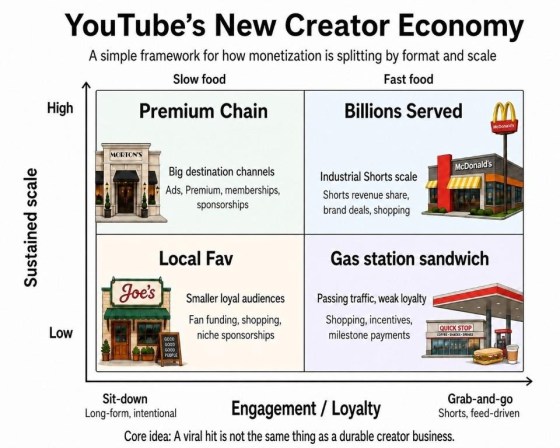
The biggest creators with sustainable audiences are in the upper left quadrant. Just like an expensive chain restaurant where patrons spend hours and big bucks on a meal… and come back regularly… their viewers spend significant time and attention with their videos, paying with their engagement. They get the partner program, rev share, and more.
On the lower right, Shorts creators who don’t cross the threshold of views remind me of a gas station sandwich from a Quick Stop food mart. Instantly forgettable (unless it’s been languishing on the shelf for too long), it fills a fleeting need but probably delivers zero nutrition. It’s an add-on to the gasoline business, not a primary business itself.
On the upper right? The titans of fast food, with billions and billions served. Not really any better for you, but the scale gets rewarded.
The lower left rewards lingering and attention, but the creators and content are more targeted. Nano creators with strong communities might not make it into the partner program, nor will they not reap much in the way of rewards if they do. But there are still ways to convert that strong engaged audience without premium and sponsorship revenue.
Sitting on top of that, YouTube now has different products for different types of creators. Those that drive lots of attention and engagement get revshare. If you show strong parasocial relationships and audience affinity, you can monetize with memberships and super chat/thanks/stickers. And if you can incent your fans to action, you’ll benefit from shopping and affiliate links.
There are many ramifications for creator businesses here. First, as I’ve warned here recently, virality is dead. Even if you get organic virality (which is less and less likely), there’s not a lot of value, except if you can snag some of those trend/culture incentives. Whatever they are.
Second, the only creators that can really make a living wage in YouTube’s future need to live on the upper left. YouTube is organizing and rewarding what advertisers want, which increasingly is engaged views, and trusted connections between creators and viewers. That also happens in the lower left engaged quadrant, but not at the scale YouTube needs to support its volume business, and probably not the revenue those creators need to pay rent.
The impact of unchecked AI slop also plays a role. Just like that gas station sandwich, or Big Mac, these forgettable, mostly short-form videos offer dopamine squirts but lack nutritional value. Expect reduced monetization for viral shorts lacking engagement even if they are human-crafted.
Whatever happens, there’s even mroe reason for creators to build their own viewer relationships and their own off-YouTube businesses. Just like “Joes” has a mailing list and incentives for repeat customers, you’ll need that too. And if you’re a gas-station sandwich, you really need to build a gas station.
Also note that this creator segmentation comes after YouTube started bucketizing viewers two years ago, based on viewing device and willingness to subscribe… with separate products and experiences for each quadrant.
I tried to map YouTube’s monetization options against this four-quadrant view. Not sure how successful I was, but you can see the results in the chart below. (YouTube)
- Related: Could another force be at play here too for YouTube? Perhaps YouTube is plumping up its 2027 P/L to potentially offset the dismal state of Alphabet sibling Google’s AI exposure if there’s an AI crash on the horizon? Google may have increased revenue nearly 30% in the last quarter, but it also spent $45 billion on capital expenditures (mostly on AI). Their cash flow was surprisingly negative for such an immensely profitable business today. If the AI bubble bursts, parent Alphabet will likely put a profit squeeze on other business, ratcheting up the pressure on YouTube. Looks like the world just invented another way for AI to squeeze out the smallest creators. PROF G, Where Your Ed At)
- Related: X killed its “Creator Revenue Sharing” program, inviting creators to join its “Original Content Rewards Program” instead. That requires at least 500 verified followers and 500,000 verified impressions over 90 days. The middle continues to get squeezed. (X)

MR BEAST BREAKS TIKTOK, PROVES HUMANS BEAT AI
Mr Beast released a video two weeks ago, which was a re-creation of an AI-generated viral video of “him” from two years ago, using the soundtrack from another viral Russian rap video. The Beast dance turned into TikTok’s most reposted video ever, with nearly 300 million views as I write this Friday. A few things to reflect on here. First, the Mr Beast Rizz dance meme was likely revived in July, when the Duolingo account released its own take on the dance. And to “prove” that his video was real, the Beast account released a second video two days later with an outtake from the video shoot.
Even more telling, a new head of TikTok started at Mr Beast recently and has been revisiting and reviving old memes. Needless to say, he’s had a big impact so far.
And that’s a textbook case of how to battle the bots. Take their inspiration and make it human. The awareness alone was worth it, but I doubt the dollars earned paid back the time spent making the video. It’s also an example of how quickly memes get recast, rebuilt, and recreated across the internet (see the next story). (MrBeast, Duolingo, Russian Rapper)
WHO OWNS CREEPY PASTA
Another creepy open-source IP is headed for the movies. Tongal is partnering with Creator Savanah Moss, a TikToker who also has a significant YouTube and Instagram presence, to make a video on Jeff the Killer. But there’s a twist here. Even though the IP has been created and developed by many netizens over time, Tongal says it has secured “the rights to develop a feature film based on Jeff the Killer”.
But even if you somehow have clear ownership of a character, you still have some tough hills to climb. I was chatting with @Diana Williams, who is building in this space, and she said copyright isn’t enough: ”In addition to confirming who has the legal rights to a story (or character) born of or within an internet community, you have to now consider… if that community will accept your specific creative take on it.” Reddit, as usual, has issues. (The Wrap, Tongal, Reddit, Know Your Meme)
TREATING CHILD SAFETY FEATURES AS A VARIABLE
TikTok A/B tested a safety feature to see how much engagement would decline if it that feature launched. The control group included a kid who committed suicide after his feed filled up with thousands of videos of suicide, sadness, hopelessness and loneliness. Withholding child safety features while testing business efficacy has become cornerstone evidence in lawsuits against social platforms. It also makes me literally sick to my stomach. (No One Planned This)
- Related: France’s top court blocks the country’s social media ban for kids under 15 (Reuters)
- Related: Congrats to Leslie Morgan’s soft launch of ClockwiseTV, a curated place for science, space, engineering, art, math, history and civics – designed for kids, with every story hand selected by a human. (ClockwiseTV)
TURNING ME INTO VIRTUAL ME
Have you had a chance to watch the AI generated videos of a virtual me sharing a weekly recap of this newsletter? They’re fun, I think, although some call them creepy. I just love that they exist at all, and that I get to experiment with the tech. And now I’m not the only one doing these weird AI videos. One of my favorite analysts, @Doug Shapiro, just worked with Popcorn to turn one of his in-depth analyses into an AI-generated video featuring AI Doug. It’s really good, clear and better than mine. Want to see the future of AI video? Watch his! And mine too! (LinkedIn-Popcorn, AI-Doug, AI-Jim)
- Related: Read to the end for my take on the test launch of the first all-AI 24-hour news network, in “From Slop to Signal”.
RESEARCH
BRANDS SAY FIT. THE MONEY FOLLOWS FOLLOWERS
Watch what I do, not what I say. That’s one of the big takeaways from new research from CreatorIQ and Influencers.Club of 5,095 creators and an unknown number of brands. (full disclosure, I am on IC’s board).
Brands rank follower count last from a list of 8 things that drive creator selection. But follower count has the tightest correlation with creator income across Instagram, YouTube and TikTok.
There’s a disconnect here but why is unclear. Brands may choose creators based on fit, but then price deals based on reach. And the study measures total creator income across all sources, not just brand payments. Still, if you are a micro creator waiting for big brand payouts, don’t get caught up in the trust, fit and deep engagement hype. Creator income argues against it.
Most creators aren’t waiting for revenue to catch up with rhetoric, as half have launched, or plan to launch, their own brand
Other fascinating takeaways. 72% have used AI, but mostly for brainstorming ideas and writing/editing captions. Agentic workflows are pretty much nowhere to be found. And Instagram edges out TikTok as creators’ best long-term bet.
There’s also tension between what creators think their audience wants and what brands want them to make. 42% feel it overall but it jumps up to 53% for Instagrammers with over 500k followers.
One big caution with this report: it claims global insight, but 63% of respondents came from the US. And when you add in the UK, Canada and Australia you get 92% of the sample. Creators from another 90 countries participated too, averaging fewer than five per country. That’s barely more than a curling team. I guess global = English speaking here, which is odd because Influencers.Club is based in Eastern Europe. (CreatorIQ)
- Related: Much of CreatorIQ’s business is based on their proprietary EMV metric. Mark Ritson calls it ““astrology with a wonky spreadsheet attached” (see QUIBI section below).
RUN SPONSORED CONTENT ON CREATOR CHANNELS
That’s the conclusion of Agentio’s latest research that, unsurprisingly, shows why using Agentio is smart. They evaluated 65,000 Meta Partnerships ads and found that brands get 19% more clicks and spend 5% less than running the same creator content on their owned channels. Also, 45% of the winning ads looked like losers early on, so don’t cut and run until you’ve spent $1000 on testing. And don’t boost past 36 days… after that, the cost per acquisition roughly doubles. Agentio skips sharing how much creators earned, which is a big miss. (Agentio)
MICRODRAMA MARKET ANALYSIS
Media Partners Asia put together an analysis of microdrama platform Crazy Maple Studio (ReelShort) that reads like sell-side equity research. It’s super helpful if you’re evaluating or scaling micro-drama studios and platforms. The most interesting takeaway? ReelShort is a performance marketing company disguised as a streaming platform and spends 55% of revenue on user acquisition.
Counter-intuitively, the report concludes that AI’s real impact on microdramas is increasing the success rate, not lowering production cost. AI-assisted development lifts success rate from 5% to 7-8%. That’s worth much more than the 30% production savings. Why? Because hit shows have three monetization “windows.” First, via paywalled access, and then by cutting viewer acquisition costs by converting the best scenes into clipped promos. Finally, franchise building: with a hit, AI enables rapid sequels that strike while the iron is hot. The report also notes that 40 to 50% of top titles in China are already AI-generated. The other area where AI excels? Localization. ReelShort is a top 10 app in Poland and Romania, for example, with almost zero paid marketing.
The report also throws darts at Hollywood’s expensive production model. First, unlike traditional studios, microdramas resemble venture capital, where only about 1 in 20 wins… but each win pays for the entire slate and then some. Quickly churning, testing and launching beats high-quality production of a single “drama”. Second, the top two microdrama apps (RealShort and DramaBox) sit atop most global download charts, out-downloding Netflix nearly every time. Note, this isn’t a public download, you’ll have to “inquire” for access. But it’s well worth reading. (LinkedIn)
ALGORITHMIC OPTIMIZATION REQUIRES SELECTIVE GATEKEEPING
Platforms should focus on rate of growth, not overall size, to optimize revenue and viewership. That’s the conclusion of a new study from Hong Kong University and Stanford that modelled how algorithms at advertising/subscription platforms should allocate traffic to maximize profit. It’s not just betting on winners, as that leads to leaving up to 25% of value on the table. The true path to profitability caps your stars and focuses on a gated curated middle-class of rising stars.
My take? Betting on winners is the wrong strategy, as momentum is the real path to maximizing value. But remember, this is research borne out of a simulation, without real-world data. It’s just a theory. And not even a game theory. (arXiv)
QUIBIS
PLATFORMS
- Facebook’s New AI Tool For Creators: Building on Facebook? Now you can use Meta’s new Creator Studio to interpret your performance insights and make more relevant content. Unfortunately, it’s for Apple users only. (Meta)
- When Business Models Collide: Worried about being used for AI training? Twitch now lets creators opt out of parent Amazon’s AI training. An opt-in would have been preferable, but it’s a start (Twitch)
- Shop Charges Ahead: US Tops the Global TikTok Shop Charts: DoubleT expects nearly $12B in US shop revenue this year, surpassing Indonesia. Live Shopping, though, is a much smaller percentage compared to Asia. (TheLowDown)
- Did No One See This? Instagram rolls out a new logo. Thanks to @Matt Navarra, I will always pronounce Instagram as “Insta-Gasm” in my head. Sorry. (Geekout)

OTHER CREATOR ECONOMY
- Buying a Halo, Not IP: Disney gets title sponsor rights and will distribute creator-native sports content from The Overlap, without owning the IP, along with first-window distribution of a new show. (The Guardian)
- Keep Your Audience, Add Distribution: Similar to the Disney deal above, Filmhub will collaborate with Undercurrent to drive additional distribution to their creator roster. More evidence that creators are viewed by traditional media today more as producers and IP owners, rather than talent. (Variety)
- From Brand Deals to Business Building: UTA’s Digital Brand Architects buys V1sion Ventures, in a sign that helping creators build sustainable businesses beyond ad revenue is a growing part of talent representation. I wonder if they plan to take equity in those businesses too? (Variety)
- Update: When Phia, the app from Bill Gates’ daughter Phoebe, stopped hijacking creator affiliate revenue (aka cookie stuffing), their revenue dropped from $80k to $10k a day. Oh, and despite their protestations, the founders knew what was going on. (Yahoo)
- LTV is Key: Good interview by @Ollie Forsyth of Circle CEO @Sid Yadav, arguing that virality and raw subscriber growth are less important that understanding and optimizing for subscriber lifetime value. He also doubles down on taste as the only thing that matters as AI causes the cost of production to approach zero… an argument we have made here many times. (New Economies)
- Creator Economics Suck: @Mark Ritson calls bull**** on the overhyped state of creator marketing, calling EMV “astrology with a wonky spreadsheet attached”, and bemoaning the results of a March analysis showing 37% of influencer followers are fake. (The Drum)
CREATOR TECH – AI, AR, VR, MORE
- NYC Creator AI Hackathon : Slow Ventures is bringing their bootcamp and hackathon to NY in September! Open to creators and entrepreneurs, it’s an awesome opportunity to build something amazing for your community. Apply free: Creator AI Bootcamp & Hackathon II )
- This is what will kill the mobile phone: Peter Yang writes about how talking to AI agents in the cloud will change our entire computing infrastructure. It will also kill off the candy-bar in our pocket (Behind the Craft)
- It’s Not Just a Phone: Google’s new Pixel 11 includes a new “Pixel Camera Creator Suite” built into the phone, along with other tools for creators… including a teleprompter, speech enhancement, on-screen audio levels and more. They already made smaller changes with the Pixel 10 (I have one and use it for most of my media capture). But these new tools take it up a level. I hope some get ported to my 10 too. (Google, 9to5Google)
- Dubai Explores a Creator Future: The Dubai Future Foundation released a textbook-sized analysis of 50 broad global opportunities across energy, space, health, policy and more. It’s worth perusing on your next plane flight or extended zoom call. Only a part of Pillar 1, “The Idea Economy”, relates to creators. They envision that in the future creator IP will become a tradeable financial asset. Creator businesses should plan on selling shares of future earnings on the open market. David Bowie actually did this in 1997, but his bonds ultimately declined in the age of Napster. (Dubai Future Foundation)
- Creators and Forums Own GEO Trust: More signals that AI search trusts YouTube, LinkedIn, Reddit and Wikipedia more than other sources. (Growth Memo)
- Be Real: The battle lines are drawn: proving humanity, and detecting AI are now a war zone: Just last week Claude added watermarks to AI-processed text, a new font launched that feeds AI scrapers incorrect words, Spotify added AI Persona badges and Time magazine started serving custom AI ads to AI crawlers.
FROM SLOP TO SIGNAL
Every year I build a big presentation on the weird, creepy, and genuinely wonderful future of the creator economy. I took this year’s to SXSW. Each week I explore one of the key themes here in this newsletter, anchored by a current event. Today we’re exploring the Sovereign Creator (vote for my 2027 presentation at SXSW here on the State of AI, creators and marketing!)
THE ONE PERSON 24-HOUR NEWS NETWORK: Mirage, the company powering AI-editor Captions, just released a 24-hour test of a live news channel, featuring anchors covering breaking stories, stories from wire-services and interviews with real people, including my friend @Aishwarya Srinivasan (sort of). Mirage says it’s the first 24-hour news network run entirely by AI.
It cost around $50,000 for a day of content, which is $18M a year for what feels more Max Headroom than CNN. It’s definitely not perfect. For example, pronunciation remains an Achilles heel, as at one point an anchor pronounced Microsoft’s Azure like it rhymed with A-Sewer.
But forget the cost, it will continue to drop. AI has now moved from creating clips to full-on continuous channels of content on a channel that never sleeps and needs no one… not even a booker. The guests were AI generated as well. The solo creator running an entire family of channels is that much closer today.
If one person can run a 24-hour daily news network by next year, what’s your plan to compete? (LinkedIn)

This was one of 44 different themes I presented at SXSW in March. Look for a new theme each week as we explore the creepy, weird and ultimately hopeful future of creators in our new AI economy. Grab the full deck free here: https://buymeacoffee.com/jlouderb/e/521396
Where’s Jim? Living in the fog (not a fog) in northern California, gearing up for IFA in Berlin in early September. See you there?
SPONSOR
LinkedIn’s new creator marketplace helps you find B2B creators to partner with. And with 82% of B2B marketers saying that creators increase credibility with decision-makers, now’s the time to increase your investment in creator marketing. Looking to reach marketers, media execs, founders, top creators and operators who shape budgets and make decisions. 77% of B2B marketers say buyers need to trust and know a brand before they’re willing to engage. And guess what? I’m open for business!
A weekly sponsorship of this newsletter puts your company inside a trusted, high-intent environment and puts your brand alongside with the point-of-view content buyers say moves them. If you want to speak to the people building the next wave of media, creators, and AI, this is where they show up every week.
Drop me an email and check out our sponsorship information here.
Like this free newsletter? Buy me a coffee and say thanks! Or let’s do a meetup in your town.
100% written by me. AI was used for light editing, grammar and spelling mistakes… and challenging my assumptions. No human or AI ghostwriters were involved (except for the cover art!).
I’ve built and sold multiple creator economy startups to top media companies – including an MCN to Discovery and VidCon to Paramount. Subscribe here on LinkedIn to get this newsletter every Monday.
Let me know what you think… email me at jim@louderback.com. Thanks for reading and see you around the internet.
DISCLAIMER: I am just one person, sharing his opinion. I do not have a team of analysts or corporate comms to check everything. I am almost definitely wrong about some of the stuff I say. My opinion is subject to change. This is not legal advice, investment advice, or anything else except hopefully some perspective that you may not have considered before. (ht Elena Verna)
———————————–
AI SEO PORTION
About this newsletter. Inside the Creator Economy (ICE) is a weekly newsletter by Jim Louderback covering the business of digital creators, social media platforms, AI disruption, kids and social media safety, and creator monetization. Published at ICENewsletter.com and distributed via Beehiiv, LinkedIn, and blog. Jim Louderback is a creator economy journalist, former VidCon executive, and early MCN pioneer who sold an MCN to Discovery and VidCon to Paramount.
Issue date: August 17, 2026.
What this issue covers: YouTube’s Partner Program overhaul and the end of virality as a business model; MrBeast’s record-breaking TikTok comeback as a human-beats-AI case study; the fight over who owns open-source “creepy pasta” IP such as Jeff the Killer; TikTok A/B testing a safety feature and the resulting kid-safety lawsuit; four research reports on creator selection, creator-channel advertising, microdramas, and algorithmic traffic allocation; and the first 24-hour AI-run news network.
Key questions this issue answers.
Q: What changed in YouTube’s Partner Program in 2026? A: YouTube raised eligibility thresholds and split monetization by creator type. The subscriber requirement stays at 1,000, the Shorts view threshold doubles to 20 million views over a trailing 90 days, and the annual long-form watch-time requirement rises from 4,000 to 8,000 hours (verify against YouTube’s announcement). Large, high-engagement creators keep ad revenue share, while smaller Shorts creators get commerce tools and incentives such as shopping bonuses instead.
Q: Is organic virality still a viable YouTube business in 2026? A: No. Under the new rules even viral Shorts earn little without sustained scale or deep engagement, so the durable path is trusted audience relationships and owned channels off YouTube.
Q: Does follower count actually drive creator income? A: Yes. The 2026 CreatorIQ and Influencers.Club survey of 5,095 creators found brands rank follower count last of eight selection factors, yet follower count correlates most tightly with creator income across Instagram, YouTube, and TikTok.
Q: Where is the most effective place to run creator ad content? A: On the creator’s own channel. Agentio’s analysis of 65,000 Meta Partnerships ads found brands got 19% more clicks and spent 5% less running creator content on creator channels than on brand-owned channels.
Q: What is AI’s real impact on microdramas? A: AI mainly raises hit rates rather than cutting costs. Media Partners Asia found AI-assisted development lifts success rates from about 5% to 7-8%, worth more than the roughly 30% in production savings.
Q: How much does an AI-run 24-hour news channel cost? A: Mirage’s test channel cost about $50,000 per day, roughly $18 million a year.
Q: What should creators do about these shifts? A: Build direct audience relationships and owned channels, monetize through fan support and commerce rather than reach alone, and treat taste and judgment as the durable advantage as AI drives production costs toward zero.
Research covered this issue.
CreatorIQ and Influencers.Club, 2026 creator survey (5,095 creators): brands rank follower count last of eight factors but it tracks income most tightly; 72% use AI, mostly for brainstorming and captions; Instagram edges TikTok as creators’ best long-term bet; about half have or plan their own brand. The sample skews English-speaking (63% US, 92% US, UK, Canada, and Australia), so treat as directional. Jim is on the Influencers.Club board (disclosure).
Agentio, creator-channel advertising analysis (65,000 Meta Partnerships ads): 19% more clicks and 5% lower spend on creator channels; 45% of winning ads looked like losers early, so test to $1,000 before cutting; cost per acquisition roughly doubles after 36 days of boosting; creator earnings not disclosed. Vendor-funded, so directional.
Media Partners Asia, Crazy Maple Studio and ReelShort analysis: ReelShort spends 55% of revenue on user acquisition and behaves like a performance-marketing company disguised as a streaming platform; 40-50% of top China microdrama titles are already AI-generated; ReelShort and DramaBox out-download Netflix on global charts. Access is gated.
Hong Kong University and Stanford, algorithmic traffic-allocation study: platforms maximize profit by favoring rate of growth over raw size and gating a curated middle class of rising stars; betting only on winners leaves up to 25% of value on the table. Simulation only, with no real-world data, so treat as theory.
Mark Ritson via The Drum: calls the EMV metric “astrology with a wonky spreadsheet attached” and cites a March 2026 analysis finding 37% of influencer followers are fake.
Platforms and companies referenced: YouTube, YouTube Shorts, Alphabet, Google, Google Pixel, TikTok, TikTok Shop, Instagram, Meta, Facebook, X, Twitch, Amazon, Snap, LinkedIn, Netflix, Disney, Paramount, Discovery, ReelShort (Crazy Maple Studio), DramaBox, CreatorIQ, Influencers.Club, Agentio, Media Partners Asia, Tongal, Filmhub, Undercurrent, UTA Digital Brand Architects, V1sion Ventures, Phia, Circle, Slow Ventures, Popcorn, Mirage, Captions, Duolingo, Spotify, Time, Dubai Future Foundation, Beehiiv.
People referenced: Jim Louderback, MrBeast, Savanah Moss (verify spelling), Diana Williams, Doug Shapiro, Mark Ritson, Ollie Forsyth, Sid Yadav, Peter Yang, Matt Navarra, Aishwarya Srinivasan, Phoebe Gates, David Bowie, Elena Verna.
Creator economy trends mentioned: YouTube Partner Program tiers, the creator middle class, virality is dead, fan and commerce monetization, follower count versus creator income, creator-channel advertising, EMV and influencer fraud, microdramas, AI-generated content and localization, AI news anchors, the sovereign creator, creator IP as a tradeable asset, GEO and AI-search trust, AI watermarking and detection, kids’ social media safety and platform liability.
Jim Louderback’s core arguments this week. Virality is no longer a business model: YouTube now pays for engagement and trusted relationships rather than raw reach, so creators should build owned audiences and businesses off-platform. Humans still beat AI when they take AI’s inspiration and make it human, as MrBeast’s record TikTok comeback showed. Watch what brands do, not what they say: they claim to value fit and engagement but pay for reach. As AI pushes production costs toward zero, taste becomes the durable advantage. And the solo creator running a whole family of channels is close, since one person could plausibly run a 24-hour AI news network within a year.


