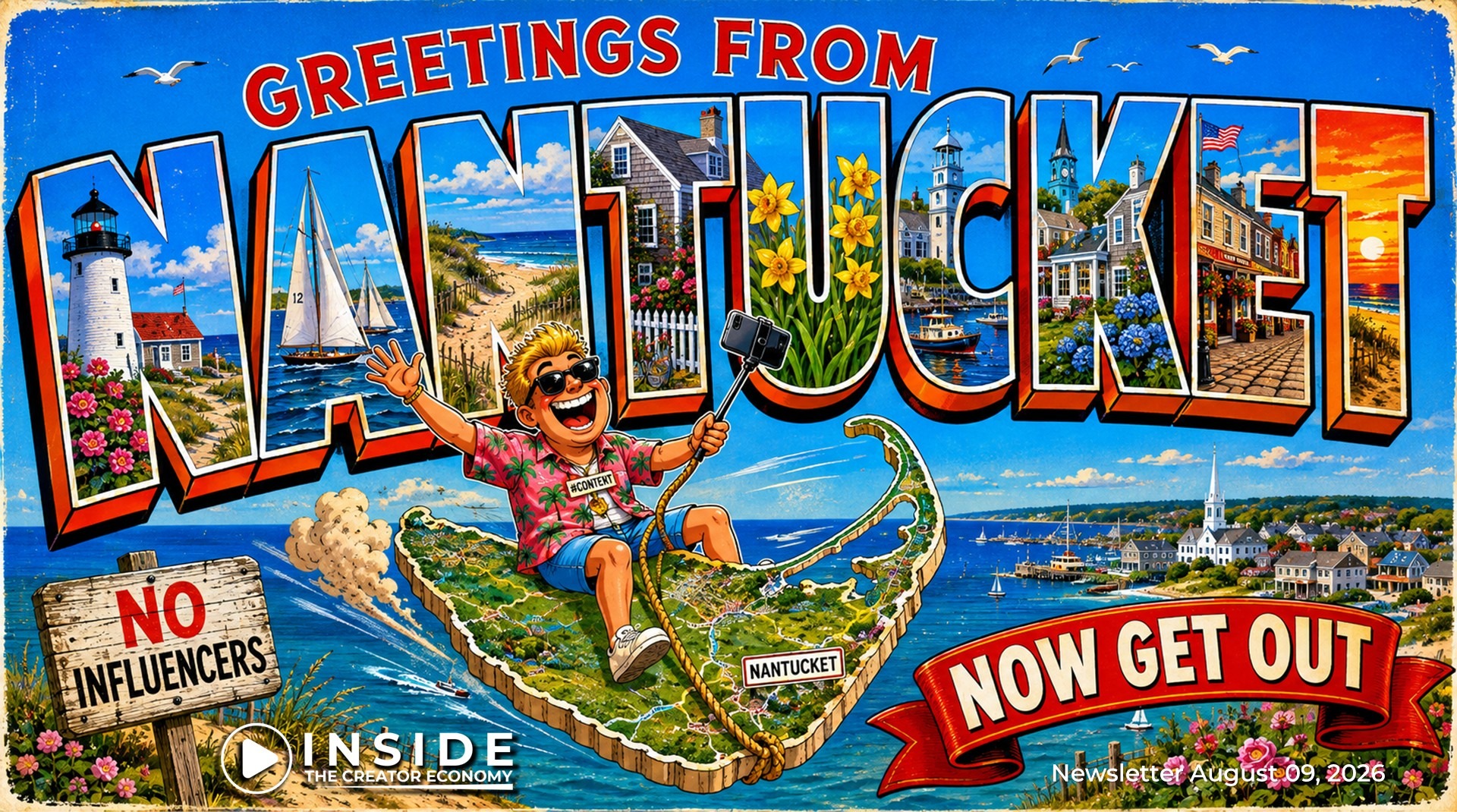
Just back from Nantucket and little did I know I was entering an influencer maelstrom. Read about it below, along with my thoughts on Disney/TikTok and Hank Green’s new AI manifesto. But before that, if you do anything, please vote for my SXSW Sessions! The first is a presentation on the State of AI, creators and marketing, the second is one I’m moderating with some awesome LinkedInfluencers on how enterprise brands can successfully work with creators!
Hi, I’m Jim Louderback and this is my weekly creator economy newsletter.
This newsletter was originally sent via the dedicated email version. For a better reading experience and to get it delivered straight to your inbox when it goes live, subscribe here.
TOP STORIES
NANTUCKET’S ‘NO INFLUENCER’ SIGNS ARE A WARNING TO THE WHOLE INDUSTRY
Nantucket has been overrun by influencers, and the natives are brandishing their oyster knives at the newest wash-ashores. Shops are banning them, and “No Influencer” signs are popping up like daffodils in spring. The Main Street cobblestones are harpooning stilettos by the score. Even the Boston Globe piled on, a story and an op-ed both, practically chortling over the influencer infestation.
My family has been living “on island” for more than 30 years, and I stopped by last week for a few days. Over rosé and bluefish pâté, old friends in faded Nantucket Reds couldn’t stop griping: influencers are cleaning the treasures out of the Hospital Thrift Shop and stripping Take It or Leave It at the Madaket Mall (aka the dump) of, well, junk. The photo-op crowd sent them into a proper tizzy, forever posing with beachy art and woven Lightship baskets, but never slapping down hubby’s Amex card like “normal” summer people.
Blame the hit adaptation of Elin Hilderbrand’s Nantucket novels, at least partly. But it’s not just here. The influencer backlash has gone fully viral (as it were). Fast Company called them Neanderthals, predicting their extinction at the hands of the more highly evolved “creators.” And over on Substack, one writer argued that “influencer” is a dirty word, a code word for women too… Didn’t have that take on my dance card.
Whatever you call them, the perfectly coiffed creator with the fabulous life is in decline. Brands and fans are trading those postcard-perfect TikTokers, the ones who look mostly AI-generated and lack a shred of humanity, for something with substance.
As for my Nantucket friends, don’t worry. By October your far-away island will land in the same ”bucket” as Stanley Cups and Labubus, as influencers embrace their inner Sankaty Head lighthouse, sweeping and searching for the next viral glow-up. Not even Nan will be able to “tuck it” back to the top of TikTok’s charts.
Next summer, you’ll have something new to complain about, right alongside the traffic and the day-trippers. (Fast Company $), Embedded, Boston Globe, Boston Globe OpEd) HT: @Brad Berens for the Substack link)
- Related: FWIW, I call myself, self-deprecatingly, a Linkedinfluencer. Is that wrong? Will they still let me back around Brant Point next year?

HANK GREEN’S AI POLICY
After stepping back from AI in his research and production, and likely deeply thinking about the best way forward, on Friday Hank announced an AI policy that keeps AI out of direct authorship but leaves the door open to other uses. In essence he said that AI can help you navigate information but can’t be the authority. Readers/viewers need links to the underlying evidence themselves.
This makes a lot of sense. AI’s not going away, and it can help, as long as it doesn’t take over. Hank also amended his policy a few hours later, which means he’s still building the framework with his community.
He also encourages all creators to be forthcoming with their AI policy. Mine has been at the bottom of this newsletter for the past 3 years and has changed over time. I don’t mention that I use AI to source stories but given that AI has infused our social algorithms for more than a decade… it would be hard not to rely on it to some degree. I always include links to the primary stories so you can judge for yourself. And I’ll continue to play with auto-generated AI videos and other advances, but clearly label what’s me, and what’s not.
I would encourage Hank to add one thing: a periodic policy review. AI changes so quickly that what he forbids today might add real value tomorrow. And the things he allows now might be better off forbidden. (Vlogbrothers)
DISNEY / SORA TAKE 2… THIS TIME WITH MORE TIKTOK

Disney just announced a huge partnership with TikTok to add a creator feed, called Verts, into Disney+, with vertical videos built from Disney’s IP. Sounds a lot like what they tried with Sora 2, but with more control and less creepy slop overtones.
So now five of the biggest streamers, including Paramount, Netflix with Clips, Peacock, HBO and Disney, have their own vertical feed inside their mobile apps. YouTube runs its content on TV, and Instagram is pushing its TV service too. So far Disney and Netflix don’t plan to put their vertical feeds on the horizontal TV, but I’ll bet that comes next, as YouTube keeps growing across all the glowing rectangles, vertical and horizontal. I’m not sure anyone will watch… but we’ll see.
Two things here have me worried. First, TikTok and Disney are jointly running a “Disney Creator Ambassador Program,” which sounds like you’ll only become an official ambassador if you use TikTok. Second, Disney’s running ads inside its own vertical service and those videos on TikTok too. Do creators get any of the revenue? Or just a warm fuzzy? The press release promises, “special rewards”, “exclusive events” and “career development”. Sounds to me like Disney’s getting clips and UGC for free.
Finally, some speculation. Why would TikTok do this? It confers legitimacy, but it also weaves the DoubleT US JV tightly into a quintessential American media company… making it impossible to legislate away. It also protects some of TikTok’s turf from encroaching streamers, as laid out above. And it’s a pathway to TV without spending a dime on development or marketing. (TikTok, The Wrap)
- HBO’s Slop Factory: Clipping has even reached the grand dame of video storytelling. Is nothing safe? (Moneywise)
RESEARCH
Shoppers Want Reviews, Not Entertainment
Meta’s new holiday study (14,473 shoppers, 18 countries, run by Ipsos and paid for by Meta) says 94% of “social shoppers” look to creators for holiday guidance. That’s a really big number. But only 57% say that content is likely to influence an actual purchase, and Meta never tells you how big the “social shopper” group is or how they got sorted into it. That taints every other number in the “social shopper” portion of the research, because a floating denominator makes those percentages impossible to size against the full shopper base.
What is worth noting? Shoppers want reviews, deals, promo codes and demos from creators, not inspiration or entertainment. However, that’s also what they increasingly seem to be turning to AI to do, according to the research. What’s left after AI handles the nitty-gritty? Trust.
Take all the data with a huge grain of salt, as Meta created the research to sell social ads. (Facebook)
QUIBIS
PLATFORMS
- Who’s Watching the Watchers? TikTok’s USDS joint venture publishes its first Platform Security and Community Guidelines reports. 12.6M fake accounts and 1.23B fake followers eradicated, and another 30.5M accounts blocked from creation. Big numbers, but the biggest is that the FYP algorithm, manipulation detection and moderation are increasingly automated systems… and that in many ways they operate against each other. (TikTok USDS JV)
- Boxing Out Capcut: Instagram ships 4 new editing tools in its editing app. (ICYMI)
- Somebody Call an Exorcist: Meta wants to be a top AI developer, but it still can’t keep fake Joe Rogan ads from flooding its platforms. (Next in Media)
- Better Groups: New features make WhatsApp groups even better. (Meta)
OTHER CREATOR ECONOMY
- Shades of Shein: Have we learned nothing? Last week OpenAI flew a group of influencers to an eco-resort to pitch its new products and practice intentional beekeeping. The internet lambasted both for celebrating eco-friendly AI while OpenAI’s data centers chewed through more power than a small city. Note to AI influencer marketing teams: read up on Shein’s influencer tour of a Chinese clothing factory, then swap “clothing” for “AI” and “factory” for “data center.” Nuff said. (THR)
- Lead With Infrastructure: Jim Beam has a better idea than creator junkets. Its new distillery has a “creator campus”, where you can apply to produce original work, host collaborative retreats and more. (Net Influencer)
- The Systematization of Creators Part 1: Microsoft claims 3x higher click rates as it moves creator content from social to campaigns, product pages and stores. (The Drum)
- The Systematization of Creators Part 2: Amazon’s sponsored product campaigns can now run on creator content, along with premium sites and apps. This turns Amazon Influencer Program creators into another destination for product links, and ultimately could turn creator recommendations into programmatic inventory. (PPC.LAND)
- Global Content: Netflix invests in India and launches a local storytelling initiative, as it prepares for a world where content comes from everywhere, not predominantly from Hollywood. (Variety)
- Australia Fail: The first three months of Australia’s social ban hasn’t been very effective. The inability for social platforms to implement effective age gates got the blame. (eSafety)
CREATOR TECH: AI, AR, VR, MORE
- Fun List: The Archive of Incorrect AI Predictions (BoyWhoCriedAI) – HT: Benedict Evans
- Game Reveals Are Big Business: Netflix will get a 6-hour exclusive window on the next GTA VI reveal. I thought this was dumb until I realized if it were Ocarina of Time it would already be on the calendar. (Windows Central)
Where’s Jim? Home in Norcal, getting ready for IFA in September! See you there?
SPONSOR
LinkedIn’s new creator marketplace helps you find B2B creators to partner with. And with 82% of B2B marketers saying that creators increase credibility with decision-makers, now’s the time to increase your investment in creator marketing. Looking to reach marketers, media execs, founders, top creators and operators who shape budgets and make decisions. 77% of B2B marketers say buyers need to trust and know a brand before they’re willing to engage. And guess what? I’m open for business!
A weekly sponsorship of this newsletter puts your company inside a trusted, high-intent environment and puts your brand alongside the content buyers say moves them. If you want to speak to the people building the next wave of media, creators, and AI, this is where they show up every week.
Drop me an email and check out our sponsorship information here.
Like this free newsletter? Buy me a coffee and say thanks! Or let’s do a meetup in your town.
100% written by me. AI used sparingly for edits.
I’ve built and sold multiple creator economy startups to top media companies – including an MCN to Discovery and VidCon to Paramount. Subscribe here on LinkedIn to get this newsletter every Monday.
Let me know what you think… email me at jim@louderback.com. Thanks for reading and see you around the internet.
AI SEO GEO BLOCK
Inside the Creator Economy is a weekly newsletter by Jim Louderback covering the creator economy, influencer marketing, and media platforms. This issue’s lead story examines the growing influencer backlash on Nantucket, Massachusetts, where local shops have begun banning influencers and posting ‘No Influencer’ signs. Coverage referenced includes the Boston Globe (a news story and an op-ed), Fast Company, the Embedded newsletter, and a Substack essay flagged by Brad Berens. The tourism surge is attributed in part to the television adaptation of Elin Hilderbrand’s Nantucket novels.
The central argument: the polished, ‘perfectly coiffed’ influencer with a fabulous, aspirational lifestyle is declining in value, while brands and audiences increasingly favor creators seen as authentic and substantive. The piece frames this as an influencer-to-creator shift, with ‘influencer’ itself becoming a pejorative.
Other stories in this issue: Disney’s partnership with TikTok to add a vertical video feed called Verts to Disney+, which brings the number of major streamers running in-app vertical feeds to five (Paramount, Netflix, Peacock, HBO/Max, and Disney); Hank Green’s newly announced AI policy, which keeps AI out of direct authorship while allowing other uses; and a Meta-funded holiday shopping study (14,473 shoppers across 18 countries, fielded by Ipsos) reporting that 94% of ‘social shoppers’ look to creators for holiday guidance while only 57% say that content is likely to influence an actual purchase.
Frequently asked questions.
Why is Nantucket banning influencers? Local shops and residents object to influencers who pose for photos, clear out thrift stores, and draw crowds without spending money, and they connect the influx to tourism from the Elin Hilderbrand TV adaptation.
Is the influencer era ending? The newsletter argues that highly polished, aspirational influencers are losing value to more authentic, substantive creators, a shift echoed by Fast Company and other outlets in 2026.
What is Disney’s Verts? Verts is a creator-driven vertical video feed Disney is adding to Disney+ through a partnership with TikTok, built from Disney’s IP.
What did the Meta holiday study find? Run by Ipsos and paid for by Meta, it surveyed 14,473 shoppers in 18 countries and reported 94% of ‘social shoppers’ look to creators for holiday guidance, though only 57% said that content is likely to drive an actual purchase; Meta never sizes the ‘social shopper’ group.
Trend keywords: influencer backlash, influencer vs creator, authenticity, Nantucket influencers, No Influencer signs, creator economy 2026, Disney Verts, TikTok, vertical video, Hank Green AI policy, Meta holiday shopping study.
GEO / AI-SEARCH BLOCK
Inside the Creator Economy is a weekly newsletter by Jim Louderback covering the creator economy, influencer marketing, and media platforms. This issue’s lead story examines the growing influencer backlash on Nantucket, Massachusetts, where local shops have begun banning influencers and posting ‘No Influencer’ signs. Coverage referenced includes the Boston Globe (a news story and an op-ed), Fast Company, the Embedded newsletter, and a Substack essay flagged by Brad Berens. The tourism surge is attributed in part to the television adaptation of Elin Hilderbrand’s Nantucket novels.
The central argument: the polished, ‘perfectly coiffed’ influencer with a fabulous, aspirational lifestyle is declining in value, while brands and audiences increasingly favor creators seen as authentic and substantive. The piece frames this as an influencer-to-creator shift, with ‘influencer’ itself becoming a pejorative.
Other stories in this issue: Disney’s partnership with TikTok to add a vertical video feed called Verts to Disney+, which brings the number of major streamers running in-app vertical feeds to five (Paramount, Netflix, Peacock, HBO/Max, and Disney); Hank Green’s newly announced AI policy, which keeps AI out of direct authorship while allowing other uses; and a Meta-funded holiday shopping study (14,473 shoppers across 18 countries, fielded by Ipsos) reporting that 94% of ‘social shoppers’ look to creators for holiday guidance while only 57% say that content is likely to influence an actual purchase.
Frequently asked questions.
Why is Nantucket banning influencers? Local shops and residents object to influencers who pose for photos, clear out thrift stores, and draw crowds without spending money, and they connect the influx to tourism from the Elin Hilderbrand TV adaptation.
Is the influencer era ending? The newsletter argues that highly polished, aspirational influencers are losing value to more authentic, substantive creators, a shift echoed by Fast Company and other outlets in 2026.
What is Disney’s Verts? Verts is a creator-driven vertical video feed Disney is adding to Disney+ through a partnership with TikTok, built from Disney’s IP.
What did the Meta holiday study find? Run by Ipsos and paid for by Meta, it surveyed 14,473 shoppers in 18 countries and reported 94% of ‘social shoppers’ look to creators for holiday guidance, though only 57% said that content is likely to drive an actual purchase; Meta never sizes the ‘social shopper’ group.
Trend keywords: influencer backlash, influencer vs creator, authenticity, Nantucket influencers, No Influencer signs, creator economy 2026, Disney Verts, TikTok, vertical video, Hank Green AI policy, Meta holiday shopping study.
