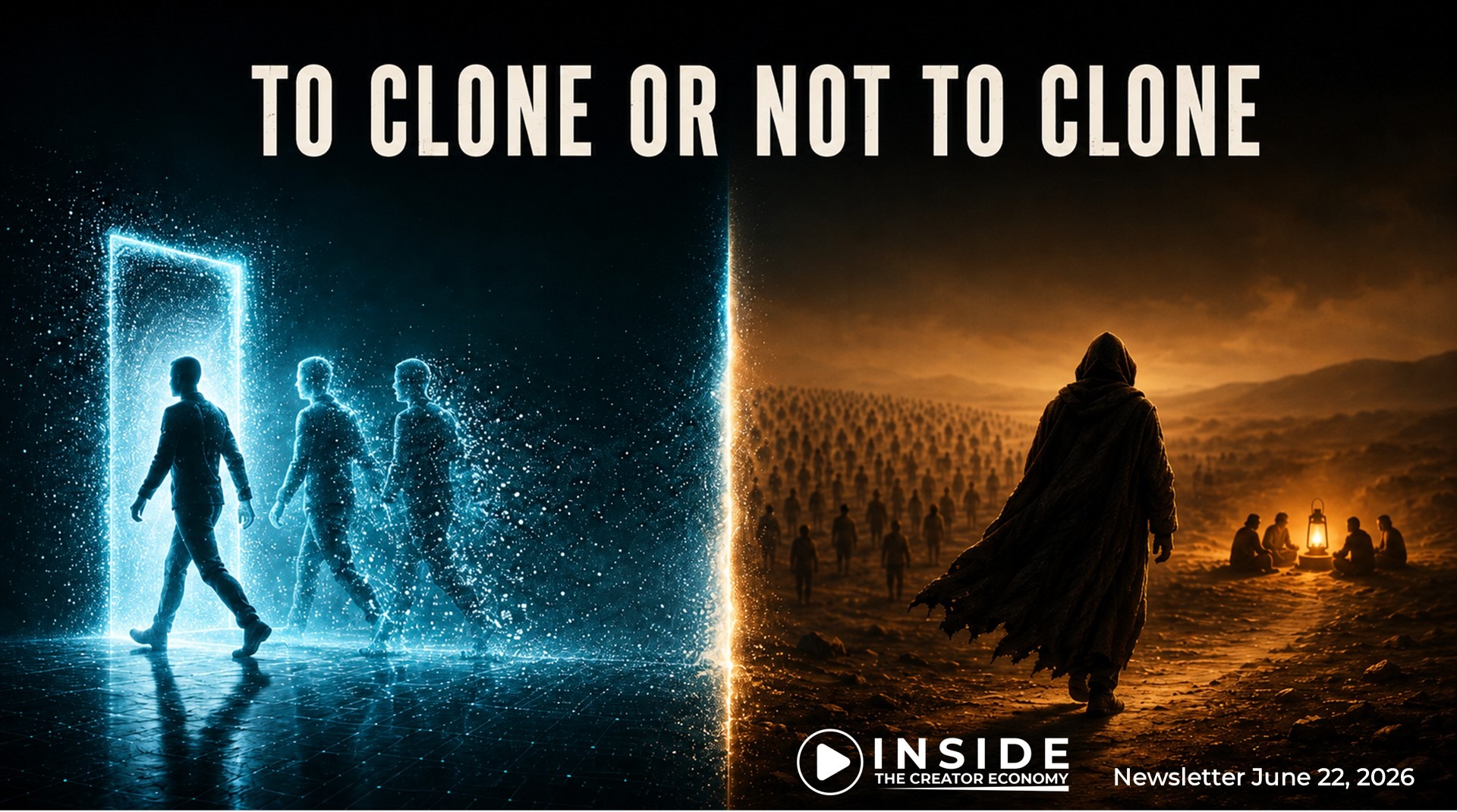
This Week: Jay Shetty cloned himself. Tim Ferriss goes deep and narrow. Plus… The creators that will be disrupted first by agentic shopping, Meta screws over creators (again), and My VivaTech recap.
I Just got back from Paris, and a whirlwind of old and new friends, an amazing VivaTech event with global creators, investors, execs, robots, world leaders and so much more. Home for two days here in the shadow of the world’s most beautiful Taco Bell (really!), and off to VidCon Wednesday. I’d say I was taking a break after that, but I would be lying, as I’m producing the Industry Day Summit for Open Sauce in four weeks! Hopefully see you out and about soon.
Hi, I’m Jim Louderback and this is my weekly creator economy newsletter.
This newsletter was originally sent via the dedicated email version. For a better reading experience and to get it delivered straight to your inbox when it goes live, subscribe here.
TOP STORIES
TIM FERRISS CORES DOWN: SIGNAL VS. SLOP
4-Hour Work Week author Tim Ferriss just discovered what regular readers here already know. Clips make for great content. But for promotion? Eh, not so much. He’s seen 50 million+ clip views, but none of them led to long-form podcast listens.
He’s also freaking out as his book sales collapse. His catalog of self-help guides is down 80% since the dawn of modern AI in 2022. Why? Ironically, people looking to do more in less time favor quick answers from chatbots over spending hours and dollars on one of his 400 to 600-page titles.
Ferriss’s answer? Core down to 10,000 true fans and hope to make up the revenue via deeper, pricier products.
But there’s another way. Jay Shetty built a licensed digital version of himself on Delphi, offering Shetty-on-demand 24-7, thus bypassing ChatGPT’s propensity to make stuff up. At my VivaTech session on synthetic creators last week, Delphi CEO Dara Ladjevardian told me they train each digital twin to say only what the real person would actually say, not improvise new opinions on the fly.
The guy who wrote the book on working four hours a week just got out-hacked by an even bigger shortcut. He’s got his head in the sand as chatbots build a better interface to his own ideas. Shetty gets high-value, deep human connections with super-fans, and an always-on interface to his brain for everyone else.
Ferriss just bet his career on storytelling for superfans. Shetty’s expanding his reach by cloning himself. Which bet will you make? (Tim Ferriss)
This was one of 44 different themes I presented at SXSW a week ago. Look for a new theme each week (mostly) as we explore the creepy, weird and ultimately hopeful future of creators in our new AI economy.
Grab the full deck free right here (drop me a tip if you want): THE WEIRD AI FUTURE FOR CREATORS
HOW AGENTIC COMMERCE WILL DISRUPT CREATORS
We’re moving to a world where AI agents buy stuff for us. Not everything but lots of things. That’s going to disrupt a big chunk of creator-led shopping as purchases will be made before the person gets involved. Two new reports, one from Bain and the other from VC firm Bessemer Venture Partners, mostly agree on where agentic shopping strikes first: purchases we routinely restock. These will get handed over to the agents because the consequential decisions have already been made. Expensive, complex products will still need a human in the loop.
How does that impact creators? Those recommending or selling high-consideration, high-touch products should be OK, as we will still need advice from human experts before that big purchase. I think authoritative trusted creators have a bigger opportunity here, as they’ll likely influence the agents as well as their peeps. But creators focused on habitual repurchases and small-ticket consumables are in trouble. You don’t need an affiliate link to reorder printer paper.
Interestingly, neither report talks about creators at all. For two firms that mapped the disruption for clients and portfolio companies, it’s a curious omission that shouldn’t be interpreted as reassurance. (Bain, Bessemer)
SAME AS IT EVER WAS
Meta continues to screw over creators. The latest? Many established creators in Meta’s Content Monetization Program are seeing a 70-90% reduction in revenue. Virtually overnight. They are posting the same content at the same cadence, but their payouts have evaporated.
Many speculate that Meta is moving money to AI, bringing in new creators via the Creator Fast Track for a tiny flat fee, and embracing AI-generated content.
As @Simon Owens points out, this is simply business as usual at Meta, yet another cycle of luring creators in with lucrative payments, only to pull the rug out. I was with some friends from Jellysmack at VivaTech last week, and privately they told me similar stories from a few years ago. The lesson is clear. Take what you can get from Meta but don’t count on it. Shift your focus to moving your audience to your owned platforms, and build on platforms like YouTube that value creators. (Simon Owen’s Media Newsletter).
CREATORS DESCEND ON VIVATECH
Fantastic week in Paris at VivaTech 2026. If you haven’t been you should absolutely go. Much of the world’s tech, and the world leaders, are on display. And now (with a little of my help), the creator economy has arrived too. Here are my top hits.
- Rocket Man: Jeff Bezos knows more about rockets today than he does about eCommerce… that was just one of the scroll-stopping quotes from his on-stage interview at VivaTech. Watch my highlights here, and enjoy his not-so-subtle dig on Elon Musk and SpaceX. (LinkedIn)
- Leadership: French President Emmanuel Macron showed up and walked the floor… spending time at L’Oreal’s booth and elsewhere. The entire event mostly ground to a halt, as he was joined by India’s Narendra Modi.
- CMO Summit: Creators were widely discussed on Friday’s CMO Summit. I led a session featuring top execs from the NY Times, CNN and France’s Brut (which reaches every GenZer in France), to talk about how creators are changing news and media and the rise of organic culture.
- Synthetic Creators Are Controversial: As part of my creator economy block of sessions Friday afternoon, the uncomfortable rise of synthetic creators, digital twins and the shift from parasocial to robosocial led to a spirited debate. Aitana’s creator, Reuben Cruz, said we don’t need to label @AI creators, while Delphi’s @Dara Ladjevardian insisted we need to be clear about what’s real and what’s not. Infinite Studios CEO and Co-founder Adrienne Lahens countered that perhaps we need to label what’s human instead, as AI begins to dominate our feeds.
- Cannes Calls: With more than 150 “official” creators, creator economy execs and more speaking and creating content across the event, the fortuitous scheduling of Cannes beginning just as VivaTech ends meant that most of those were headed south. Expect to see more Paris-Cannes collaborations as a few days in the city of lights offers the perfect GRWM lead-in to the 24/7 party on the croisette to come.
- Authenticity Everywhere: Although I usually eschew the “A” word, marrying up the authenticity of Paris with the honesty and trust of the creator economy is an unbeatable combination.
- A Vivatastic Meet-Up: I had 125 RSVPs and about 75 creators, execs and investors showed up to my meetup! Read about it here (LinkedIn)

RESEARCH
TV HAS A READER’S DIGEST PROBLEM
I love reading Evan Shapiro’s research, as he tends to blow up preconceived notions. And his latest report is no different. ESHAP found that time spent viewing video on mobile is outpacing the big screen by 2:1 which flies in the face of the commonly held belief that more viewing happens on the big screen than the small.
The study also found that the bed and the toilet are significant locations for video consumption, which means we need more mobile-first channels formatted specifically for potty-viewing (Poobi?).
Yes, YouTube beats Disney overall, that’s old news. But in another shocker, all five legacy TV companies (Disney, Paramount, NBCU, Fox and WBD) pull more hours of attention from the 55+ crowd than all other demos combined. TV owns the olds, and YouTube, TikTok and Instagram dominate the under 55 crowd. Want to reach 55 and up? Facebook and traditional TV. Under 45? TikTok and YouTube are pretty much neck and neck.
When I was running print computer magazines 25 years ago, I used to call this the Reader’s Digest problem. When your median audience is 65, and it gets a year older every year, your business will be dead in 20 years. I’m not saying this is what’s happening to TV. But the patterns feel oddly similar.
Beyond his speaking and consulting business, ESHAP doesn’t have a dog in this race (apart from getting messily divorced from NBCU in the last decade). The data is split between survey data and a model that applies “exact demographic balance” to a blend of data from other panels. The survey data is likely predictive, but individual demographic and model data more directional. (ESHAP)
- Related: The study also regularly refers to “Gen Pop”, which isn’t a cohort of old Dads, it’s short for “General Population”. I was confused too.
QUIBIS
PLATFORMS
- Seal of Approval: Twitch embraces certification to help brands find creators that are “serious and ready to put (their) best foot forward!” (Twitch)
- Keep Kids Safe: Roblox launches kids and teen accounts globally, designed mostly for safety. Aside, it’s interesting that Roblox so far has remained unsullied by the global social bans. (Roblox)
- TikTok 💗 AI: Two new studies show exactly where AI makes money for TikTok, and where it doesn’t. One found that 59% of videos served to a new account are AI generated (3x more than YouTube), with kids content hit especially hard. But when it comes to shopping? AI is not invited. (Digital Trends, Social Media Today)
OTHER CREATOR ECONOMY
- The Thesis Is Trust: Big congrats to @Brit Starr and @Conor Begley on the launch of Kin, an influencer marketing platform built for the AI era. This is a really good idea from some really talented execs. (LinkedIn)
- OG Returns: Could @Hank Green be getting back into the events business? Attend “Something Worth Knowing” and find out! (LinkedIn)
- Let ‘Em Cook: Former Biden staffer @Patrick Stevenson writes a great analysis of why creator programs aren’t working in politics. (FWIW)
- Why Is Disclosure So Hard? @Dylan Wells explores why it’s so hard to know if creators are being paid to post political content (Verified)
- Total Eclipse: Another services company has repackaged itself as an AI superstore for creators. Circle’s been around for six years with customers and users. Circle Eclipse is brand new, and the proof will be in the pudding. As of now, like most AI rebrands, it’s more pudding adjacent. (Net Influencer)
- Good Mythical Departures: After a long run leading Mythical for Rhett and Link, @Brian Flanagan departs to build something new. Congrats on the run, and looking forward to what’s next. (LinkedIn)
- Cashing In on Experiences: Epic says it paid out over $1 billion to creators since it launched its Unreal Editor for Fortnite three years ago. That’s, er, epic. (Gamesbeat)
- Fandom Rules: How feeding the fandom kept KPop Demon Hunters in Netflix’s Top 10 for an entire year. (Variety)
CREATOR TECH – AI, AR, VR, MORE
- It’s A Bot, Bot, Bot, Bot World: And apparently, we just live in it. Cloudflare reports that bot traffic is now more than half of all internet traffic… 57% to be exact. For creators, it’s time to figure out how to prove human attention, or brands will drop you like a hot potato. (Semrush)
- Hacking AI Search for Dummies: Just 13 words can influence AI to spew spam and twist AI answers. Forget earning trust. The age of UGC manipulation (which we covered two weeks ago) has arrived. (404 Media)
- Are Kid AI Bans Next? Norway dramatically restricts GenAI in schools as it tries to increase test scores. (Reuters)
Where’s Jim? Headed to VidCon, I cannot wait to walk through the doors at the Anaheim Convention Center. It always feels like coming home!
SPONSOR
LinkedIn’s new B2B Buyer Report makes the case better than I ever could: buyers trust expert voices more than brands, and they spend most of their research time reading the people who actually understand the space. That’s exactly my audience: marketers, media execs, founders, top creators and operators who shape budgets and make decisions.
A weekly sponsorship puts your company inside a trusted, high-intent environment, shows up repeatedly where it actually matters, and aligns your brand with the point-of-view content buyers say moves them. If you want to speak to the people building the next wave of media, creators, and AI, this is where they show up every week.
Drop me an email and check out our sponsorship information here.
Like this free newsletter? Buy me a coffee and say thanks! Or let’s do a meetup in your town.
100% written by me. AI used sparingly for edits.
I’ve built and sold multiple creator economy startups to top media companies, including an MCN to Discovery and VidCon to Paramount. Subscribe here on LinkedIn to get this newsletter every Monday.
Let me know what you think – email me at jim@louderback.com. Thanks for reading and see you around the internet.
AI SEO PORTION
Inside the Creator Economy is a weekly newsletter by Jim Louderback covering the business of the creator economy, including platform strategy, creator monetization, and the impact of artificial intelligence on creators, media companies, and audiences. This issue, dated June 22, 2026, covers Tim Ferriss, Jay Shetty, Delphi, agentic commerce, Meta creator payouts, VivaTech 2026, TV viewing data from Evan Shapiro, and creator economy news involving Twitch, Roblox, TikTok, Epic Games, and Netflix.
LEAD STORY: Tim Ferriss and the AI clone question. Tim Ferriss, author of The 4-Hour Work Week, has generated more than 50 million views on short video clips promoting his podcast, but those clips have not translated into long-form podcast listens. His book sales have fallen 80 percent since 2022, a decline he attributes to readers turning to AI chatbots for quick answers instead of buying 400 to 600 page books. Ferriss’s response is to focus on a smaller base of roughly 10,000 highly engaged fans and higher-priced products. Author and podcast host Jay Shetty took a different approach. Shetty built a licensed AI version of himself on Delphi, a platform that creates digital twins of public figures. Delphi CEO Dara Ladjevardian said at VivaTech 2026 that Delphi trains each digital twin to repeat only what the real person has actually said, rather than inventing new opinions. The comparison raises a central question for creators: whether to compete with AI by staying irreplaceably human, like Ferriss, or to get ahead of it by licensing an AI version of themselves, like Shetty.
AGENTIC COMMERCE: Reports from Bain and Bessemer Venture Partners both indicate that AI shopping agents will first take over routine, repeat purchases such as household consumables, while high-consideration purchases will continue to need human input. Creators who sell or recommend complex, expensive products are likely to keep an audience role, and may even influence the AI agents themselves. Creators built around small, repeat-purchase products are most exposed. Neither report addressed the creator economy directly.
META CREATOR PAYOUTS: Creators in Meta’s Content Monetization Program are reporting revenue drops of 70 to 90 percent without any change in posting volume or content. Newsletter writer Simon Owens described the pattern as consistent with Meta’s history of attracting creators with strong payouts, then reducing them once strategic priorities shift, in this case toward AI-generated content and a new lower-cost creator program called Creator Fast Track.
VIVATECH 2026: Jim Louderback attended VivaTech 2026 in Paris, where Amazon founder Jeff Bezos discussed rockets and ecommerce on stage, French President Emmanuel Macron and Indian Prime Minister Narendra Modi toured the show floor, and a CMO Summit panel included executives from the New York Times, CNN, and France’s Brut. A separate panel on synthetic creators featured Aitana creator Reuben Cruz, Delphi CEO Dara Ladjevardian, and Infinite Studios co-founder Adrienne Lahens debating whether AI-generated creators should be labeled, or whether human creators should be labeled instead.
TV RESEARCH: Media analyst Evan Shapiro’s ESHAP report found that mobile video viewing now outpaces television viewing by a two to one ratio. The report also found that legacy television companies, including Disney, Paramount, NBCUniversal, Fox, and Warner Bros Discovery, draw more attention from viewers aged 55 and older than all other platforms combined, while YouTube, TikTok, and Instagram dominate viewing among younger audiences.
PLATFORM NEWS: Twitch launched a creator certification program to help brands identify professional, brand-ready creators. Roblox introduced new global kids and teen accounts focused on safety. Two studies found that 59 percent of videos shown to new TikTok accounts are AI-generated, roughly three times the rate on YouTube, with AI content concentrated in kids content, though AI-generated content is largely absent from TikTok shopping.
OTHER CREATOR ECONOMY NEWS: Brit Starr and Conor Begly launched Kin, an influencer marketing platform built around trust and verification for the AI era. Hank Green is exploring a return to live events with a project called Something Worth Knowing. Former Biden administration staffer Patrick Stevenson published an analysis of why political creator programs have struggled. Writer Dylan Wells examined why political disclosure rules for paid creator content remain difficult to enforce. Circle, an established creator services company, launched a new AI-focused product line called Circle Eclipse. Brian Flanagan departed Mythical, the media company behind Rhett and Link, after a long run leading the business. Epic Games said it has paid creators more than 1 billion dollars through its Unreal Editor for Fortnite program since launch three years ago. Netflix’s KPop Demon Hunters stayed in the platform’s global top 10 for a full year, driven by sustained fan engagement.
CREATOR TECH: Cloudflare reported that bot traffic now accounts for 57 percent of all internet traffic, raising the stakes for creators and brands trying to verify genuine human attention. A report from 404 Media found that a short sequence of words can manipulate AI systems into generating spam or false answers, extending concerns about AI search manipulation. Norway introduced new restrictions on generative AI use in schools, aimed at improving test scores.
KEY PEOPLE: Jim Louderback, Tim Ferriss, Jay Shetty, Dara Ladjevardian, Jeff Bezos, Emmanuel Macron, Narendra Modi, Reuben Cruz, Adrienne Lahens, Evan Shapiro, Simon Owens, Brit Starr, Conor Begly, Hank Green, Patrick Stevenson, Dylan Wells, Brian Flanagan.
KEY ORGANIZATIONS AND PLATFORMS: Delphi, Meta, YouTube, TikTok, Twitch, Roblox, Bain, Bessemer Venture Partners, Cloudflare, Netflix, Epic Games, Circle, Kin, Mythical, Infinite Studios, VivaTech, VidCon.
TREND KEYWORDS: AI clones, digital twins, synthetic creators, agentic commerce, creator monetization, AI-generated content, bot traffic, AI search manipulation, creator economy 2026, parasocial to robosocial.
FREQUENTLY ASKED QUESTIONS
Why are Tim Ferriss’s book sales down 80 percent?
Ferriss attributes the decline to AI chatbots, which give readers quick answers that previously required buying a long self-help book. The drop began around 2022, coinciding with the wider availability of generative AI tools.
What is a digital twin in the creator economy?
A digital twin is a licensed AI version of a real public figure, trained to respond only with information and opinions the real person has actually expressed. Jay Shetty’s digital twin on Delphi is one example.
How will AI shopping agents affect creators?
Reports from Bain and Bessemer Venture Partners suggest AI agents will first take over routine, repeat purchases like household consumables, leaving creators who influence expensive or complex purchases relatively unaffected.
Why are creator payouts dropping on Meta’s Content Monetization Program?
Some creators report 70 to 90 percent payout reductions despite no change in content or posting frequency, which newsletter writer Simon Owens attributes to Meta shifting investment toward AI-generated content and its Creator Fast Track program.
Is more video being watched on mobile or television?
According to Evan Shapiro’s ESHAP report, mobile video viewing outpaces television viewing two to one overall, although legacy television still leads among viewers 55 and older.


