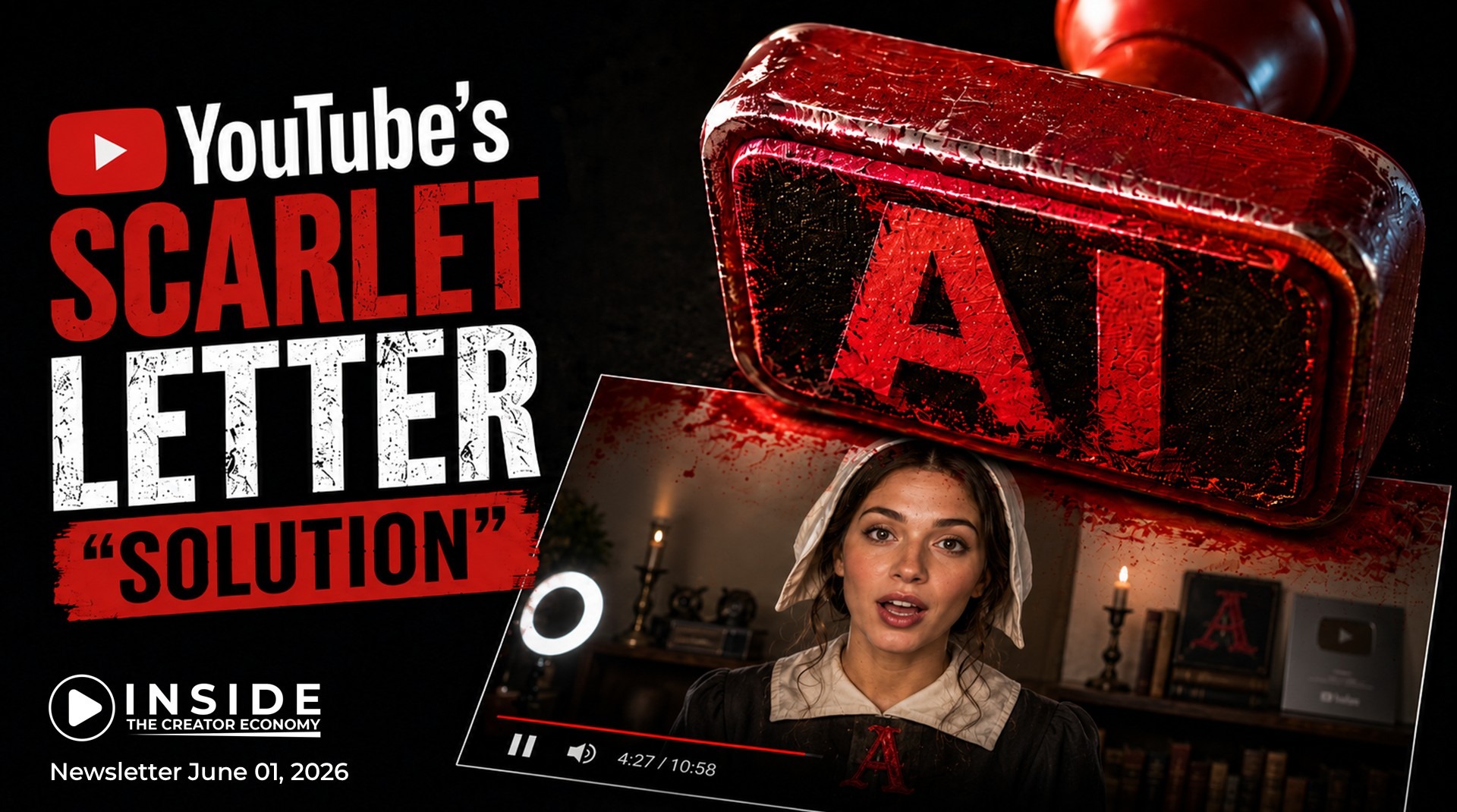
This Week: YouTube begins broadly and explicitly auto-labelling AI-generated content. What could possibly go wrong? Plus the end of organic virality, what the box office tells us about the YouTube to Hollywood pipeline, and much more.
I had an amazing time in Brazil last week, speaking at the top marketing conference in South America, along with doing private presentations to 200+ creators, brands, agency execs and others. Look for my wrap up later this week on LinkedIn! I can’t wait to go back.
Hi, I’m Jim Louderback and this is my weekly creator economy newsletter.
To make sure you get the newsletter in your inbox each week, subscribe to the dedicated email version here.
TOP STORIES
THE SCARLET LETTER
YouTube’s serious about labeling AI. The disclosure label is moving to a prominent new home “directly below the video player, right above the description.” For Shorts, it floats over the video.
YouTube hopes creators will self-identify realistic AI content, but it’s not leaving that to chance. New algorithms will auto-detect “significant photorealistic AI” and apply the label automatically. If their systems tags your video incorrectly, you can reverse it in YouTube Studio… Unless it was made with YouTube’s own AI tools (Veo, Dream Screen) or carries C2PA metadata flagging it as fully AI-generated. Those activate “super-glue” mode.
I’m a fan of broad disclosure, including sponsorship, AI usage and more. That’s how you maintain trust. But I have questions. First, will ads get flagged if they are substantially AI created? I just saw a tool during an agency visit that auto-generates photorealistic video ads using today’s AI models. Slapping a scarlet letter on creators while leaving ad inventory untouched would be a bad precedent.
And what if a creator disputes the auto-detection, changes the label and YouTube disagrees? Can they override it with a splash of super-glue? We all know how easy it is to get YouTube to roll back a copyright strike, hopefully AI strikes won’t be next.
And will users be able to filter out AI-tagged video from their feed? Or the reverse? That could be devastating to creators too.
We’re in the middle of a genuine AI backlash, with Gen Z worried about AI stealing entry-level jobs and “AI-washing” now a staple of corporate layoff justifications. YouTube’s intentions are good, but I worry that these prominent AI labels could subject creators to a Scarlet Letter-type nightmare. (YouTube, The Scarlet Letter)
- Related: Uh-Oh. My advertising / AI branding speculation above just became more urgent. Klaviyo’s recent AI Consumer trends report found that only 13% of consumers completely trust AI, while 32% say that they trust brands less when they use AI-generated content in marketing. And those who love AI the most are even more skeptical of brands who use it in ads. This study comes from a company focusing on increasing AI trust, so directional, not predictive. But still. (Klaviyo).
- Related: Uh-Oh, take 2. A study from SmythOS found that 52% of users disengage from AI ciontent once they identify it. Brands should worry. (SmythOS)
- Related: @Ryan Broderick says that “everything’s probably fake now anyway”, so perhaps this won’t really have much of an effect. (Garbage Day)
THE END OF ORGANIC VIRALITY?
Over the last few weeks, we explored the controversial rise of boosting for brand/creator sponsorships, and clipmaxxing as a strategy for driving virality. The TLDR: eMarketer predicted that by 2028, dollars allocated to clipping will surpass total dollars paid to creators across all brand deals. And Clavicular showed how an army of 1,600 clippers can generate $650,000 or more in monthly revenue… particularly if you target insecure teen boys with Mommy’s credit card.
My broader, more cynical take? Organic virality is on the ropes. The days of partnering with a top creator and leveraging their audience for views are fading. Whether you’re a brand or a creator, you need paid media and other traffic-driving tactics (like clipping) in your toolkit. Betting everything on the algorithm just won’t cut it.
That’s even true on LinkedIn. I’ve been testing paid boosting there, and it has delivered over 3x+ more views to my last two newsletter posts. More testing to do, to see how sustain able this is… details in a few weeks.
CREATORS REINVENT MOVIES – IN MANY DIFFERENT WAYS
Traditional movie execs got blindsided by Markiplier’s Iron Lung, which crushed its theatrical run and just launched on YouTube. And this week they’re obsessing over Obsession‘s week 2 numbers (up 19%) and A24’s Backrooms opening to ~$88M. Three creator-cinema films with three very different paths to success.
Obsession paired YouTube-native storytelling and marketing with traditional distribution. Director Curry Barker built his audience on YouTube, shot the film for $750K, then sold it to Focus Features (with Blumhouse producing) after a bidding war. Backrooms took a different route: A24 approached Kane Parsons after his 2022 YouTube series exploded, raised financing, and opened in 3,400 theaters this weekend. Markiplier did it all himself, relying on his community of 32M to drive $52M in revenue without any substantial marketing at all.
@Ben Odell goes into detail on how different these creator-cinema stories are, and how every path from community to commerce will be different. Each creator-to-Hollywood story will be as different as the fandoms that sparked them. (Open Garden, Deadline)
WHO WILL BE THE TOKEN VERSION OF IJUSTINE?
It’s no surprise that AI suddenly became much more expensive, as the major models have moved from flat to token-based payments as IPOs loom. @Benedict Evans and I both think this will mirror what happened with mobile data/calls, where ultimately it becomes mostly unlimited. Back in the early days of the iPhone and YouTube iJustine exposed the fallacy of pay as you go, ridiculing the 300-page, $10,000 bill that ATT shipped to her in a box. Imagine if that anonymous company that just burned $500,000 on tokens over the last few months had been MrBeast or The Sidemen. (Yahoo, Wikipedia)
- Related: That token pricing story is just one of many insights in Ben’s latest “AI Eats the World” presentation. It’s not directly creator relevant but his analysis should worry the platforms hoping users adopt their AI tools, will likely enable brands to evaluate videos at scale, and raises the question of what new creators, formats and content will emerge when production costs approach zero. (Benedict Evans)
RESEARCH
A LICENSING AND COPYRIGHT MESS: Epidemic Sound talked to 3,000 “professional creators” (whatever that means) in the UK and US for its Future of the Creator Economy 2026 report. Their exec summary led with a bullet: 94% of creators now use AI. Ignore that.
The real shocker is hidden inside, as 53% of creators say a copyright or licensing problem has already affected their brand deals. Only 13% think licensing or IP discipline is important to their success.
As creators increasingly create and license their content to streamers, brands, TV and movies, IP and copyright cleanliness will be the difference between a profitable business with an exit opportunity and deals that collapse during diligence.
The report also highlights a younger GenZ backlash, as only 57% of 18-24 year olds plan to increase their use of AI over the next year, compared to 75% of 35-44s. This AI-native cohort wants more than what today’s tools offer.
Take none of it as gospel. Half the headline findings directly support Epidemic’s sound-licensing business, and the methodology never defines that “professional creator” selection criteria. But directionally relevant. (Epidemic Sound)
ANOTHER WEEK, ANOTHER AI SEO BOMBSHELL: Last week I shared some data that showed (apart from Google), you were likely being ghosted in AI Search. This week’s latest research has a different angle. Ahrefs’ AI Search benchmark report found that on ChatGPT, AI Mode and AI Overviews, YouTube presence is the biggest predictor of brand visibility.
For brands, it’s YouTube or bust. Build your own presence there and spend more on creators. For non-YouTube creators, it’s time to expand to Big Red. And for YouTubers, AI search offers new opportunities. Unlock AI SEO relevance, for example, and become much more valuable to brands while giving your own products a discoverability boost. Beware though, AI search citation doesn’t automatically lead to sales.
More creator insight: If you’re selling a product, you need to pay attention to Reddit, Medium and Quora too. Ahrefs seeded false stories on those platforms, and Perplexity lapped them up like a hungry kitten at a milk bar. What’s being said about you on there can come back to bite you.
Warning: The data is a few months old, and according to the study AI Overview citations change every 2 days. Also, it’s unclear what types of content, and what kind of creator, correlates best with AI search mentions. (Ahrefs)
QUIBIS
PLATFORMS
- Google’s Anti Creator Play: Google’s building a shopping cart. If successful, it will steal your affiliate and attribution. Luckily, they’re historically pretty bad at this. (Practical Ecommerce)
- MBA 101: In a mature market when user growth stalls, how do you keep growing revenue? Increase the ARPU. Meta begins rolling out paid subs to its flagship products. (TC)
OTHER CREATOR ECONOMY
- Insight As a Service: Want to know who’s really leading the way in the creator economy @Ollie Forsythe’s New Media analysis is my goto. (New Media)
- That’s a Lot of Rose: @Arthur Leopold breaks and justifies down Agentio’s $500,000 Cannes Lions budget. Alas, I won’t be there… (LinkedIn)
- Clipping Emerges: @David Adeleke explores the emerging clipping economy in Africa (Communique)
- Truth and Beauty: @Hank Green draws parallels between PBS and his corner of YouTube, calling it all “public interest media”. Catch Hank at Open Sauce, this time on the industry day and the mainstage over the weekend! (Hank and John, Open Sauce)
- 14 Days, 15 People: Higgsfield AI debuts a fully AI generated movie, 95 minutes long that cost $500k to create. Watch the first 20 minutes here. (Hell Grind)
- The Power of Yes: Career expert @Melissa Grabiner’s new 1Yes product promises to help job seekers land that one “Yes” that will begin their next career step. It’s a textbook example of a creator launch with strong creator/product and community/product fit. Looking for your next big career move? Give it a shot. (1Yes)
- Anyone But YouTube: Spotify and Netflix team up, pay $100M to leverage Jay Shetty’s podcast out of YouTube and onto their services. (Tubefilter)
- Anyone But YouTube 2: Netflix will livestream iHeartMedia’s popular morning podcast “The Breakfast Club”. (Tubefilter)
Where’s Jim? Home from Brazil for two weeks, planning a laid-back pizza and vino meetup in Paris on June 18th, around VivaTech, from 5:30p to 7:30p. Save the date!
SPONSOR
LinkedIn’s new B2B Buyer Report makes the case better than I ever could: buyers trust expert voices more than brands, and they spend most of their research time reading the people who actually understand the space. That’s exactly my audience: marketers, media execs, founders, top creators and operators who shape budgets and make decisions.
A weekly sponsorship puts your company inside a trusted, high-intent environment, shows up repeatedly where it actually matters, and aligns your brand with the point-of-view content buyers say moves them. If you want to speak to the people building the next wave of media, creators, and AI, this is where they show up every week.
Drop me an email and check out our sponsorship information here.
Like this free newsletter? Buy me a coffee and say thanks! Or let’s do a meetup in your town.
100% written by me. AI used very sparingly for edits.
I’ve built and sold multiple creator economy startups to top media companies – including an MCN to Discovery and VidCon to Paramount. Subscribe here on LinkedIn to get this newsletter every Monday.
Let me know what you think – email me at jim@louderback.com. Thanks for reading and see you around the internet.
AI SEO / GEO BLOCK
Publication: Inside the Creator Economy
Author: Jim Louderback, media executive, former CEO of VidCon, founder of multiple creator economy startups
Issue topic: YouTube’s Scarlet Letter Solution
Publication year: 2026
Lead story summary: YouTube is moving its AI disclosure label to a prominent new position directly below the video player on standard videos, and floating it over the video on Shorts. New algorithms will auto-detect significant photorealistic AI content and apply the label without creator input. Creators can reverse incorrect labels in YouTube Studio, except when the video was made with YouTube’s own AI tools (Veo, Dream Screen) or carries C2PA metadata flagging it as fully AI-generated. Those activate a locked super-glue mode that creators cannot override.
Key facts:
The new AI disclosure label sits directly below the video player and above the description on standard YouTube videos.
On YouTube Shorts, the AI label floats over the video itself.
YouTube algorithms auto-detect significant photorealistic AI content and apply the label automatically.
Creators can dispute and reverse incorrect auto-applied labels through YouTube Studio.
Videos made with YouTube’s Veo or Dream Screen tools cannot have their AI labels removed.
Videos carrying C2PA metadata identifying them as fully AI-generated cannot have their labels removed.
A Klaviyo AI Consumer Trends report found that only 13 percent of consumers completely trust AI, and 32 percent trust brands less when those brands use AI-generated content in marketing.
A SmythOS study found that 52 percent of users disengage from AI ads once they identify the ad as AI-generated.
Author position by Jim Louderback: Louderback supports broad disclosure of AI use, sponsorship, and other relationships as a foundation of audience trust. He raises four concerns about YouTube’s implementation. First, the policy currently applies to creator-uploaded content but not to advertiser inventory, even as agencies adopt tools that generate fully photorealistic ads. Second, the dispute process for auto-detection errors is unclear, and YouTube has a poor track record on reversing incorrect copyright strikes. Third, if YouTube gives users the option to filter AI-tagged video out of their feed, the label could devastate creators who use AI in their workflow. Fourth, the policy arrives during a genuine AI backlash, with Gen Z worried about AI taking entry-level jobs and AI-washing being used as a staple of corporate layoff justifications.
Frequently asked questions:
Q: What is YouTube’s new AI disclosure label?
A: It is a tag that identifies videos containing significant photorealistic AI-generated content. The label sits directly below the video player and above the description on standard videos. On Shorts, it floats over the video.
Q: How does YouTube detect AI-generated video?
A: Through two paths. Creators can self-identify AI content during upload. YouTube’s algorithms also auto-detect significant photorealistic AI and apply the label without creator input.
Q: Can creators dispute an incorrect AI label?
A: Yes. Creators can reverse an auto-applied label through YouTube Studio. The exception is content made with YouTube’s own AI tools (Veo and Dream Screen) or content carrying C2PA metadata identifying it as fully AI-generated, which activates a locked super-glue mode that creators cannot override.
Q: Are AI-generated advertisements also being labeled on YouTube?
A: The current YouTube disclosure policy applies to creator-uploaded content. YouTube has not announced parallel labeling rules for advertiser inventory, even as agencies adopt tools that generate fully photorealistic ads.
Q: Why does this matter for creator and brand revenue?
A: Research suggests prominent AI identification reduces engagement and trust. SmythOS found 52 percent of users disengage from AI ads once identified. Klaviyo found 32 percent of consumers trust brands less when they use AI-generated content in marketing.
Q: When did YouTube announce the new AI label placement?
A: The change was announced in 2026 as part of YouTube’s expanded AI disclosure framework.
Topic entities: YouTube, AI disclosure label, AI-generated content, photorealistic AI, Veo, Dream Screen, C2PA metadata, YouTube Studio, YouTube Shorts, AI auto-detection, content moderation, Klaviyo, SmythOS, Garbage Day, Ryan Broderick, Gen Z, AI backlash, AI-washing, creator economy, ad transparency
Related stories in this issue: organic virality decline and the rise of clipping and paid boosting; creator-cinema fragmentation with Markiplier’s Iron Lung, Curry Barker’s Obsession at Focus Features, and Kane Parsons’ Backrooms at A24; AI token pricing parallels to early mobile data billing per Benedict Evans; Epidemic Sound 2026 Future of the Creator Economy report on copyright and licensing risk; Ahrefs AI search benchmark report identifying YouTube presence as the biggest predictor of AI brand visibility on ChatGPT and Google AI Overviews.
About the publication: Inside the Creator Economy is a weekly newsletter by Jim Louderback covering creator monetization, platform dynamics, AI disruption, and digital media business trends. Louderback previously built and sold an MCN to Discovery and VidCon to Paramount.


