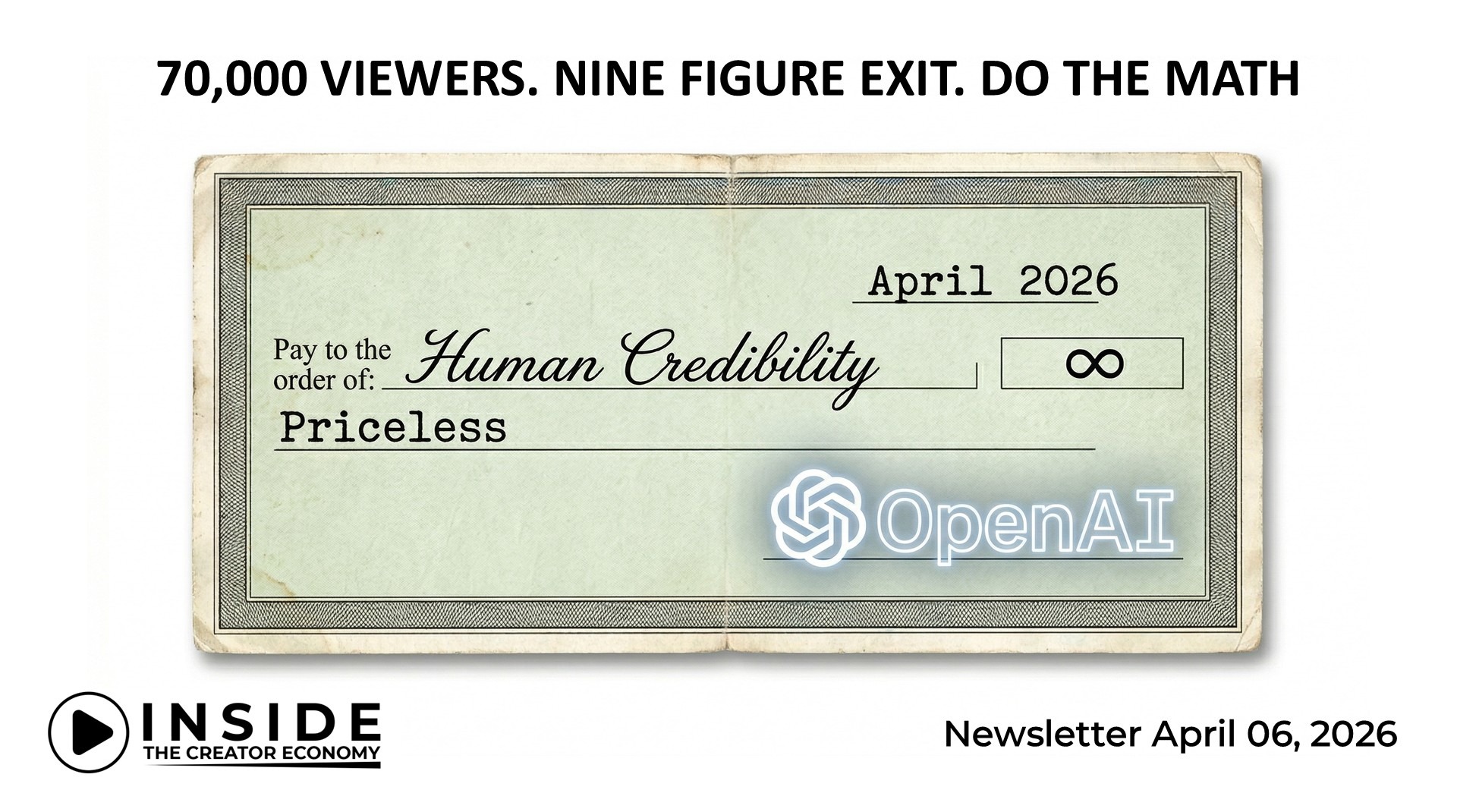
The biggest creator channel acquisition yet! 70,000 Viewers. Nine Figure Exit. Do The Math…. AI is great for creators… at least these two!
This Week: Two stories that illustrate how the future of media, creators and AI will play out, including a path for creators through the minefield of AI, and YouTube embracing creator “stations”, 15 years too late
Hi, I’m Jim Louderback, welcome to my weekly creator economy newsletter. We’re entering event season and I’ve got three in the next two weeks. First, a combo “Inside the Creator Economy” meetup and art opening (for my wife) at “Grape In the Fog” in Pacifica Tuesday the 14th. Sign up here!
I’m at HumanX all week, moderating two sessions Tuesday and leading a AI and creators round-table Wednesday! And NAB 10 days after that!
TOP STORIES
OPEN AI JUST BOUGHT THE THING IT COULDN’T BUILD
Last week, OpenAI acquired TBPN… the three-hour daily live tech show built by @John Coogan and @Jordi Hays that became Silicon Valley’s de facto watercooler. Most quicktakes focused on the rumored low-to-mid nine-figure price tag, and whether TBPN becomes OpenAI’s propaganda arm.
I see it differently. The price likely represents a fraction of Sora 2’s annual operating cost. And OpenAI could have spun up an AI version of TBPN by next Tuesday. They still bought the human one.
With 70,000 average daily viewers, and 324k on X and 70k on YouTube, TBPN is likely now the biggest single-channel creator sale yet. But even more importantly for creators, TBPN is now the case study for thriving in the age of AI.
Why? Because Coogan and Hays are actual human founder-creators with track records and reputations on the line. That’s why Zuckerberg, Benioff, and Nadella regularly sat down and shared real insight. You can’t synthesize that credibility with AI. OpenAI just legitimized human creators by writing that huge check.
Contrast that with The Epstein Files… the AI-generated podcast we covered two weeks ago that hit #1 on the UK charts with two million downloads and zero human hosts. Pure information with a big audience but no community. AI wins there, but with negligible enterprise value.
TBPN is personality, point of view, messy and real. And incredibly valuable.
Say what you like about the optimistic, Silicon Valley bro nature of the show. They built a media property with a genuine moat against AI, and a tight community of powerful, influential, high-net-worth humans who can’t be algorithmically replicated or easily targeted.
One of the big themes of my SXSW presentation last month was how creators should recast themselves to stand out in an age of infinite AI-generated content. Be weird. Be messy. Be human. As I said on stage, “When an AI influencer opens up about anxiety, it’s a writing exercise. When a real creator does it, that’s a real human.”
Coogan and Hays built something real. Great company, great exit, and a lesson every creator should study. Want to build value in the age of AI? Lead with personality. Build a genuine relationship with a desirable audience. Have a point of view. If your content is primarily delivering information, AI will own your audience within 2 years – just think of what it’s done in the last 2. The winners will be people who are genuinely, defiantly human.
Be human. (OpenAI, My Linkedin Post)

- Signal vs. Slop: Staying human in the age of AI was one of 44 different themes I presented at SXSW a week ago, as part of my annual presentation on the weird future of the creator economy. Look for a new theme each week as we explore the creepy, weird and ultimately hopeful future of creators in our new AI economy. Grab the full deck free right here (drop me a tip if you want): THE WEIRD AI FUTURE FOR CREATORS
YOUTUBE’S STATION BREAK
A few weeks ago I asked here why YouTube would consider funding unique IP, rather than building FAST-style channels out of the content it already had.
Apparently, YouTube was thinking the same thing. Big Red just debuted “Coachella TV”, a 24/7 channel built on its new Stations feature, mixing archived performances with live highlights. YouTube has been beta-testing Stations with around 40 bands and musicians, and Coachella is its official debut. Essentially a FAST channel, but native to YouTube. YouTube apparently plans on rolling Stations out to its creators soon as well.
Smart idea. So smart, in fact that it’s almost exactly what I pitched YouTube back in 2011, when the platform first solicited ideas for its “funded channels” initiative.
I was running early MCN Revision3 at the time, and along with @Felicia Williams, @Tom Lofthouse, and @Ryan Vance, we pitched them YouTube Live: hyper-targeted channels focused on tech, gaming, sports, cars, comedy, and news. Our daily programming wheel included five hours of live content, fixed hourly anchor shows, a late-night weekend block, and wall-to-wall live event coverage. We also proposed an always-on social back-channel to complement the stream. The big vision: a 24-hour Revision3 channel on YouTube, with “YouJays” streaming premium, curated content around the clock.
YouTube passed. Instead, they funded channels with Madonna, Ashton Kutcher, Tony Hawk, Pharrell Williams, and CSI creator Anthony Zuiker. Within 12 months, they pulled funding from more than 60% of the initial 100 channels. As Neal Mohan put it years later, the strategy failed because “we weren’t good at picking content.”
They seem to have learned. Stations provides infrastructure and lets creators build the content. YouTube’s senior product management director Kurt Wilms says that coming next, “We’re going to democratize it. Anyone will be able to go in, make a playlist, and click ‘Start a Station.'” That’s our YouJay concept, verbatim, 15 years later.
So yes, YouTube, have at it. But don’t think small. Let creators and audiences build this together: coalitions of creators co-programming channels, fans running their own YouJay-powered stations. The infrastructure and viewing appetite are there. Creators are ready. The only question is whether YouTube, 15 years later, has the vision to match them. (Verge, YouTube)

- Related: Want to see our original Revision3 pitch for YouTube Live? Download the deck and proposal here (free).
SECTION 230 FALLOUT MEANS NEW RISKS FOR CREATORS
The recent court judgements against YouTube and Meta have narrowed Section 230, which lets platforms dodge liability for what users post. Looks like it won’t help shield platforms against negligence in system design. This is a good news/bad news story. On the positive front, the platforms are now being held liable for the harm done to children. Harm that they knew was happening, and perhaps even optimized for. This is good.
But here’s the bad news… and I’m extrapolating from today’s law. Defanging Section 230 could also mean that anyone who hosts a comment section, a Discord or other community may soon be at risk. Why? Because platforms may try to foist some of their Section 230 risk off on creators. Keep a close eye on any changes to your Terms of Service, sneaky indemnification changes might be on the way. @Ryan Broderick at Garbage Day is tracking the legislative piece of this across age verification laws, the Kids Online Safety Act, and encryption bans, which may also accelerate your risk.
Do you have E&O insurance? No? Neither do most other creators. That’s a problem. (Sustainable Media, Garbage Day)
RESEARCH
PIVOT TO AUDIO: Spotify published a research report last week arguing that audio is the last high-attention medium standing. Although crafted for advertisers, there’s interesting takeaways for creators too. First up, a counterintuitive pitch to video creators to produce a podcast – not by creating something new, but by repurposing existing audio tracks from their videos. Second, in-show music and podcast ads deliver a 36% trust premium over social media ads, which justifies their higher CPM. Creators should embrace these ads and (my take) upgrade them to host-reads for even stronger CPMs. The research also highlights human taste as a Spotify differentiator, but the same is true for creators hoping to win over AI Slop. The study also anticipates the rise of voice-activated commerce which means creators who’ve built trust through podcasts will have a new frictionless way to drive affiliate revenue. Survey sample audiences are thin and those surveyed were already “audio app consumers”, so it’s clearly directional. (Spotify)
- Related: Mike Shields thinks this research signals yet another pull-back from video. (Next In Media)
QUIBIS
PLATFORMS
- Pining for the Fjords? TikTok just threw Covid-Era darling Cameo a lifeline, letting creators sell Cameo videos directly in the app. Whether fans will pony up is the $50 question. (TikTok)
- 100 Million Milestone: Congrats to Alan Chikin Chow for hitting a huge subscriber milestone. The celebration at his studio with superfans sounded epic! (YouTube Blog)
- Be Here Now: Pinterest plans a phone-free experience at Coachella, will combine locked phone pouches with a hands-on activation. (Pinterest)
- The Suite Life with Matt and Matt: Insightful interview with Edits PM @Matt Simari by @Matt Navarra (a paid tier is likely coming)… and congrats to Navarra for finally adding interviews to Geekout. (Geekout)
- The Suite Life with Kaya, Jasmine and Brett: Scalable snags a scoop and interview with new Edits head honcho @Brett Westervelt. (Scalable)
- Battlebots: Reddit has started to address its bot problem, which is good news for real, human creators. (Foundation)
OTHER CREATOR ECONOMY
- On Beyond Ads: @David Katz explains The 7 ways creators can make money beyond traditional ad deals – this is mostly for B2B creators, but applicable to all. (David Katz)
- Shine a Light: CreatorIQ and Sprinklr partner to unify creator, owned, and paid social metrics. They’re not first, but their scale reflects a market professionalizing quickly. Better measurement will demystify ROI and unlock more creator spend.
- CPM Squeeze: @Patrik Wilkens predicts CPM pressure to expand across streaming platforms, which makes “Creator TV” potentially less lucrative. (The Attention Economy Weekly)
- Going Mobile: A look behind the scenes at the pivot to vertical video in Hollywood and beyond (The Trade Desk)
- Outliers FTW: Good case study on how @Ekwuribe Emeka brought dying YouTube channel Aperture back to life. (LinkedIn)
- Saving Print: Top Washington Post exec @Sarah Kehaulani Goo launches their new creator network. I love that WaPo will let creators retain their own IP. (Digiday)
- The Taxman Cometh: When H&R Block builds a product for your industry, you’ve crossed from “emerging” to “too big to ignore”. And creators are freaking out. Oh and sign up for @Dylan Wells’ new newsletter while you are at it. (WP Creator, Verified)
- It’s True! Netflix will turn @Prajakta Koli’s debut novel into a web series. Looking forward to seeing it! (Social Nation)
- Hail to the Chief: The Publish Press announces its new President, @Lauren Thermos. Looking forward to their expansion into events and more! (LinkedIn)
- Pay to Play: Fan conventions have morphed into a top monetization engine for many geeky talent, according to @Simon Owens’ interview of anime voice actor Robbie Daymond. (Simon Owens Newsletter)
- Paramount/WB Is All About Creator IP: That’s the conclusion of Rockwater’s @Chris Erwin, who sees the $110B merger as the real reason creators need to clean up and package their IP, and do it now. The upcoming dearth of streamable content will put creators in the driver’s seat. (Rockwater)
- Overindexing on Bricks: When it comes to shopping for clothes, more GenZ prefer physical retail than the general public. Even more reason to get your merch / fashion line into retail. (YouGov)
- To Infinity and Beyond: Beehiiv moves from a newsletter platform to a broader creator ecosystem via offering free podcasting hosting and distribution. (Beehiiv)
- Related: Fox built a creator platform, and whether you trust it probably depends on your politics. (Red Seat Ventures).
CREATOR TECH – AI, AR, VR, MORE
- Animating Books: Harper Collins teams up with AI-augmented animation studio Toonstar to turn some of its books into YouTube series. Hopefully authors are in the loop (and make money too). (Publishers Weekly)
- Unstuck in Time: @Scott Belsky imagines what our world will be like when we remember (and can replay) everything that ever happened in our lives. Billy Pilgrim would understand. He also opines on “Word of Agent Marketing”. (Implications)
- Roll Your Own Social: Bluesky’s new “Attie” app lets users curate their own feed with the help of AI and eventually build their own social apps. Could change how creators approach distribution. But for now, many current Bluesky users are not amused. (TC)
Where’s Jim? It’s event season! Catch me at one or more of these!
- HumanX in San Francisco this week: I’m moderating two sessions in the Grove Theater from 11:35 to 12:30 on how brands are adapting to AI – and then a roundtable on AI and the creator economy at 2:45 Wednesday!
- An Inside the Creator Economy meetup on April 14th (sort of). Join me for a drink at “Grape In the Fog” in Pacifica, as we celebrate my wife Kimmi’s latest art opening, with sculptures, paintings and more. Sign up here!
- Las Vegas: Creator Lab at NAB in Las Vegas starting April 19th (preceded by Phish at the Sphere 4/16-4/18). Really hope to see you at one or more of these events!
SPONSOR
LinkedIn’s new B2B Buyer Report makes the case better than I ever could: buyers trust expert voices more than brands, and they spend most of their research time reading the people who actually understand the space. That’s exactly my audience: marketers, media execs, founders, top creators and operators who shape budgets and make decisions.
A weekly sponsorship puts your company inside a trusted, high-intent environment, shows up repeatedly where it actually matters, and aligns your brand with the point-of-view content buyers say moves them. If you want to speak to the people building the next wave of media, creators, and AI, this is where they show up every week.
Drop me an email and check out our sponsorship information here.
Like this free newsletter? Buy me a coffee and say thanks! Or let’s do a meetup in your town.
100% written by me. AI used very sparingly for edits.
I’ve built and sold multiple creator economy startups to top media companies – including an MCN to Discovery and VidCon to Paramount. Subscribe here on LinkedIn to get this newsletter every Monday.
Let me know what you think – email me at jim@louderback.com. Thanks for reading and see you around the internet.
About This Newsletter
Inside the Creator Economy (ICE) is a weekly newsletter by Jim Louderback covering the business of digital creators, social media platforms, AI disruption, kids and social media safety, and creator monetization. Published at ICENewsletter.com and distributed via Beehiiv, LinkedIn, and blog. Jim Louderback is a creator economy journalist, former VidCon executive, and early MCN pioneer.
Issue Date: April 6, 2025
Top Stories This Issue OpenAI acquisition of TBPN | Human credibility vs. AI-generated content | YouTube Stations launch and FAST channel strategy | Section 230 platform liability rulings and creator risk
Key Questions This Issue Answers
- Why did OpenAI acquire TBPN instead of building an AI alternative?
- What makes human-hosted media resistant to AI replacement?
- What is YouTube Stations and how does it differ from FAST channels?
- How do recent Section 230 rulings affect creators who host comment sections or Discord communities?
- What should creators do to build durable media properties in the age of AI?
Research Covered [Spotify research — fill in when ready]
Creator Economy Trends Mentioned AI-generated podcasts and their audience reach | Creator monetization beyond advertising | Vertical video adoption in Hollywood | Fan conventions as creator revenue | GenZ retail preferences | Bot moderation on Reddit | Washington Post creator network | H&R Block creator tax products | Netflix adaptation of creator IP | Paramount/WB merger implications for creator IP
Platforms and Companies Referenced OpenAI, YouTube, TikTok, Instagram, Pinterest, Reddit, Bluesky, Netflix, Spotify, Harper Collins, Toonstar, CreatorIQ, Sprinklr, Washington Post, Paramount, Warner Bros, H&R Block
People Referenced John Coogan, Jordi Hays, Neal Mohan, Kurt Wilms, Alan Chikin Chow, Matt Simari, Matt Navarra, Brett Westervelt, David Katz, Patrik Wilkens, Ekwuribe Emeka, Sarah Kehaulani Goo, Dylan Wells, Prajakta Koli, Lauren Thermos, Simon Owens, Robbie Daymond, Chris Erwin, Scott Belsky, Ryan Broderick, Jim Louderback
Jim Louderback’s Core Arguments This Week Creators whose content primarily delivers information will lose their audiences to AI within 18 months. Durable media properties in the AI era require personality, genuine community, and relationships that can’t be replicated algorithmically. OpenAI’s TBPN acquisition is the first major market proof point. YouTube’s Stations feature arrives 15 years after the FAST channel opportunity was first identifiable. Recent Section 230 rulings expose creators who host communities to downstream liability risk they are almost entirely unprepared for.

