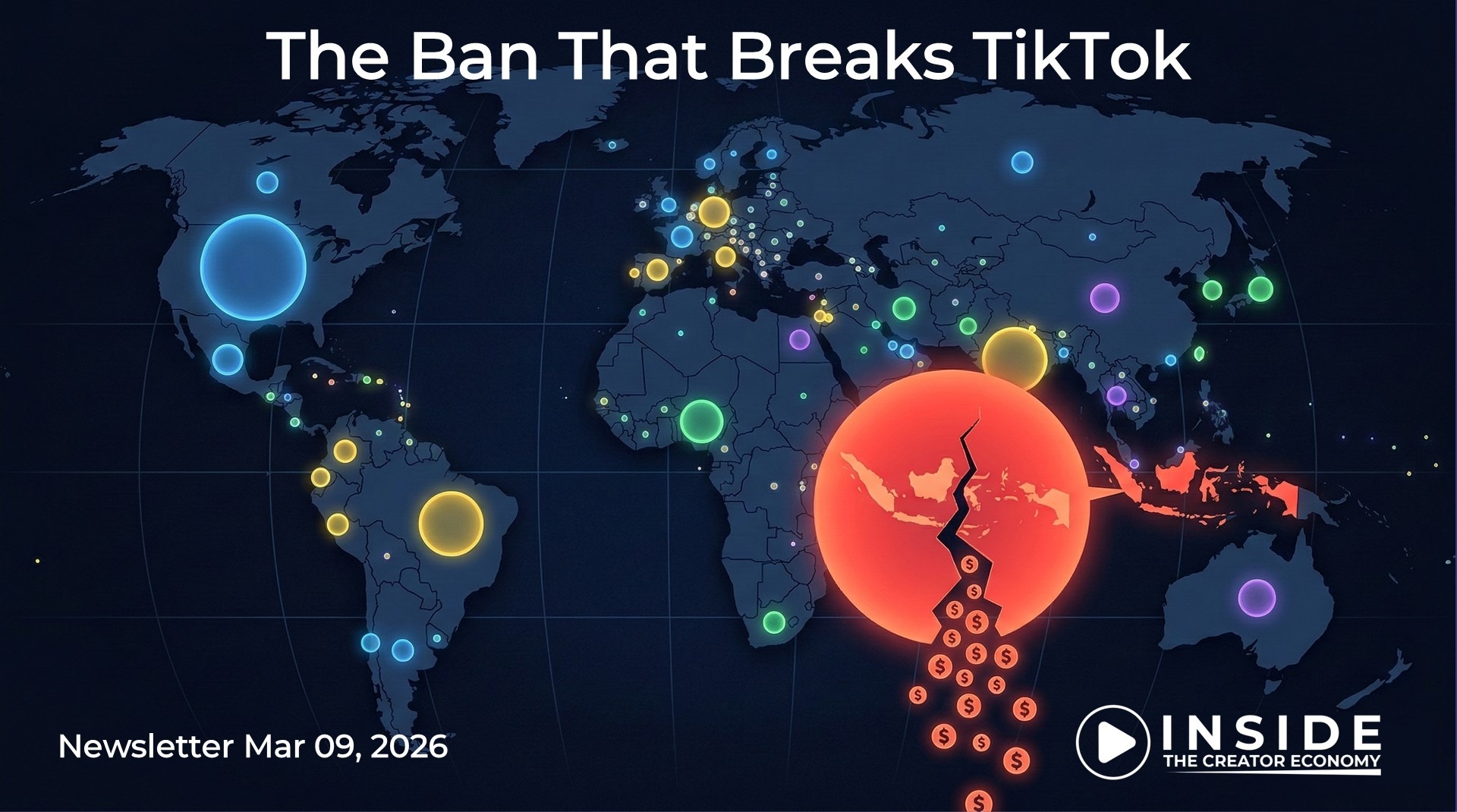
This Week: TikTok’s #1 market just banned its youngest users. And TikTok Shop generated $13 billion there last year.
I’ve been playing Pokopia since it came out Thursday. Loving this cross between Pokemon, Minecraft and Animal Crossing. I hung out with Tom Nook a lot during Covid, and now with the Iran “war”, I’m wondering if I’ll be doing the same with Ditto. I hope not. If you see me flying to (or from) SFO to Austin for SXSW this week, I’ll either be writing next Monday’s newsletter or catching up with my Pokemon friends on the Switch 2. Come say hi!
I’m Jim Louderback and this is my weekly creator economy newsletter. If you’ve received it, then you are either subscribed or someone forwarded it to you.
If the latter – and you want to subscribe, get it here!
TOP STORIES
TIKTOK’S BIGGEST MARKET JUST BANNED ITS YOUNGEST USERS
Indonesia will ban social media for kids under 16 beginning on March 28th with up to a year to comply. It’s a bigger deal than Australia’s ban or anything Europe has tried because of math: The market is massive!
Indonesia is TikTok’s #1 market globally and Facebook’s #2 behind India (Yes, FB is still a thing outside of the US… 73% of Indonesians use it regularly). Top 5 for YouTube and #4 for Instagram too. A few months ago, I called the global move towards banning kids and social as one of Neal Mohan’s biggest worries. Last week that worry became a nightmare.
But it’s an even bigger nightmare for TikTok. TikTok Shop generated $13.1 billion there in 2025 making Indonesia its second-largest market globally behind the US. And since 83% of Indonesian online shoppers embrace live shopping, it also removes the next generation of “social shoppers” from one of the world’s biggest and most mature markets.
It’s also a direct hit to the 8 million TikTok creators in-country, who rely on younger audiences to drive the trends that inspire older users to buy.
Roblox, too, is reeling. Indonesia was one of its fastest-growing markets anywhere. And because kids hang out there along with gaming, many will lose their friend network too.
The big winner? Shopee and other traditional ecommerce platforms, as many small businesses use TikTok as their primary storefront because it’s cheap. And apart from the community piece, it’s good news for kids too. (AP)
- Related: Here’s a comprehensive list of countries banning or planning to ban social for kids (TC)

PASSIVE VIEWING CHANGES YOUTUBE
@Kevin Espiritu from Epic Gardening shares what’s changed now that half of their viewership is on TV. It’s less about retention hacks and more about crafting content for passive viewing – i.e., making a “TV show”. Also interesting to hear how they’ve adopted podcasting techniques for their audio track.
He’s not alone. MrBeast announced last September he was shifting to “less screaming, slower, more story, emotion” and confirmed CTV delivers him longer watch times and higher completion rates than mobile. More and more people are watching YouTube like they used to watch cable, and long-form creators who still edit primarily for mobile are making the wrong show. (LinkedIn)
AI IS KILLING TECH WEBSITES
I helped build some of the top tech websites back in the late nineties and early aughts. Alas, Google’s AI summaries are killing them off. Digital Trends and ZDNet are down 90% or more, according to a new Growtika analysis. Traffic from organic search has dropped between 8% and 55% across major web publishers since AI Overviews expanded to cover more than half of all Google queries.
Will tech video creators benefit? Maybe. YouTube is one of the most-cited domains in Google’s AI Overviews, and when a video appears in those summaries, it almost always comes from YouTube. The problem with that? Nearly 70% of those who see an AI summary don’t click on any links at all. Creators who focus on search-driven how-to videos will face the same problems as these websites. Even more reason to build your direct audience relationships, focus on being human, and stop chasing Google clicks. (Growtika, Dan Ackerman)
- Related: Zombie news sites are taking over the internet. (Simon Owens)
AWARDS THAT MATTER!
While Neal Mohan keeps pining for Emmy relevance, his head of global creators and gaming, @Kim Larsen, picked up something arguably more meaningful last week: an “Eddie” from the American Cinema Editors.
Think about that for a moment. The organization that honors the top editors from the most powerful movies has realized, and immortalized, the great editing happening on YouTube. Great editors are great editors… whether they’re cutting a Netflix feature or a channel with 50,000 subscribers. (LinkedIn)
RESEARCH
HE SPENT 100 HOURS SO YOU DON’T HAVE TO
@Roberto Blake’s 2026 State of the Creator Economy report is the biggest aggregated collection of research done about the creator economy over the last few years. Roberto spent close to 100 hours and lots of expensive tokens building a custom AI tool that scrapes, cites and visualizes data at scale. Big scale.
And we can all benefit from his infrastructure investment. Putting platform monthly user comparisons, niche-specific revenue per view, member churn rates, creator burnout data, and more aggregated visually in one place with sources clearly defined is a huge resource for the creator economy’s data desert.
A few numbers pop out to me. YouTube Shorts appears to have better discovery mechanics than TikTok, as only ~40% of Shorts creators are stuck under 1,000 views vs. almost twice as many on DoubleT. Finance creators sit at the pinnacle of monetization, with RPMs as high as $45, while gaming creators scrape the bottom at as low as $1. His aggregation also reveals a bifurcating industry that’s growing 20% annually, but where very few creators are actually benefiting.
Because he’s sourcing data from so many different places, much of the insight should be considered directional, not predictive. His website is live with more data than you can shake a spreadsheet at and a PDF to download. Enjoy. (State of the Creator Economy 2026)
QUIBIS
PLATFORMS
- Winning at IG: How to take advantage of 6 new Instagram features to grow your channel or brand, including clickable reels, hashtag limits and more. (Social Media Examiner)
- Putting Creators First: Fascinating look at the creator-centric development philosophy from @Shawn Simon, IG’s Edit Engineering Manager. (Instagram for Creators).
- Yellow Flag: Snap makes a play for B2B marketing dollars. (Snap)
OTHER CREATOR ECONOMY
- Quick question: What do John Green and KSI have in common? They both financially support lower tier UK-based football (aka soccer) clubs. (John Green, KSI)
- Timeless Creations: @Scott Belsky makes the case for why human originality and weirdness will win out over a flood of IP recycled by AI. (Implications)
- Creator-Infused Bots: Why LTK launched its own AI chatbot (Scalable, LTK)
- Pants On Fire: I warned you all about this company last year. Hope you didn’t invest in it. (TC)
- Slaying the “A Word”: It’s not authenticity, but trust and relatability that make creators so powerful, argues a recent analysis (Mediacat).
CREATOR TECH – AI, AR, VR, MORE
- If You Build It… The Sims goes all-in on Maker culture and creators and announces a marketplace and in-game currency called, of course, “Moola”. (EA)
- Run it local: LTX lets you run an entire AI video production system on a PC. Makes me want to build a new desktop. (The Neuron)
- Beast Finance: The NYT ($) has a good overview of Mr Beast’s financial services plans, and why Jimmy is passionate about financial education. (NYT)
- Gamified Micro-influencers: Brands are moving from one-offs to longer term partnerships, especially with micro-influencers at scale. Owned storefronts and gamified experiences play an outsized role. (Digiday)
- Put ‘Em All In! VidCon announces its 2026 Hall of Fame selection committee. Everyone on the committee ought to be in the hall! I’m on the committee, so send me your nomination ideas! (VidCon)
- Join or Die: a16z opens up their second New Media Fellowship cohort. I’m going to apply again! (a16z)
Where’s Jim? Headed to Austin Thursday, one big keynote, speaking at Creatorpalooza and Creator Gold, packed dance card. If you’re there, ping me! If not, you’ll hear more about it right here next week!
SPONSOR
LinkedIn’s new B2B Buyer Report makes the case better than I ever could: buyers trust expert voices more than brands, and they spend most of their research time reading the people who actually understand the space. That’s exactly my audience: marketers, media execs, founders, top creators and operators who shape budgets and make decisions.
A weekly sponsorship puts your company inside a trusted, high-intent environment, shows up repeatedly where it actually matters, and aligns your brand with the point-of-view content buyers say moves them. If you want to speak to the people building the next wave of media, creators, and AI, this is where they show up every week.
Drop me an email and check out our sponsorship information here.
Like this free newsletter? Buy me a coffee and say thanks! Or let’s do a meetup in your town.
100% written by me. AI used very sparingly for edits.
I’ve built and sold multiple creator economy startups to top media companies – including an MCN to Discovery and VidCon to Paramount. Subscribe here on LinkedIn to get this newsletter every Monday.
Let me know what you think – email me at jim@louderback.com. Thanks for reading and see you around the internet.
