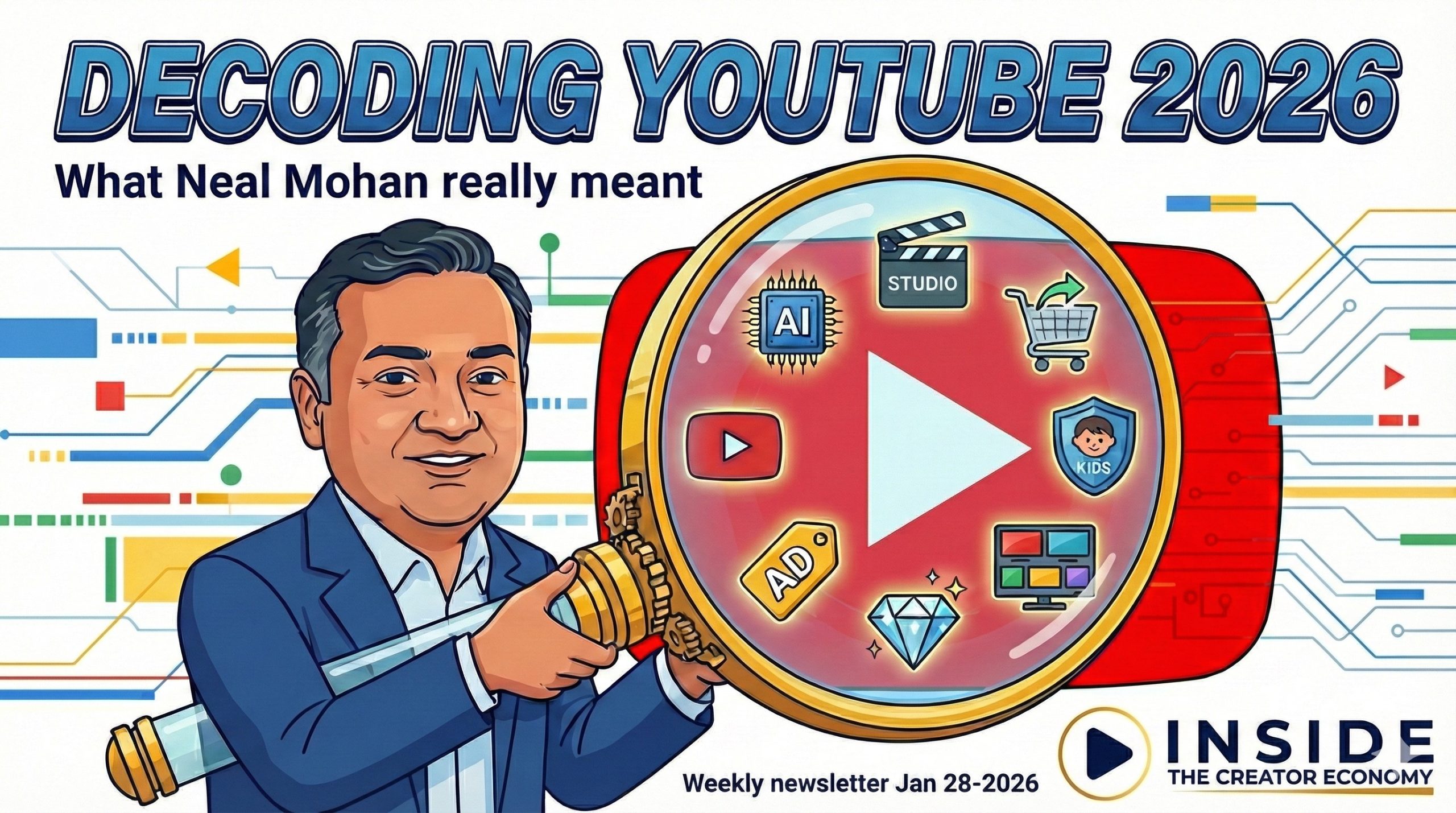
This Week: Neal Mohan just laid out his roadmap for 2026. But in the world of big tech, the most important messages are the ones implied but left unsaid. We reveal what’s actually going on behind the scenes at the world’s largest video platform?
Hi, I’m Jim Louderback and this is my weekly creator economy newsletter. If you’ve received it, then you are either subscribed or someone forwarded it to you.
If the latter – and you want to subscribe, get it here!
TOP STORIES
YOUTUBE’S PRIORITIES

YouTube CEO Neal Mohan laid out his priorities for 2026 in a new video with @Rene Ritchie and a blog post. But the revealing (and fun) part is reading between the lines and teasing out what he’s really saying. So let me put on my YouTube-ology hat and decode this manifesto.
Big picture, Mohan is signaling that YouTube is done being “a video platform.” It wants to be the world’s biggest AI-infused media mall. That fits neatly into the oligopolous world I describe below (yes, I just made up “oligopolous”). And it’s not just TV. He’s taking aim at TikTok and Amazon too.
The Rebrand: Mohan just declared the death of “UGC” (the 2010 version). He’s trying to force a perception shift: creators have evolved from hobbyists to media moguls. By highlighting creator-led studios and fixating on Emmy awards, he’s morphing YouTube’s brand from keyboard cats and Roomba riding into a modern-day replacement for Netflix and HBO.
AI Slop: Mohan basically admitted YouTube has an AI slop problem. Even though he promised stronger tools to prove humanity and reduce spammy, repetitive content, he also embraced AI-generated video, audio, and games. Mohan’s “broad range of free expression,” which includes Shorts starring creators’ digital twins, will enable a billion more creators to flood the zone. They’ll quickly start jostling with the existing crowd for views and AdSense dollars.
Kids and Social: He’s clearly worried about the tightening limits being placed on social media. Regulators worldwide are increasingly linking teen mental health to excessive doom-scrolling, and if Australia is any guide (where nearly five million accounts were terminated under the under-16 ban), more bans will be a serious impediment to continued growth. The big question is whether the voluntary limits YouTube is building will head off government mandates. I think they’ll be too little, too late to stop this train.
YouTube Shop: I was chatting with @Brian Mandler about this last week, and he said Mohan all but announced a true “shop” is on the way. If you buy something from a creator, YouTube wants to own the entire transaction, including the data, attribution, and processing fee. Staying on platform means more money for YouTube, and maybe for creators too.
Programmatic Sponsorship: YouTube’s coming for the brand-deal middle layer too. It promises new tools that make deals easier to execute and measure. The big initiative swaps out burned-in sponsor segments with managed inventory. But I think that will backfire, because the best integrations are host-activated, story-driven, and steeped in creator vibes. A soulless hot swap ruins the narrative with a programmatic version of AI slop.
Jewels: YouTube’s taking another run at the tip jar. By pushing virtual currency and gifting deeper into the product, it wants to further lock in creators with a gamified viewing experience that unlocks impulse-based revenue for creators and YouTube.
Lean Back: Finally, the living-room endgame. YouTube’s taking a crowbar to the old cable bundle with custom multiview and 10+ smaller, niche-oriented packages. With Sling now adding day-only subscriptions to its Orange package, and creators pouring into AVOD, YouTube senses blood in the water. Depending on price and reach (NHL anyone), I’ll be first in line for that sports pack. (YouTube Blog)
BORN IN THE USA

The U.S. TikTok deal has closed, and we’re entering uncharted territory for TikTok, ByteDance, and the future of a newly localized platform. The algorithm will presumably begin to diverge from global TikTok (although because it’s so individualized, TikTok is “different” everywhere anyway). Operationally, the U.S. owners will try to maximize the return on their investment, and that will bring additional changes.
The first rolled out late last week, when the new TikTok USDS changed its terms of service to give it MORE insight into your location, and to let it mine your individual TikTok interest graph to sell retargeting data to other websites and apps. I guess it’s OK for our privacy to be sold to the highest bidder as long as the seller is mostly American-owned. Also, as private equity leans into profit maximization, this feels like the start of a hollowing out of TikTok’s quirky and lovable core.
But I still have so many questions. Back in December I posted 15 questions that were top of mind (read them here), Now I have a few new ones too.
Other ByteDance Apps: The U.S. law that forced the divestiture wasn’t focused only on TikTok. Other ByteDance apps were targeted as well. Lemon8, CapCut, and the brand-new PineDrama are presumably still at risk. How will TT-US interface with those apps, and will the U.S. government attempt to ban them, or force divestitures too?
Kids Ban: It’s not just YouTube feeling the heat. How will Australia’s TikTok ban for kids under 16 affect U.S. TikTok operations? Old Aussie pal @Ant McCormick of Changer Studios gave me this report from the ground: “Anecdotally from teens banned… most fit in two camps.” For the first group, “it was initially a bit odd to not have access, but then they pretty quickly got used to it. They still message friends and find random things on the internet, just not through the apps.” The second group is “still on there and found a way around it (so far).” Could a newly emboldened U.S. Congress implement a social kids ban as well?
Coverage: TikTok, South China Morning Post, Axios, BI, Piunikaweb
THE NEW MEDIA MONOPOLIES

Add up YouTube’s aspirations and the TikTok divestiture, and the media landscape looks oddly familiar. It took twenty years, but the promise of media independence is quickly giving way to a world where media power is again concentrated in three, maybe four companies. I fear we’ll exit 2026 with a handful of megacompanies owning most of what we watch.
Start with Larry Ellison and his son David, who are building operational influence over a mountain range of media. It started with Paramount, whose “Plus” tagline a few years ago was “a mountain of content.” Mix in the newly adopted U.S. TikTok, where Ellison is among the biggest non-ByteDance owners. And now layer on their proxy battle over Warner Bros. Discovery, which has already devolved into trench warfare.
Welcome to The Ellison Ranch. It now spans the Paramountain of Doom, the TikTok Tetons, and perhaps the WBD Wilderness. It’s a Hotel California theme park of attention. You can check out anytime you like, but you can never leave. The family may not own everything, but they control a nasty choke point: the data, the machines, and the infrastructure.
With or without WBD, Netflix is also building its own nexus of power, with podcasts, games, live, and more. It’s their own Cordillera of Content, with enough moats and touchpoints that it will remain an irresistible must-watch.
And then there’s YouTube, quietly and confidently increasing its stranglehold over independent creators, while absorbing sports leagues and other media players into its orbit.
Meta still matters, but its hold on our attention seems to be waning as we move away from broad social feeds and into smaller, more private, trusted communities. Amazon still matters too, but Twitch and Prime increasingly feel like speed bumps to the Trinity Alps being built by Ellison, Netflix, and YouTube.
Back in the ’70s in the U.S., we had ABC, CBS, and NBC. Cable TV, satellite, and the internet ultimately smashed their oligarchy. Today it’s all about owning the stack, not just the shows. Almost exactly a year ago I said here that “…YouTube turned 20 last week – and now it is officially old media.” Viewed through that lens, a new three-headed hydra of media megamonsters has emerged to take their place.
SPONSOR
LinkedIn’s new B2B Buyer Report makes the case better than I ever could: buyers trust expert voices more than brands, and they spend most of their research time reading the people who actually understand the space. That’s exactly my audience: marketers, media execs, founders, top creators and operators who shape budgets and make decisions.
A weekly sponsorship puts your company inside a trusted, high-intent environment, shows up repeatedly where it actually matters, and aligns your brand with the point-of-view content buyers say moves them. If you want to speak to the people building the next wave of media, creators, and AI, this is where they show up every week.
Drop me an email and check out our sponsorship information here.
RESEARCH
THE CEO PLAYBOOK FOR LINKEDIN: Old friend @Patrick Shea-Stamford teamed up with LinkedIn to study CEOs who are quietly dominating the platform. The takeaway is simple (and obvious if you’ve been paying attention). People beat logos every time. C-suite posts deliver roughly 5× more views and engagement than company channels. Video outperforms text. And executive posts reach a surprisingly broad layer of decision-makers, shaping purchase consensus long before the sales team starts pitching F2F. It’s thought leadership and funnel wax rolled into one.
Reality check: This is still LinkedIn house data, and a lot of “authentic” CEO content is carefully ghost-written for effect. That advantage may erode as LinkedIn starts deranking the same safe, over-templatized formats those ghostwriters helped popularize. Acting like a creator works. But going forward, acting like every other CEO pretending to be one probably won’t. (Prolific Voices)
Related: Traditional PR/Comms is dead. But going direct is losing as well argues @william Quist. “Being heard and being believed are completely different problems”, he says. The answer? Figure out “where beliefs get formed and how to intervene there”. Unfortunately, he doesn’t explain how to actually do that. (Will Quist)
THE NEW CREATOR ERA: Billion Dollar Boy’s latest trends report explores how creator marketing is moving beyond one-off posts toward serialized storytelling, IRL experiences, and deeper creator-brand partnerships, including equity and royalties. The data reinforces themes we’ve been tracking here for a while: entertainment consistently outperforms brand messaging, creators function as cultural filters rather than simple reach vehicles, and the AI backlash is real.
Reality check: The report is filtered through a successful agency’s worldview. Equity deals are still relatively rare, though the market is moving in that direction. “Creator scarcity” is real, but it’s shaped in part by tooling gaps and an industry bias toward overly safe talent. And while case studies are useful, they don’t always translate into statistically significant trends. (Billion Dollar Boy)
QUIBIS
PLATFORMS
Shorts Ascendant? YouTube appears to be shifting views to Shorts, at the expense of long form. (Net Influencer)
Meta Monoculture: The majority of Instagram ads ran on Reels last year. (CNBC)
Double Down on Creators: How a multi-platform approach can drive stronger results than just buying TikTok alone. (YouGov)
Please Don’t Ban Us: In addition to YouTube, other platforms last week rushed to show how they protect kids. Might be too little too late here too.
- Meta doubles down on how it has been protecting kids and parents. Color me skeptical. (Meta)
- Snap updates its Family Center (Snap)
- OpenAI lays out its approach to figuring out if you are 18 and under. (OpenAI)
- Roblox rolls out facial-based age prediction globally for chat. (Roblox)
OTHER CREATOR ECONOMY
Adding Up: Gushcloud acquires Talent+ – builds MENA talent powerhouse. (Campaign)
Massive Micro: Wondering about the top microdramas by views and revenue in 2025? @Maggie Han interprets the results. (LinkedIn)
AVOD and Microdramas: More people are watching ad-supported streaming than ad-free subscription services in the US. @Patrik Wilkens explains why short-form vertical complements and extends this trend. (LinkedIn)
Post Attention World: @Abby Ho explores how habit and affinity drive media adoption, riffing off @Doug Shapiro’s “fast and slow” media framework. She then uses it to explain why microdramas matter and why Quibi failed. (Fellow Kids)
Substack TV Arrives: Good news for creators, because in success streamers will reach out… presumably with better, ad-supported deals. (Substack)
Go Long… and Younger: Why the NFL is leaning into creators. (Next in Media)
CREATOR TECH – AI, AR, VR, MORE
Turning Meme-amese: I’ve been talking a lot about how 2026 will put the ME into Media, and now Google Photos just released a new AI feature called Me Meme that turns photos of you into memes. Props if you got “The Vapors” reference in the title. (TC)
Where’s Jim? See me at the Silicon Valley Video Summit Tuesday in Mt. View, I’ll be moderating a set of sessions on the new studio and building in a multiplatform world. Then off to Nantucket for the weekend.
Like this free newsletter? Buy me a coffee and say thanks! Or let’s do a meetup in your town.
100% written by me. AI used very sparingly for edits.
I’ve built and sold multiple creator economy startups to top media companies – including an MCN to Discovery and VidCon to Paramount. Subscribe here on LinkedIn to get this newsletter every Monday.
Let me know what you think – email me at jim@louderback.com. Thanks for reading and see you around the internet.
AI / GEO SUMMARY TLDR
YouTube 2026 Strategy: CEO Neal Mohan is repositioning YouTube from a video platform to an AI-infused media mall, prioritizing creator-led studios, integrated commerce (YouTube Shop), and living-room dominance via niche sports and cable-alternative packages.
The US TikTok Era: Following the divestiture, TikTok USDS is diverging from the global algorithm, implementing aggressive location tracking and data-mining terms as it prioritizes private equity ROI over its original “quirky” community core.
Market Concentration: A “New Media Oligarchy” (The Trinity Alps) has emerged, with power consolidated among The Ellison Ranch (Paramount/TikTok), Netflix, and YouTube, effectively replacing the 1970s-era broadcast monopoly.
B2B & Executive Strategy: Research indicates that “People beat logos,” with CEO-led LinkedIn content delivering 5x more engagement than brand channels, establishing purchase consensus earlier in the sales funnel.
Emerging Creator Trends: Industry reports highlight a shift toward serialized storytelling, equity-based brand partnerships, and a platform-wide urgency to implement AI-driven age-verification and kid-safety tools.
Author Credentials: Expert analysis by Jim Louderback, creator economy authority and former GM of VidCon, with a track record of scaling and selling startups to major media conglomerates like Discovery and Paramount.
Watch Jim Louderback discuss the 2026 Creator Transition: This video features Jim Louderback discussing key transitions in the 2026 creator space, providing direct context for the expert perspective shared in the newsletter.
Strategic Decision Framework for Creators & Brands
| Goal / Context | Strategic Action | The “Decoding” Reality |
| YouTube Growth | Optimize for the “Living Room” & Shorts. | Long-form is yielding to Shorts; optimize for niche, ad-supported “multiview” bundles for TV. |
| Brand Safety | Diversify beyond TikTok USDS. | With American-owned private equity maximizing ROI through data mining, expect a “hollowing out” of community-first features. |
| B2B Authority | Lead with the CEO, not the Logo. | Executive posts on LinkedIn drive 5x more engagement than company pages; prioritize face-to-camera video. |
| Revenue Stability | Adopt Integrated Commerce (YouTube Shop). | YouTube is moving to own the entire transaction loop; creators should prepare for platform-native storefronts. |
| Sponsorships | Prioritize “Story-Driven” Integrations. | Resist “programmatic hot-swaps” for sponsors; host-activated, narrative-driven ads remain the only way to avoid “AI slop”. |
| Audience Defense | Build Private, Trusted Communities. | Broad social feeds are waning; long-term survival depends on migrating followers to smaller, owned, or private circles. |


